


1


Päivitetty marraskuu 2026 · järjestetty suosituimmuuspisteiden mukaan (jokaisen teoksen haut, vierailut ja tilaukset) · 50 teosta taiteilijalta Adrian Scott Stokes luettelossamme
Lyhyesti
Hunters on the moor north of Skagen (1886) on se Adrian Scott Stokes -maalaus, joka herättää eniten huomiota; alkuperäisteos kuuluu museolle Skagens Museum, Skagen. Sen jälkeen katse siirtyy kohteisiin Angler Am Bachufer ja Rumanian Cottages In Transylvania. Adrian Scott Stokesin 50 teoksemme joukosta nämä 49 ovat kuuluisimpia; jokainen on ainutlaatuinen alkuperäisteos, joka on esitelty vuosiluvun, museon ja sen syyn kera, miksi teos on säilyttänyt suosionsa.


A Serene Twilight: Capturing Cornish Beauty Adrian Scott Stokes’ "Sunset" is a captivating glimpse into the tranquil beauty of the Cornish coast at twilight. This evocative oil painting exemplifies the Impressionistic style, prioritizing atmosphere and emotional resonance over meticulous detail. The artwork transports viewers to a scene dominated by rolling sand dunes gently sloping towards a vibrant horizon where the sun dips below view. A solitary tree stands sentinel atop…


 Lago Maggiore
12
 The seaweed gatherer
13
 November In The Dolomites
14
 Dr. Johnson's Penance
15
 From Klobenstein
16
 A Winter Afternoon In Provence
17
 The Palace Of The Popes
18
 A Field of Marigolds, Lower Alps
19
 The Harbour Bar
20
 The Setting Sun
21
 In The Dauphine
22
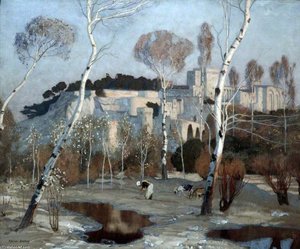 Popes' Palace, Avignon, France
23
 Moonrise On The Zuyderzee
24
 Autumn In The Mountains -
25
 Snow In The Dolomites
26
 The Rumanian Church At Desze
27
 A Slav Cottage At Kalocsa
28
 Autumn Landscape In The Western Highlands
29
 Seven Cornstooks in Upper Hungary
30
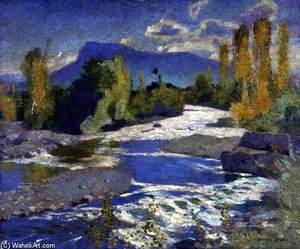 A River In The Dauphine
31
 Near The Simplon Pass
32
 Where Chavez Flew, The Simplon Pass
33
 The Durance At Sisteron
34
 Villeneuve-les-avignon And Ruins Of The Bridge
35
 Autumn In The South Of France
36
 A Cottage On A Riverbank
37
 From our Windows in Vazsecz
38
 Cows In A Copse
39
 By The Walls Of The Hougue
40
 A Rumanian Homestead At Desze
41
 Autumn In The Mountains
42
 Sketch for 'Autumn in the Mountains'
43
 Twilight in a Forest
44
 Warwick Castle
45
 A Rumanian Homestead At Desze -
46
 Snow In The Tyrol
47
 Wild Cherries In The Tyrol
48
 Early Spring In The Austrian Tyrol
49
 Wild Cherries In The South Tyrol, Austria
Nämä neljä aihetta toistuvat näissä alkuperäisteoksissa useimmin, jokaisesta löytyy hienoin esimerkki.
Museo, jossa on eniten tämän sivun maalauksista.
| Museo | Kaupunki | Adrian Scott Stokes teokset | Tämän listan maalaukset |
|---|---|---|---|
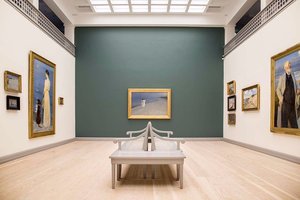 Skagens Museum |
Skagen | 1 | Hunters on the moor north of Skagen |
Kaikki täällä näkyvät päivätyt Adrian Scott Stokes -alkuperäisteokset kuuluvat samalle vuodelle, 1886: ne on esitetty suosituimmuusjärjestyksessä.
Valitse vuosi nähdäksesi alkuperäisteokset.
Hunters on the moor north of Skagen (1886), Skagens Museum, Skagen. Seuraavina ovat Angler Am Bachufer ja Rumanian Cottages In Transylvania.
32 vuotta vanha: Hunters on the moor north of Skagen on peräisin vuodelta 1886, ja Adrian Scott Stokes on syntynyt vuonna 1854.
Hunters on the moor north of Skagen, Angler Am Bachufer, Rumanian Cottages In Transylvania, Sunset, An Evening On The Seine, Islands Of The Adriatic, Uplands And Sky, Fishing boats leaving Zuyderzee Port, Sunset In Provence, France ja On The Coast Of County Kerry. Yllä oleva sijoitus kertoo kunkin teoksen vuosiluvun ja museon.
Katalogissamme on 50 teosta taiteilijalta Adrian Scott Stokes.
Pääasiassa Skagens Museum (Skagen). Yllä oleva museotaulukko listaa ne kaikki.
Autumn (5), Sky (3) ja Winter (3), yhteensä 49 teosta tällä sivulla.
Impressionism, tämän sivun alkuperäisteosten perusteella.
The story of Charles Adrian Scott Stokes is one of unexpected artistic discovery and a profound connection to the natural world. Born in Southport, Lancashire, his initial path led him toward the commercial world of Liverpool, where he worked as a cotton broker. However, the call of the canvas proved irresistible. His latent talent was brought to light by the discerning eye of John Herbert RA, who recognized the promise in Stokes' drawings and encouraged him to seek formal training. This pivotal moment led him to the Royal Academy Schools in 1872, marking the beginning of a career dedicated to capturing the ephemeral beauty of the earth through paint.
His artistic journey was deeply shaped by his travels across Europe, which allowed him to absorb the essence of various landscape traditions. By venturing to Fontainebleau and Barbizon, Stokes came under the profound influence of French plein air landscape painters, most notably Jules Bastien-Lepage. These experiences instilled in him a commitment to painting directly from nature, seeking to capture the atmosphere and light as they truly appeared in the moment. His vision was further enriched by his time spent in Skagen, Denmark, where he developed close ties with the prominent Skagen Painters, including Michael and Anna Ancher.
Stokes’ work is celebrated for its evocative ability to transport the viewer into serene, atmospheric settings. His style often leaned toward Impressionism, prioritizing emotional resonance and the play of light over rigid, meticulous detail. In masterpieces such as "Sunset," one can observe his mastery of a warm, transitioning palette—moving from pale blues to rich pinks and oranges—to convey the fleeting magic of twilight. His technique utilized visible, expressive brushstrokes that lent a palpable sense of texture and materiality to his canvases, particularly when depicting the rolling sand dunes and coastal vegetation of the Cornish coast.
While landscape painting remained his primary passion, Stokes demonstrated remarkable versatility throughout his career. His repertoire included:
Beyond his individual technical skill, Stokes' life was intertwined with the broader art history of his era through his marriage to the Austrian painter Marianne Stokes. Together, they navigated the vibrant art circles of Europe, sharing a passion for capturing the light and spirit of the landscapes they encountered. His legacy remains etched in the soft light of his seascapes and the quiet dignity of his rural scenes, standing as a testament to the enduring power of the plein air tradition.
