Early Influences & The Fauvist Spark
Georges Braque, born in Argenteuil in 1882, embarked on a journey that would irrevocably alter the course of modern art. His beginnings, however, were steeped in tradition – a family lineage of house painters and decorators instilled an early appreciation for craftsmanship and form. Yet, young Braque yearned for more than mere replication; he sought to capture the *essence* of perception itself. Initial studies at the École supérieure d'art et design Le Havre-Rouen provided foundational skills, but it was the vibrant explosion of Fauvism in 1905 that truly ignited his artistic sensibility. The bold, non-naturalistic colors employed by Matisse and Derain weren’t simply a stylistic choice for Braque; they were a liberation – a permission to prioritize emotional resonance over strict representational accuracy. He quickly aligned himself with artists like Raoul Dufy and Othon Friesz, developing a distinctly tempered Fauvist approach characterized by a more restrained palette than some of his contemporaries. This early period wasn’t merely an imitation but a crucial stepping stone, honing Braque's eye for color and composition while simultaneously challenging conventional artistic norms.
The Genesis of Cubism: Collaboration with Picasso
Cubism is an early-20th-century avant-garde art movement which began in Paris. It revolutionized painting and the visual arts, and sparked artistic innovations in music, ballet, literature, and architecture. Cubist subjects are analyzed, broken up, a...
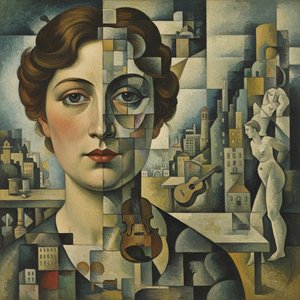
The year 1907 marked a pivotal turning point in Braque’s career – his encounter with Pablo Picasso. This wasn’t simply a meeting of two artists; it was the collision of two intensely inquisitive minds, both grappling with similar questions about representation and perception. Inspired by Cézanne's revolutionary approach to form and space, particularly after the large retrospective at the Salon d'Automne, Braque began dissecting objects into geometric components, exploring multiple perspectives simultaneously. This nascent exploration found fertile ground in his dialogues with Picasso. Their studios became laboratories of experimentation, a shared space where traditional notions of perspective were systematically dismantled. The paintings produced during this period – often indistinguishable in style – represent the birth of Cubism. It’s important to note that while Picasso's name is more readily associated with the movement, Braque was not merely a follower; he brought a unique sensibility to the collaboration, a quiet contemplation that balanced Picasso’s dynamic energy. He focused on everyday objects—the familiar comforts of his surroundings—as subjects for this radical new approach.
Analytic & Synthetic Cubism: Deconstructing Reality
Modern art includes artistic work produced during the period extending roughly from the 1860s to the 1970s, and denotes the styles and philosophies of the art produced during that era. The term is usually associated with art in which the traditions o...
The early phase of Cubism, known as Analytic Cubism (roughly 1908-1912), was characterized by a monochromatic palette – predominantly browns, grays, and blacks – and the fragmentation of objects into increasingly abstract forms. Braque and Picasso sought to represent subjects from multiple viewpoints simultaneously, collapsing space and challenging the viewer’s perception of reality. Objects were broken down into their constituent parts, analyzed, and then reassembled on the canvas in a complex interplay of planes and angles. This wasn't about depicting *what* an object looked like but rather *how* it existed in space. As the movement evolved, Synthetic Cubism emerged (around 1912-1914). This phase saw the introduction of collage – actual fragments of everyday materials such as newspaper clippings, wallpaper, and sheet music incorporated directly into the artwork. This was a further rejection of illusionistic representation, emphasizing the flatness of the canvas and blurring the boundaries between art and life. Braque’s use of *papier collé* wasn't simply decorative; it was a deliberate attempt to question the very nature of painting itself.
Braque's Later Years: A Return to Figuration and Still Life
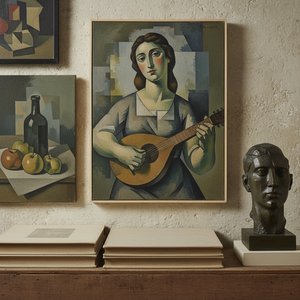
Following World War I, Braque’s artistic trajectory took a subtle but significant turn. While he never entirely abandoned the principles of Cubism, his work began to exhibit a renewed interest in figuration and traditional still life arrangements. This wasn't a rejection of his earlier innovations but rather an integration of them – a refinement of his aesthetic vocabulary. His post-war paintings are characterized by a greater sense of calm and order, with softer colors and more recognizable forms. However, the influence of Cubism remains palpable in the fragmented perspectives and carefully considered compositions. He explored themes of intimacy and domesticity, often depicting musical instruments, bottles, and fruit arranged on tabletops. Works like “The Bottle of Marc” (1930) exemplify this period – a masterful interplay of geometric forms, restricted palette, and dynamic composition that showcases Braque’s enduring commitment to artistic innovation. This later work demonstrates his ability to synthesize the lessons of Cubism with a more lyrical sensibility.
The Enduring Legacy of Georges Braque in Modern Art
Georges Braque's contribution to modern art is immeasurable. He wasn’t merely an artist; he was a philosophical explorer, relentlessly questioning the fundamental principles of representation and perception. His collaboration with Picasso birthed Cubism, a movement that revolutionized painting and sparked artistic innovations across multiple disciplines – from sculpture and architecture to music and literature. Braque's influence extends far beyond his own body of work. He paved the way for subsequent generations of artists to experiment with abstraction, collage, and non-traditional materials. His quiet intensity and contemplative approach stand in stark contrast to Picasso’s more flamboyant persona, yet it was this very quality that allowed him to delve deeper into the complexities of form and space. Today, Braque's paintings are celebrated for their intellectual rigor, aesthetic beauty, and enduring relevance. His work continues to inspire and challenge viewers, reminding us that art is not simply about depicting reality but about *interpreting* it – a legacy secured through his pioneering spirit and unwavering dedication to artistic exploration. For collectors seeking works of profound depth and historical significance, Georges Braque represents an unparalleled investment in the evolution of modern thought.