
 Esikatselu
 Jaa
Jaa Jaa
Jaa
 Tarkemmat tiedot

 Lataa
Lataa
 Samanlaisia
 Röntgenkuva
 Diaesitys
Medallion House


 Näytä lisää
Käsinmaalattu öljykopio
Käsinmaalattu öljyväri kankaalle haluamassasi koossa ja kehyksissä, taiteilijoidemme valmistamana tilauksesta. ( Siirry tulosteeseen Vaihda kuvaksi)




































Valitse valmiista mitoistamme sellaiset, jotka vastaavat teoksen alkuperäisiä mittasuhteita.

Voit syöttää omat mitat sopimaan tiettyyn kehykseen tai tilaan. Jos valitsemasi koko ei vastaa alkuperäisen kuvan mittasuhteita, rajaamme taideteoksen tai jatkamme maalausta käsin maalatuilla elementeillä. Digitaalinen esikatselu lähetetään hyväksyttäväksi ennen tuotannon aloittamista.
Huomioithan, että näytöllä oleva esikatselu ei vastaa todellista rajausta tai jatkamista. Vain digitaalinen mallikuva näyttää lopullisen sommittelun tarkasti.
Vaikka mittatilaustyöt ovat mahdollisia, suosittelemme valitsemaan mitan ennalta määritetystä listasta alkuperäisten mittasuhteiden säilyttämiseksi.
Tilauksen jälkeen OriginalUniqueArt.com -tiimi lähettää asiakkaalle ohjeet ja esikatselukuvan.
Maailmanlaajuinen toimitus () 3–4 viikossa tavallisen 5 viikon sijaan. (6 elokuu). Laadusta ei tingitä.

Ilmainen pikatoimitus ympäri maailman

Korkealaatuinen pellavakangas

Kattava kuljetusvakuutus

Tulliveron palautustakuu

Täydellinen värien vastaavuustakuu

60 päivän palautusoikeus (vain valmistusvirheet)

100% rahat takaisin -takuu

Määräalennus tarjous
 Lasivaihtoehto on saatavilla vain alle 110 cm kokoisina teoksina

Medallion House
Reproduktiotekniikka
Replikaatin koko
-


Kokonaishinta
$ 300
Teoksen kuvaus
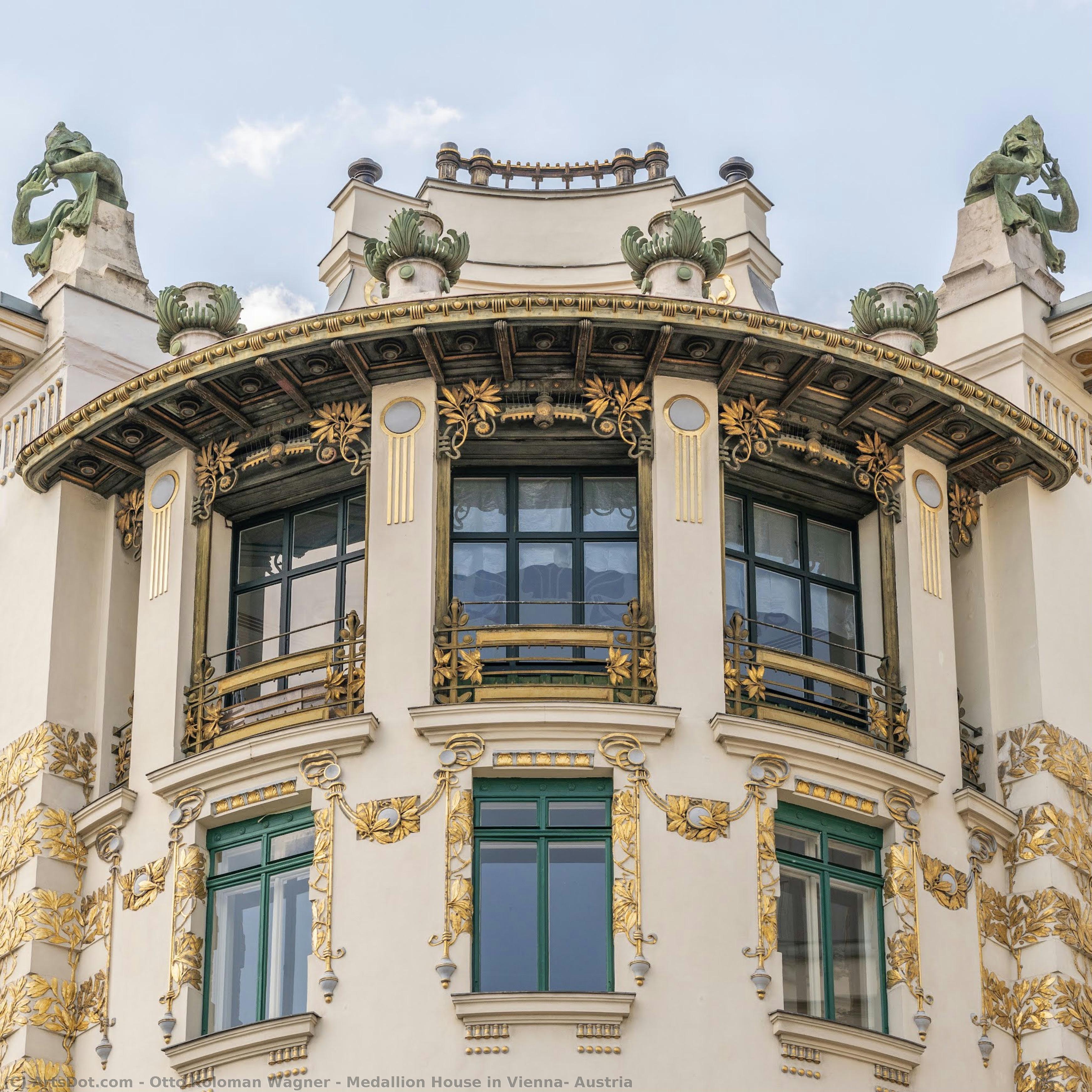
Medallion House in Vienna, Austria – A Symphony of Gold and Sorrow
Vienna’s Naschmarkt side is graced by an architectural marvel—the Medallion House, designed by Otto Koloman Wagner and completed in 1899. More than just bricks and mortar, it embodies the spirit of the Vienna Secession movement, a bold reaction against academic tradition and a fervent embrace of artistic innovation. This building isn’t merely beautiful; it whispers tales of ambition, experimentation, and ultimately, a poignant reflection on the passage of time.- Architectural Style: The Medallion House is undeniably Secessionist—a style characterized by geometric forms, flattened planes, and a deliberate rejection of ornamentation found in earlier eras. Wagner sought to liberate architecture from historical constraints, prioritizing functionality alongside striking visual impact.
- Material Palette: Dominating the façade is majolica tile – vibrant floral motifs rendered in brilliant hues of pinks, blues, greens, and yellows. These tiles weren’t chosen arbitrarily; they represented a conscious effort to move away from the muted palettes favored by traditional Viennese builders. Wagner's protégé Koloman Moser skillfully executed this ambitious project.
- Decorative Elements: Beyond the tilework, intricate wrought iron balconies adorn the building, adding textural contrast and reinforcing the Secession aesthetic. Above all, however, are “The Criers,” sculpted angels perched atop the roof—a dramatic gesture that elevates the house to a theatrical level. Wagner’s sculptor Othmar Schimkowitz had previously created angelic figures for Otto Wagner’s Postal Savings Bank, demonstrating Wagner's penchant for monumental sculpture.
A Tale of Two Houses – Majolica and Medallion
The Medallion House stands alongside its sister building, the Majolica House at Linke Wienzeile 40, creating a captivating duo that exemplifies Wagner’s vision for urban renewal. These buildings were conceived as part of a larger project to transform Vienna's waterfront district—a bold statement against the prevailing academic style and a celebration of modern artistic expression. The juxtaposition of these two structures underscores Wagner’s desire to challenge established conventions and forge new paths in architectural design.- Wagner’s Influence: Otto Koloman Wagner was instrumental in shaping Vienna's cultural landscape during his lifetime, championing the Secession movement and fostering collaborations with artists like Gustav Klimt and Josef Hoffmann.
- Symbolism: The floral motifs of Majolica House are laden with symbolic meaning—representing fertility, beauty, and renewal—reflecting Wagner’s belief in architecture's ability to inspire contemplation and elevate the human spirit.
More Than Just Decoration – Functionality Meets Art Nouveau Flair
Wagner wasn’t simply interested in creating aesthetically pleasing buildings; he insisted on incorporating innovative engineering solutions alongside artistic embellishments. The Majolica House’s façade was designed to be easily cleaned by fire hoses—a pragmatic consideration that speaks volumes about Wagner's commitment to practicality and his understanding of the needs of modern urban life. This blend of form and function is a hallmark of Art Nouveau, demonstrating that beauty could coexist with utility.- The Corner Location: The Medallion House’s placement on a corner necessitated Moser’s ingenious use of decorative ironwork to create visually arresting balconies—a testament to Wagner's inventive spirit and his willingness to push boundaries.
A Legacy Enduring – From Kohn Family Residence to Modern Bank
Today, the Medallion House houses a bank—a surprising twist considering its opulent origins. Originally owned by the Kohn family, it endured wartime confiscation and subsequent restitution—a narrative that underscores the building’s significance as a symbol of Viennese history and resilience. Its enduring presence serves as a reminder that even architectural masterpieces can adapt to changing circumstances while retaining their core essence. Discover 'Medallion House in Vienna' by Otto Koloman Wagner – a stunning Art Nouveau masterpiece! Admire its ornate Secession facade, gold detailing & symbolic beauty. A unique investment for art lovers.Taiteilijan elämäkerta
A Pioneer of Modernity: The Life and Vision of Otto Koloman Wagner
Otto Koloman Wagner, born in Vienna in 1841, stands as a pivotal figure bridging the gap between 19th-century historicism and the dawn of modern architecture. His journey wasn’t one of immediate revolution, but rather a gradual evolution—a thoughtful dismantling of established norms coupled with an unwavering commitment to functionality and honest expression. Initially steeped in classical training at the Vienna Polytechnic Institute and later refined at the Royal Academy of Architecture in Berlin, Wagner's early work reflected the prevailing academic styles. However, even within these traditional frameworks, seeds of innovation were sown. His studies under August Sicardsburg and Eduard von der Nüll instilled a crucial principle: architecture must possess a “rational expression” suited to its modern purpose—a concept that would become central to his life’s work. These formative years weren't merely about mastering technique; they were about questioning the very foundations of architectural thought, setting the stage for Wagner’s eventual break from convention. He began building a reputation through speculative ventures, designing apartment houses that subtly blended classical elements with emerging modernist ideas, financing these projects himself and demonstrating an entrepreneurial spirit alongside his artistic vision. Wagner's early career was marked by a fascination with reviving classical forms—a reaction against the prevailing Romantic tendencies of his time. His designs for the Vienna Opera House, alongside Eduard von der Nüll, showcased a masterful blend of Corinthian columns and ornate ornamentation, embodying the grandeur and elegance of the Baroque era. Yet, even within this stylistic embrace, Wagner harbored an intellectual curiosity that propelled him toward a more profound understanding of architectural principles. He recognized that true beauty resided not merely in imitation but in conveying meaning—a conviction that would inform his subsequent artistic endeavors. His meticulous attention to detail and unwavering dedication to craftsmanship cemented his reputation as one of Vienna’s most accomplished architects, establishing him as a leader among his peers.The Vienna Secession and a Blossoming Style
A transformative moment arrived in 1893 with Wagner’s daring participation in the Vienna city-planning competition. Though he didn't secure the overall prize—a decision that fueled considerable debate amongst Viennese intellectuals—his proposals regarding an integrated urban rail network garnered significant acclaim and swiftly propelled him to prominence. This marked a decisive shift toward urban planning, prioritizing efficiency and social betterment alongside aesthetic considerations. Simultaneously, Wagner became deeply invested in the burgeoning Vienna Secession movement, founded in 1897 by artists like Josef Maria Olbrich and Josef Hoffmann—pupils who shared his conviction that architecture should transcend mere decoration to express its essence. The Secessionists rejected the conservative artistic establishment of their time, advocating for a radical reimagining of artistic practice and embracing new visual languages. Wagner’s style during this period blossomed into a distinctive blend of Art Nouveau flourishes and functional clarity—a reaction against the academic formalism that dominated Viennese art. He championed geometric forms, simplified ornamentation focused on enhancing structure rather than concealing it, and an unwavering emphasis on functionality as the driving force behind design. Wagner's most celebrated achievement was undoubtedly his role in establishing the Vienna Secession, which served as a catalyst for artistic innovation and challenged prevailing aesthetic conventions. His influence extended beyond architectural circles, shaping broader cultural debates about modernity and artistic expression. The Secession’s commitment to experimentation—particularly its exploration of new materials like steel and glass—directly impacted Wagner's subsequent designs, foreshadowing the emergence of modernist principles. He envisioned buildings that were not merely aesthetically pleasing but also responsive to the needs of their inhabitants—a vision that resonated deeply with the spirit of the era.Landmark Creations and Architectural Innovations
Wagner’s legacy is etched into the urban landscape of Vienna through a series of remarkable buildings that showcase his evolving style and innovative thinking. The Majolica House (1900-1904), designed in collaboration with Josef Olbrich, exemplifies Wagner’s masterful fusion of Art Nouveau ornamentation and structural precision—a testament to his ability to elevate everyday spaces into works of art. Its façade adorned with vibrant majolica tiles—a technique pioneered by Koloman Moser—became a symbol of Viennese artistic ambition. The Kirche am Steinhof (Church of St. Leopold), completed between 1897 and 1902, stands as an unparalleled achievement in urban planning and architectural design—a sacred space conceived not just for worship but as an uplifting experience for the community. Wagner’s meticulous attention to detail—particularly his innovative use of steel framing—demonstrated his unwavering commitment to pushing the boundaries of architectural possibility. Perhaps most strikingly, Wagner’s Karlsplatz Pavillion (1897-1904)—originally intended as a public toilet facility—became an icon of modernist design and urban innovation. Its soaring steel frame and expansive glass façade challenged conventional notions of building construction—a bold statement that signaled Wagner’s embrace of new materials and techniques. He envisioned buildings that were not merely functional but also imbued with symbolic meaning—a reflection of his profound understanding of the relationship between architecture and human experience. His pioneering work on the Austrian Postal Savings Bank (1894-1905) solidified his reputation as a visionary architect who anticipated the trends of the coming century. Wagner’s buildings continue to inspire architects today, serving as enduring reminders of his unwavering belief in the transformative power of design—a legacy that transcends time and embodies the spirit of Viennese artistic innovation. Wagner's influence extended far beyond Vienna, shaping architectural discourse across Europe and inspiring generations of artists and designers. He championed a humanist approach to architecture—one that prioritized human needs and aspirations alongside aesthetic considerations—leaving an indelible mark on the history of modernism. His unwavering dedication to craftsmanship and his profound understanding of structural principles cemented his place as one of Austria’s most celebrated architects—a true pioneer who helped redefine the boundaries of architectural expression. Otto Koloman Wagner remains a towering figure whose work continues to inspire architects and designers seeking to create buildings that are both beautiful and functional, embodying the enduring legacy of Viennese artistic innovation.
Otto Koloman Wagner
1841 - 1918 , Itävalta
Pikatiedot
- Artistic Movement Or Style: Vienna Secession
- Artists Or Movements Influenced By This Artist: ['Modern Architecture']
- Artists Who Influenced This Artist:
- August Sicardsburg
- Eduard von der Nüll
- Date Of Birth: 1841 Wien
- Date Of Death: 1918 Wien
- Full Name: Otto Koloman Wagner
- Nationality: Austr.
- Notable Artworks:
- Majolika Haus
- Karlsplatz Pavillion
- Kirche am Steinhof
- Place Of Birth: Vienna Austria
Liittyvät artikkelit

The Vienna Secession: A Rebellion of Form & Spirit in Fin-de-Siècle Art
Discover the revolutionary Vienna Secession art movement! Explore Klimt, Olbrich & more. Learn about its history, characteristics & lasting influence on modern art. High-quality reproductions available.

Timeless Vienna: Capturing the Imperial Elegance of Austria Through the Lens of Art History
Explore the imperial grandeur of Vienna through art history. Discover the architectural mastery of Otto Wagner and the elegance of the Secessionist movement in this sophisticated guide to Austria's timeless aesthetic legacy.
Vienna Secession: The Bold Revolution That Redefined Modern Art
Explore the profound impact of the Vienna Secession movement. Discover how visionaries like Gustav Klimt revolutionized modern art through symbolism, gold leaf, and bold ornamentation in this deep dive into the aesthetic revolution that redefined the visual landscape of Europe.

The Vienna Secession: A Golden Revolution of Symbolism and Modernity
Explore the profound impact of the Vienna Secession. Discover how Gustav Klimt and the masters of Viennese Modernism revolutionized art through symbolism, gold-leafed beauty, and the concept of Gesamtkunstwerk. A deep dive into a golden era of aesthetic rebellion.
Koloman Moser: A Synthesis of Art Nouveau, Secessionism & the Gesamtkunstwerk Ideal
Explore the life & work of Koloman Moser, a pivotal figure in the Vienna Secession & Wiener Werkstätte. Discover his stunning graphic design, architecture, and applied arts – a true pioneer of Viennese Art Nouveau. Learn more at OriginalUniqueArt.


