Konstantin Makovski muotokuva

100 tunnetuinta Konstantin Makovski -maalausta, jokainen ainutlaatuinen

Päivitetty lokakuu 2026 · järjestetty suosituimmuuspisteiden mukaan (jokaisen teoksen haut, vierailut ja tilaukset) · 393 teosta taiteilijalta Konstantin Makovski luettelossamme

Lyhyesti

Emperor Alexander II on His Deathbed (1881) on se Konstantin Makovski -maalaus, joka herättää eniten huomiota. Sen jälkeen katse siirtyy kohteisiin Happy Arcadia (1890) ja Peter the Great in His Studio (1870). Konstantin Makovskiin 393 teoksemme joukosta nämä 100 ovat kuuluisimpia; jokainen on ainutlaatuinen alkuperäisteos, joka on esitelty vuosiluvun, museon ja sen syyn kera, miksi teos on säilyttänyt suosionsa.

1839 – 1915, Moskova Realism Eniten teoksia: Hermitage-museo

Konstantin Makovski -taiteilijan 10 parasta maalausta gallerian silmin

1
Emperor Alexander II on His Deathbed (1881) tekijä Konstantin Makovski

Emperor Alexander II on His Deathbed

1881 · Oil On Canvas

To stand before Konstantin Yegorovich Makovsky's Emperor Alexander II on His Deathbed is to step across the threshold of history and into a realm saturated with profound, quiet emotion. Painted in 1881, this oil on canvas masterpiece transcends mere portraiture; it is a meditation on mortality, legacy, and the weight of imperial life. Makovsky, a master of Russian Romanticism and a key figure among the Peredvizhniki, possessed an unparalleled gift…

2
Happy Arcadia (1890) tekijä Konstantin Makovski

Happy Arcadia

1890 · Oil On Canvas

In this monumental oil painting from 1890, we find ourselves transported to a lush, green meadow where the boundaries between the real and the mythical dissolve. The scene is one of profound relaxation, a quiet celebration of life set amidst a field of colorful wild flowers and fluttering butterflies. At the heart of the composition, three women in diaphanous, flowing white dresses move with a rhythmic grace. One woman carries…

3
Peter the Great in His Studio (1870) tekijä Konstantin Makovski

Peter the Great in His Studio

1870 · Oil On Canvas · Hermitage-museo, Pietari

A single shaft of light falls from the upper right, striking a heavy roll of parchment. Within this glow, the figure of Peter I emerges from the deep shadows of a workshop. He is not yet an emperor, but a man immersed in the grit of labor. His hands hold the weight of drawings and plans. Around his feet, wood shavings lie scattered across the floor, small curls of debris…

4
Egor Ivanovich Makovsky (1859) tekijä Konstantin Makovski

Egor Ivanovich Makovsky

1859 · Oil

This portrait, titled Egor Ivanovich Makovsky, was executed by the artist Konstantin Makovsky. Created about 1859, the work captures the likeness of the subject, Egor Ivanovich Makovsky, in a formal composition. The piece belongs to the genre of portraiture, focusing on the individual's presence and character.

5
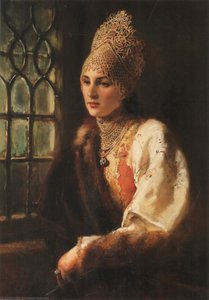
Boyar's Wife at the Window (1885) tekijä Konstantin Makovski

Boyar's Wife at the Window

1885 · Oil On Canvas

A woman sits by a window, her chin resting heavily in her hands. She wears a dress of heavy, ornate fabric, the weight of her status visible in every fold of the cloth. Her gaze is fixed on something beyond the glass, lost in a quiet, internal observation. The window is fitted with iron bars, a cold geometry that cuts through the soft light of the room. In the background,…

6
Mother and Daughter in an Interior (1883) tekijä Konstantin Makovski

Mother and Daughter in an Interior

1883 · Oil

The room feels warm, held in a soft, intimate stillness. A woman sits in a chair, her body angled toward the small life resting in her lap. They are draped in deep red fabrics that seem to glow against the muted tones of the interior. This shared color binds them together, creating a visual pulse of affection between mother and child. In the background, the soft silhouette of a couch…

7
Mermaids (1879) tekijä Konstantin Makovski

Mermaids

1879 · Oil On Canvas

In "Mermaids," Konstantin Makovsky transports the viewer into a moonlit aquatic realm where the boundaries between myth and reality dissolve. Painted about 1879, the scene captures a fantastical encounter as mythical creatures emerge from the depths to interact with humans. These mermaids move through the water, their presence turning a quiet night into a moment of profound enchantment. The interaction between the human figures and these legendary beings creates a…

8
Cup of honey (1890) tekijä Konstantin Makovski

Cup of honey

1890 · Oil

The painting Cup of honey, created around 1890, is a portrait of a woman. The subject is depicted wearing a crown and a veil that partially obscures her features. She is shown holding a bowl in her hands. The composition includes several specific elements: a cup placed on a surface near the center, another bowl located towards the bottom left corner, and two spoons, one positioned closer to the top…

9
Lady in Black (1864) tekijä Konstantin Makovski

Lady in Black

1864 · Oil

The woman stares directly from the canvas, her gaze meeting the viewer with an intensity that feels almost startling. She is draped in a deep blue dress, accented by delicate white lace that catches the light against the darker fabric. Her hair is pulled back into a neat bun, revealing the elegant line of her neck and the subtle shimmer of her earrings and necklace. A round frame encircles her…

Konstantin Makovskin kuuluisia maalauksia, numerot 11–100

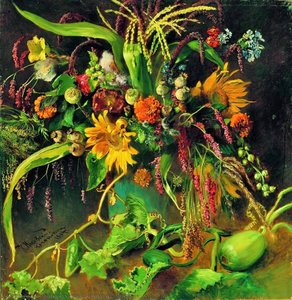
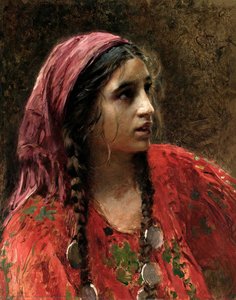
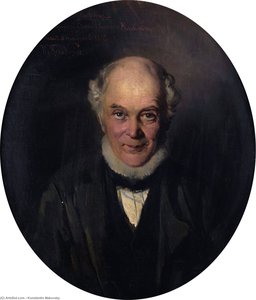
11Angels (1872) tekijä Konstantin MakovskiAngels1872 12Tea Drinking (1914) tekijä Konstantin MakovskiTea Drinking1914 13Dervishes in Cairo (1875) tekijä Konstantin MakovskiDervishes in Cairo1875 14Peter the Great in His Studio (1870) tekijä Konstantin MakovskiPeter the Great in His Studio1870 · Hermitage-museo 15Self Portrait (1856) tekijä Konstantin MakovskiSelf Portrait1856 16Kuzma Minin (1850) tekijä Konstantin MakovskiKuzma Minin1850 17Portrait of an Old Man (1860) tekijä Konstantin MakovskiPortrait of an Old Man1860 18Portrait of the Mining Engineer Nikolay Teplov (1878) tekijä Konstantin MakovskiPortrait of the Mining Engineer Nikolay Teplov1878 · Hermitage-museo 19Widow (1865) tekijä Konstantin MakovskiWidow1865 20Portrait of Princess S.Stroganova (1864) tekijä Konstantin MakovskiPortrait of Princess S.Stroganova1864 21Male Portrait (1870) tekijä Konstantin MakovskiMale Portrait1870 22Fair Booths on Admiralty Square, St. Petersburg (1869) tekijä Konstantin MakovskiFair Booths on Admiralty Square, St. Petersburg1869 23Portrait of Ossip Petrov (1870) tekijä Konstantin MakovskiPortrait of Ossip Petrov1870 24Girl with a bouquet (1876) tekijä Konstantin MakovskiGirl with a bouquet1876 25Child Funeral (1872) tekijä Konstantin MakovskiChild Funeral1872 26The handing over of the Sacred Carpet in Cairo (1876) tekijä Konstantin MakovskiThe handing over of the Sacred Carpet in Cairo1876 27Portrait of Catherine Dolgorukov (1847-1922) (1880) tekijä Konstantin MakovskiPortrait of Catherine Dolgorukov (1847-1922)1880 28Peasant Boy (1880) tekijä Konstantin MakovskiPeasant Boy1880 29African (1882) tekijä Konstantin MakovskiAfrican1882 30Portrait of the Young Lady with Green Dress (1879) tekijä Konstantin MakovskiPortrait of the Young Lady with Green Dress1879 31Portrait of Prince P.Vyazemsky (1880) tekijä Konstantin MakovskiPortrait of Prince P.Vyazemsky1880 32Portrait of Adleberg (1883) tekijä Konstantin MakovskiPortrait of Adleberg1883 33Sunday evening in the village (1879) tekijä Konstantin MakovskiSunday evening in the village1879 34The Russian Bride's Attire (1889) tekijä Konstantin MakovskiThe Russian Bride's Attire1889 · Fine Arts Museums of San Francisco 35Serezha (Portrait of Son in Sailor Suit) (1887) tekijä Konstantin MakovskiSerezha (Portrait of Son in Sailor Suit)1887 36Portrait of the Young Lady (1890) tekijä Konstantin MakovskiPortrait of the Young Lady1890 37Landlady (1886) tekijä Konstantin MakovskiLandlady1886 38Volkov's Family (1898) tekijä Konstantin MakovskiVolkov's Family1898 · Hermitage-museo 39Models waiting for Artist (basking Italians) (1904) tekijä Konstantin MakovskiModels waiting for Artist (basking Italians)1904 40Piper (1910) tekijä Konstantin MakovskiPiper1910 41Portrait of M.G. Savina tekijä Konstantin MakovskiPortrait of M.G. SavinaHermitage-museo 42Grand Duke Alexis of Russia tekijä Konstantin MakovskiGrand Duke Alexis of RussiaMusée d'Orsay 43Flowers 1 (1884) tekijä Konstantin MakovskiFlowers 11884 44The Boyarynia (1885) tekijä Konstantin MakovskiThe Boyarynia1885 45Girl Dressed as Flora tekijä Konstantin MakovskiGirl Dressed as Flora 46Portrait of Maria Feodorovna (Dagmar of Denmark) tekijä Konstantin MakovskiPortrait of Maria Feodorovna (Dagmar of Denmark) 47Portrait of the Girl with a Blue Ribbon in a Hair (1890) tekijä Konstantin MakovskiPortrait of the Girl with a Blue Ribbon in a Hair1890 48Difficult Negotiations (1883) tekijä Konstantin MakovskiDifficult Negotiations1883 49Moor tekijä Konstantin MakovskiMoor 50Portrait of the Italian Boy tekijä Konstantin MakovskiPortrait of the Italian Boy 51Gypsy tekijä Konstantin MakovskiGypsy 52Portrait of Vladimir Makovsky in Childhood (1854) tekijä Konstantin MakovskiPortrait of Vladimir Makovsky in Childhood1854 53Petersburg Patio (1850) tekijä Konstantin MakovskiPetersburg Patio1850 54Reclining Model (1850) tekijä Konstantin MakovskiReclining Model1850 55Portrait of Nikolay Nekrasov (1856) tekijä Konstantin MakovskiPortrait of Nikolay Nekrasov1856 56Christ among the teachers (1860) tekijä Konstantin MakovskiChrist among the teachers1860 57Female Portrait (1860) tekijä Konstantin MakovskiFemale Portrait1860 58Still Life (1860) tekijä Konstantin MakovskiStill Life1860 59Portrait of Alexander II of Russia (1860) tekijä Konstantin MakovskiPortrait of Alexander II of Russia1860 60Male Portrait (1863) tekijä Konstantin MakovskiMale Portrait1863 61Model (1858) tekijä Konstantin MakovskiModel1858 62Portrait of Artist Alexander Popov (1863) tekijä Konstantin MakovskiPortrait of Artist Alexander Popov1863 63Portrait of the Count Nikolay Muravyov-Amursky (1863) tekijä Konstantin MakovskiPortrait of the Count Nikolay Muravyov-Amursky1863 64Portrait of E.Makovsky, Artist's Father (1856) tekijä Konstantin MakovskiPortrait of E.Makovsky, Artist's Father1856 65Portrait of the Girl Zhenia (1860) tekijä Konstantin MakovskiPortrait of the Girl Zhenia1860 66Meeting of Isaac and Eleazar (1858) tekijä Konstantin MakovskiMeeting of Isaac and Eleazar1858 67By the Toilet (1863) tekijä Konstantin MakovskiBy the Toilet1863 68Sewer (1861) tekijä Konstantin MakovskiSewer1861 69Satyr and Nymph (1863) tekijä Konstantin MakovskiSatyr and Nymph1863 70Portrait of an Unknown (1863) tekijä Konstantin MakovskiPortrait of an Unknown1863 71Charon carries dead souls across the River Styx (1861) tekijä Konstantin MakovskiCharon carries dead souls across the River Styx1861 72False Dmitry's Agents Murdering Feodor Godunov and his Mother (1862) tekijä Konstantin MakovskiFalse Dmitry's Agents Murdering Feodor Godunov and his Mother1862 73Cairo (1867) tekijä Konstantin MakovskiCairo1867 74Children in a Field (1870) tekijä Konstantin MakovskiChildren in a Field1870 75Egyptian Warrior (1871) tekijä Konstantin MakovskiEgyptian Warrior1871 76Negress (1870) tekijä Konstantin MakovskiNegress1870 77Girl in Burnous (1870) tekijä Konstantin MakovskiGirl in Burnous1870 78Cairene (1870) tekijä Konstantin MakovskiCairene1870 79Oriental Motif (1870) tekijä Konstantin MakovskiOriental Motif1870 80Portrait of Children Stasovy (1870) tekijä Konstantin MakovskiPortrait of Children Stasovy1870 81Summer Day (1870) tekijä Konstantin MakovskiSummer Day1870 82Date (1866) tekijä Konstantin MakovskiDate1866 83Bacchante (1870) tekijä Konstantin MakovskiBacchante1870 84Girl in a Kerchief (Portrait of the Girl) (1870) tekijä Konstantin MakovskiGirl in a Kerchief (Portrait of the Girl)1870 85Reaper (1871) tekijä Konstantin MakovskiReaper1871 86Arab Boy with an Orange (1870) tekijä Konstantin MakovskiArab Boy with an Orange1870 87Prince Oscar Bernadotte, Duke of Ostgotlandiya (1870) tekijä Konstantin MakovskiPrince Oscar Bernadotte, Duke of Ostgotlandiya1870 88Woman with Rake (1870) tekijä Konstantin MakovskiWoman with Rake1870 89Peasant Dinner during Harvesting (1871) tekijä Konstantin MakovskiPeasant Dinner during Harvesting1871 90Cairo (1870) tekijä Konstantin MakovskiCairo1870 91Portrait of O.Makovskaya (1864) tekijä Konstantin MakovskiPortrait of O.Makovskaya1864 92Portrait of Artist K.Bornikov (1868) tekijä Konstantin MakovskiPortrait of Artist K.Bornikov1868 93Irrigation in Egypt (1870) tekijä Konstantin MakovskiIrrigation in Egypt1870 94In the Garden (1870) tekijä Konstantin MakovskiIn the Garden1870 95Girl in Oriental Dress (1870) tekijä Konstantin MakovskiGirl in Oriental Dress1870 96Portrait of V.Makovsky, Artist's Brother (1868) tekijä Konstantin MakovskiPortrait of V.Makovsky, Artist's Brother1868 97Household Conversation (1868) tekijä Konstantin MakovskiHousehold Conversation1868 98Fair Booths on Admiralty Square, St. Petersburg (1869) tekijä Konstantin MakovskiFair Booths on Admiralty Square, St. Petersburg1869 99Muhammed's carpet moving from Mecca to Cairo (1875) tekijä Konstantin MakovskiMuhammed's carpet moving from Mecca to Cairo1875 · Armenian kansallinen galleria 100Portrait of Vera Zubova (1877) tekijä Konstantin MakovskiPortrait of Vera Zubova1877

Konstantin Makovskin kuuluisat maalaukset aikakausittain

Early Period

1856 – 1864 · 3 teosta tässä luettelossa

Aiheet, jotka vangitsivat Konstantin Makovskiin katseen

Nämä neljä aihetta toistuvat näissä alkuperäisteoksissa useimmin, jokaisesta löytyy hienoin esimerkki.

Museot, joissa Konstantin Makovski'n alkuperäisteokset sijaitsevat

Tämän sivun teoksista eniten sisältävät 4 museota.

Museo Kaupunki Konstantin Makovski teokset Tämän listan maalaukset
Hermitage-museo, PietariHermitage-museo Pietari 7 Peter the Great in His Studio, Peter the Great in His Studio, Portrait of the Mining Engineer Nikolay Teplov
Fine Arts Museums of San Francisco, San FranciscoFine Arts Museums of San Francisco San Francisco 1 The Russian Bride's Attire
Musée d'Orsay, PariisiMusée d'Orsay Pariisi 1 Grand Duke Alexis of Russia
Armenian kansallinen galleria, JerevanArmenian kansallinen galleria Jerevan 1 Muhammed's carpet moving from Mecca to Cairo

Konstantin Makovski vuosikymmenten varrelta: jokaisesta yksi ainutlaatuinen alkuperäisteos

Teokset vuosikymmenittäin

Valitse vuosikymmen nähdäksesi sen määrittäneen alkuperäisteoksen.

Konstantin Makovskin maalaukset: kysymyksiä gallerialle

Mikä on Konstantin Makovski tunnetuin teos?Paljasta vastaus

Emperor Alexander II on His Deathbed (1881). Seuraavina ovat Happy Arcadia (1890) ja Peter the Great in His Studio (1870).

Missä iässä Konstantin Makovski loi teoksen Emperor Alexander II on His Deathbed?Paljasta vastaus

42 vuotta vanha: Emperor Alexander II on His Deathbed on peräisin vuodelta 1881, ja Konstantin Makovski on syntynyt vuonna 1839.

Mitkä ovat Konstantin Makovski kymmenen kuuluisinta maalausta?Paljasta vastaus

Emperor Alexander II on His Deathbed, Happy Arcadia, Peter the Great in His Studio, Egor Ivanovich Makovsky, Boyar's Wife at the Window, Mother and Daughter in an Interior, Mermaids, Cup of honey, Lady in Black ja Children running from the Storm. Yllä oleva sijoitus kertoo kunkin teoksen vuosiluvun ja museon.

Kuinka monta Konstantin Makovski -teosta tunnetaan?Paljasta vastaus

Katalogissamme on 393 teosta taiteilijalta Konstantin Makovski, aikaväliltä 1850–1914.

Missä voi nähdä tunnetuimmat Konstantin Makovski -alkuperäisteokset?Paljasta vastaus

Pääasiassa Hermitage-museo (Pietari), Fine Arts Museums of San Francisco (San Francisco) ja Musée d'Orsay (Pariisi). Yllä oleva museotaulukko listaa ne kaikki.

Mihin ajanjaksoon Konstantin Makovski tunnituimmat maalauksensa sijoittuvat?Paljasta vastaus

Aikakaudella 1870s: 35 sivun 100 teoksista on tehty silloin, joista Peter the Great in His Studio.

Mikä on Konstantin Makovski kuuluisimmista maalauksista varhaisin ja mikä uusin?Paljasta vastaus

Tällä sivulla vanhin on Kuzma Minin (1850) ja uusin Tea Drinking (1914).

Mitä aiheita Konstantin Makovski suosi?Paljasta vastaus

Portraits (20), Men (16) ja Women (14), yhteensä 100 teosta tällä sivulla.

Mitä materiaaleja Konstantin Makovski käytti eniten?Paljasta vastaus

Oil On Canvas, 13 teoksesta sivun 100 teoksesta.

Mihin taidesuuntaukseen Konstantin Makovski kuuluu?Paljasta vastaus

Realism ja Romanticism, tämän sivun alkuperäisteosten perusteella.

Mitä Konstantin Makovski alkuperäisteoksia voin nähdä museossa Hermitage-museo?Paljasta vastaus

Peter the Great in His Studio, Peter the Great in His Studio ja Portrait of the Mining Engineer Nikolay Teplov: Hermitage-museo, Pietari -ssä on 5 tämän sivun teoksista.

Konstantin Makovski: taiteilijan muotokuva

A Life Immersed in Russian Realism: The World of Konstantin Makovsky

Konstantin Yegorovich Makovsky, born into a Moscow household brimming with artistic sensibility in 1839, became one of the most celebrated and financially successful painters of his era. His father, Egor Ivanovich Makovsky, was an amateur artist and a pivotal figure in establishing the foundations of art education in Moscow, while his mother nurtured musical aspirations within young Konstantin. This dual influence – visual artistry from his father and a deep appreciation for harmony and expression from his mother – shaped a sensibility that would permeate his entire oeuvre. The family’s creative atmosphere extended beyond Konstantin; his brothers Vladimir and Nikolay also pursued painting careers, alongside their sister Alexandra, creating a dynasty of artistic talent. From an early age, Makovsky demonstrated exceptional aptitude, entering the Moscow School of Painting, Sculpture, and Architecture at just twelve years old, where he flourished under the tutelage of Karl Bryullov and Vasily Tropinin. It was Bryullov’s influence that instilled in him a penchant for romanticism and decorative effects, qualities that would subtly color his later, more realist works.

From Academic Roots to the Wanderers' Path

Makovsky continued his artistic education at the Imperial Academy of Arts in Saint Petersburg, beginning in 1858. Here, he produced significant early pieces like *Curing of the Blind* (1860) and *Agents of the False Dmitry kill the son of Boris Godunov* (1862), showcasing a developing skill for narrative composition and historical detail. However, it was his involvement in the “Revolt of the Fourteen” in 1863 that truly defined his artistic trajectory. Along with thirteen fellow students, Makovsky protested the Academy’s restrictive focus on mythological subjects, choosing instead to depict contemporary life and Russian realities. This act of defiance signaled a commitment to artistic freedom and paved the way for his association with the *Peredvizhniki*, or Wanderers – a group of artists dedicated to bringing art directly to the people through traveling exhibitions. The *Peredvizhniki* movement aimed to break away from academic constraints and address social issues, reflecting the changing currents of Russian society. Makovsky’s early work aligned perfectly with this ethos, focusing on scenes of everyday life—the struggles and triumphs of ordinary Russians—as seen in paintings like *Widow* (1865) and *Herring-seller* (1867). These works demonstrated a keen eye for detail and an ability to capture the dignity and resilience of the Russian peasantry.

Capturing the Soul of Russia: Themes and Style

Throughout his career, Makovsky’s art served as a window into Russian life, particularly its historical and cultural richness. He possessed an extraordinary ability to capture the nuances of Russian character and tradition. His paintings weren't merely depictions; they were immersive experiences that transported viewers to bustling marketplaces, grand weddings, or intimate family gatherings. *The Russian Bride’s Attire* (1889), also known as *Beneath the Crown*, stands as a prime example—a lavishly detailed portrayal of pre-wedding rituals, brimming with symbolism and vibrant color. The painting depicts a young woman preparing for her wedding, surrounded by family members and attendants, each figure rendered with meticulous attention to detail and expressive emotion. Similarly, works like *A Boyar Wedding Fest, Kissing Ceremony, and Before the Wedding* demonstrate his fascination with Russian customs and celebrations. He often depicted scenes of rural life, capturing the beauty of the Russian countryside and the simple joys of everyday existence. While initially aligned with the Wanderers’ focus on social realism, Makovsky's style evolved over time. A journey to Egypt and Serbia in the 1870s sparked a shift towards exploring artistic problems of color and form, leading to more polished and decorative compositions. This transition, while earning him widespread acclaim and financial success, also drew criticism from some who felt he had strayed from the movement’s original ideals.

Recognition and a Tragic End

By the late 19th century, Konstantin Makovsky was arguably the most highly regarded and well-compensated artist in Russia. His talent for capturing both historical grandeur and intimate human moments resonated with audiences across Europe. The pinnacle of his recognition came at the 1889 World’s Fair in Paris, where he received a Large Gold Medal for *Death of Ivan the Terrible*, *The Judgement of Paris*, and *Demon and Tamara*. These works showcased his mastery of composition, dramatic lighting, and psychological depth. *Death of Ivan the Terrible* is particularly striking—a powerful depiction of the Tsar’s final moments, conveying both his authority and his vulnerability. Similarly, *The Judgement of Paris* captures a pivotal moment in Russian history with remarkable clarity and emotional intensity. However, Makovsky's life was tragically cut short in 1915. While traveling in Saint Petersburg, his horse-drawn carriage collided with an electric tram, resulting in fatal injuries. His untimely death marked the end of a remarkable career that left an indelible mark on Russian art history.

Legacy and Influence

Konstantin Makovsky’s influence extends beyond his impressive body of work. He played a crucial role in shaping the landscape of Russian art during a period of significant social and political change. His commitment to depicting Russian life, coupled with his technical skill and artistic vision, inspired generations of artists. He bridged the gap between academic tradition and the emerging realist movement, paving the way for future explorations of national identity and cultural heritage in art. Today, Makovsky’s paintings are held in prominent museums and private collections worldwide, continuing to captivate audiences with their beauty, detail, and profound understanding of the human condition. His legacy endures as a testament to the power of art to reflect, preserve, and celebrate the richness of Russian culture.