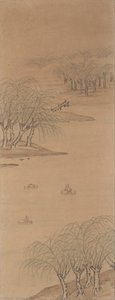
Xia Chang portree

Xia Chang maalid: 4 kuulsumat teost galeriin läbi

Uuendatud oktoober 2026 · järjestatud meie populaarsusindeksi järgi (otsingud, külastused ja tellimused igale teosele) · 4 teost Xia Chang meie kataloogis

Lühidalt

Galleriile on Xia Chang kõige kuulsam teos Painting (801). Bamboo-Covered Stream in Spring Rain (1441) ja Bamboo in Wind (1460) täidavad kolmikut, mille iga silm tunnistab. Kunstnii Xia Chang 4 teose põhjal esitleb galeriis allpool 4 kõige kuulsumat, kus iga originaal on märgitud aastaga, muuseumiga ja kirjeldatud, mis teeb selle unikaalseks.

1388 – 1470, Kunshan Enamama teoseid: Art Institute of Chicago

Galeria 10 parimat Xia Chang maali

3
Bamboo in Wind (1460) autor Xia Chang

Bamboo in Wind

1460 · Ink On Paper · Metropolitan Museum of Art, New York

is a hanging scroll created in China during the Ming dynasty. The work is attributed to the artist Zhu Chang, who is also recognized by the name Xia Chang. Dating to circa 1460, the piece belongs to the tradition of literati painting.

4
Bamboo and Rock (1457) autor Xia Chang

Bamboo and Rock

1457

A native of Kunshan, Jiangsu province, Xia Chang has been best known for his bamboos in ink. Down the ages, scholar-officials often identified themselves with the bamboo through painting for its association with resolution, humility and endurance in a tradition started by Wen Tong of the Northern Song. By the Ming dynasty, Wang Fu devised a new compositional approach that gives prominence to bamboos in a landscape with multiple perspectives.…

Muuseumid, kus on säilitatud Xia Chang originaalteosed

Kümne 2 muuseumi kollektsioonid, mis sisaldavad kõige rohkem sellel lehel esitatud teoseid.

Muuseumid Linn Xia Chang teosid Selle nimekirja maalid
Art Institute of Chicago, ChicagoArt Institute of Chicago Chicago 1 Bamboo-Covered Stream in Spring Rain
Metropolitan Museum of Art, New YorkMetropolitan Museum of Art New York 1 Bamboo in Wind

Xia Chang, iga kümnendiga üks signatuurpilt

Teosed aastakate kaupa

Vali vuosakülg, et näha selle ajastu definieerivat originaalteost.

Xia Chang maalid: galerii vastused

Milline Xia Chang maal on kõige kuulsam?Paljasta vastus

Painting (801). Järgnevad Bamboo-Covered Stream in Spring Rain (1441) ja Bamboo in Wind (1460).

Kui palju teoseid Xia Chang lõi?Paljasta vastus

Meie kataloogist leiate 4 teost kunstnikult Xia Chang, mis on pärinevad ajastust 1441 kuni 1460.

Kust leiad Xia Chang kõige kuulsamad originaalteosed?Paljasta vastus

Peamiselt Art Institute of Chicago (Chicago) ja Metropolitan Museum of Art (New York) muuseumites. Ülalpool olevate muuseumite tabelis on nendest kõik loetletud.

Millised on Xia Chang varased ja hilised kuulsad teosed?Paljasta vastus

Sellel lehel on kõige vanem teos Bamboo-Covered Stream in Spring Rain (1441) ja kõige värskeim Bamboo in Wind (1460).

Xia Chang: kunstnik

The Serene Brush: Exploring the Art and Legacy of Zhu Chang

Zhu Chang, more commonly known as Xia Chang (夏昶), was a pivotal figure in 15th-century Chinese art – a painter whose quiet mastery of ink bamboo painting continues to resonate centuries later. Born in Kunshan in 1388 and passing away in 1470, he navigated the turbulent currents of Ming Dynasty politics while simultaneously cultivating an artistic style deeply rooted in tradition yet imbued with a subtle, contemplative spirit. His life story is intertwined with the rise of the Yongle Emperor and the flourishing of literati painting, offering a fascinating glimpse into the world of courtly art and intellectual pursuits during that era.

Early Life and Official Career: A Path Through the Imperial Court

Xia Chang’s early life was marked by diligent study and a successful ascent through the imperial examination system. Born Zhu Chang, he passed the Jinshi exam in 1415, earning him the prestigious title of ‘Zhongzhao’ (仲昭) – a courtesy name signifying virtue and integrity. This achievement opened doors to a career within the Hanlin Academy, the elite scholarly institution attached to the imperial court. His talents quickly became recognized, leading to his appointment as a writer of inscriptions for new buildings commissioned by the Yongle Emperor in Beijing. This role provided invaluable exposure to the artistic sensibilities of the court and solidified his understanding of calligraphy and its integration within visual art. In 1422, he was transferred to a position in Beijing, becoming a secretary of the Bureau of Evaluations within the Ministry of Personnel – a significant step demonstrating his growing influence and administrative capabilities. This period wasn’t solely devoted to artistic pursuits; it involved navigating the complexities of bureaucratic life, reflecting the dual nature of Xia Chang as both an artist and a government official.

The Style of Wang Fu: Echoes of Nature and Inner Harmony

Xia Chang's artistic identity is inextricably linked to that of Wang Fu (王府), a prominent painter of the Yuan Dynasty known for his innovative approach to ink bamboo painting. Wang Fu’s style, characterized by its loose brushwork, emphasis on capturing the essence of nature, and a sense of spontaneity, profoundly influenced Xia Chang's own artistic development. Xia Chang adopted this philosophy, focusing on the humble bamboo plant as a symbol of resolution, humility, and enduring strength – qualities highly valued in Chinese literati painting. Unlike more overtly decorative styles, Xia Chang’s work prioritized capturing the spirit of the subject rather than meticulous detail. His paintings often feature solitary bamboo stalks against dramatic skies or rocky landscapes, creating a sense of quiet contemplation and harmony with nature. The use of negative space—the deliberate inclusion of empty areas—was also a key element, allowing the viewer to engage actively with the composition and contemplate its meaning.

Notable Works: Bamboo and Rock – A Testament to Skill

Among Xia Chang’s numerous works, “Bamboo and Rock” (竹石) stands as perhaps his most celebrated achievement. This painting, often found on platforms like https://OriginalUniqueArt.com/@@/d7ggtt-zhu-chang-bamboo-and-rock, exemplifies the artist's mastery of ink techniques and his ability to evoke emotion through subtle brushstrokes. The composition is deceptively simple: a single bamboo stalk rising from a rugged rock formation against a backdrop of swirling clouds. Yet, within this apparent simplicity lies a wealth of artistic skill – the precise control of ink washes, the delicate rendering of texture, and the skillful use of perspective to create a sense of depth. The painting’s power resides not in its grandeur but in its quiet dignity and profound connection to nature. Furthermore, Xia Chang's work is frequently cited as an influence on later generations of Chinese painters, including Shen Zhou and Zha Shibiao, demonstrating the lasting impact of his artistic vision.

Legacy and Enduring Influence: A Quiet Masterpiece

Xia Chang’s legacy extends far beyond the confines of a single studio or gallery. His paintings continue to be studied by art historians and appreciated for their understated beauty and philosophical depth. He wasn't a flamboyant figure, but rather a quiet master who quietly shaped the course of Chinese painting during his time. His artistic style—characterized by its emphasis on literati aesthetics, its reverence for nature, and its skillful use of ink—has had a profound and lasting influence on subsequent generations of artists. His work serves as a reminder that true artistry lies not in ostentation but in the ability to capture the essence of a subject with grace, simplicity, and genuine feeling. You can explore more of his works at https://OriginalUniqueArt.com/@/zhu-chang.

Further Exploration

For deeper insights into Xia Chang’s life and work, consider exploring these resources:
  • British Museum: https://www.britishmuseum.org/collection/term/BIOG15660
  • Wikipedia (Xia Chang): https://en.wikipedia.org/wiki/Xia_Chang
  • Google Arts & Culture: https://artsandculture.google.com/entity/xia-chang/m04f51dz?hl=en