William De Morgan portree

6 kulubumatamatum William De Morgan maali, galeriiselektsioon

Uuendatud november 2026 · järjestatud meie populaarsusindeksi järgi (otsingud, külastused ja tellimused igale teosele) · 6 teost William De Morgan meie kataloogis

Lühidalt

Kõigist William De Morgan jäetud originaalteostest on kõige kuulsam tile (1900), mis kuulub Londoni muuseum kogele linnas London. Järgnevad sellest The Welsh Bible (1588) ja Plate (1890). Meie kataloogist löytyb 6 teost kunstnikult William De Morgan; galeriist on säilitatud 6 maailmas kõige imetlustunud teost, millest iga on esitatud koos kuupäeva, museumi ja oma luguga.

1839 – 1917, London Arts and crafts Enamama teoseid: Londoni muuseum

William De Morgan top 10 maalist: galeriis valitud teosed

1
tile (1900) autor William De Morgan

tile

1900 · Ceramics · Londoni muuseum, London

William Frend De Morgan (1839-1917) stands as a singular figure within the Victorian artistic landscape—a testament to intellectual curiosity and an unwavering dedication to blending scientific observation with profound aesthetic expression. His artwork transcends mere decoration; it’s imbued with layers of symbolism that speak to themes of mortality, regeneration, and the interconnectedness of nature and humanity. “Tile,” created around 1900, exemplifies this distinctive approach, offering a captivating glimpse into De…

2
The Welsh Bible (1588) autor William De Morgan

The Welsh Bible

1588 · National Library of Wales, Aberystwyth

To gaze upon The Welsh Bible is to step through a temporal threshold, leaving the frenetic pace of the modern era for the quiet, reverent atmosphere of the sixteenth century. This exquisite piece, dating back to 1588, serves as more than just a historical artifact; it is a tactile connection to an age of profound spiritual and linguistic transformation. The artwork captures the intimate essence of a title page that…

5
Music Cabinet (1880) autor William De Morgan

Music Cabinet

1880 · Furniture Art · William Morris Gallery, Walthamstow

In the quiet corners of the William Morris Gallery, there exists a masterpiece that transcends the boundary between functional furniture and fine art: the Music Cabinet. Created in 1880, this exquisite piece is not merely a storage vessel but a lyrical dialogue between two titans of the Arts and Crafts movement, Philip Webb and William Frend De Morgan. As one gazes upon its imposing 241 x 115 cm frame, one…

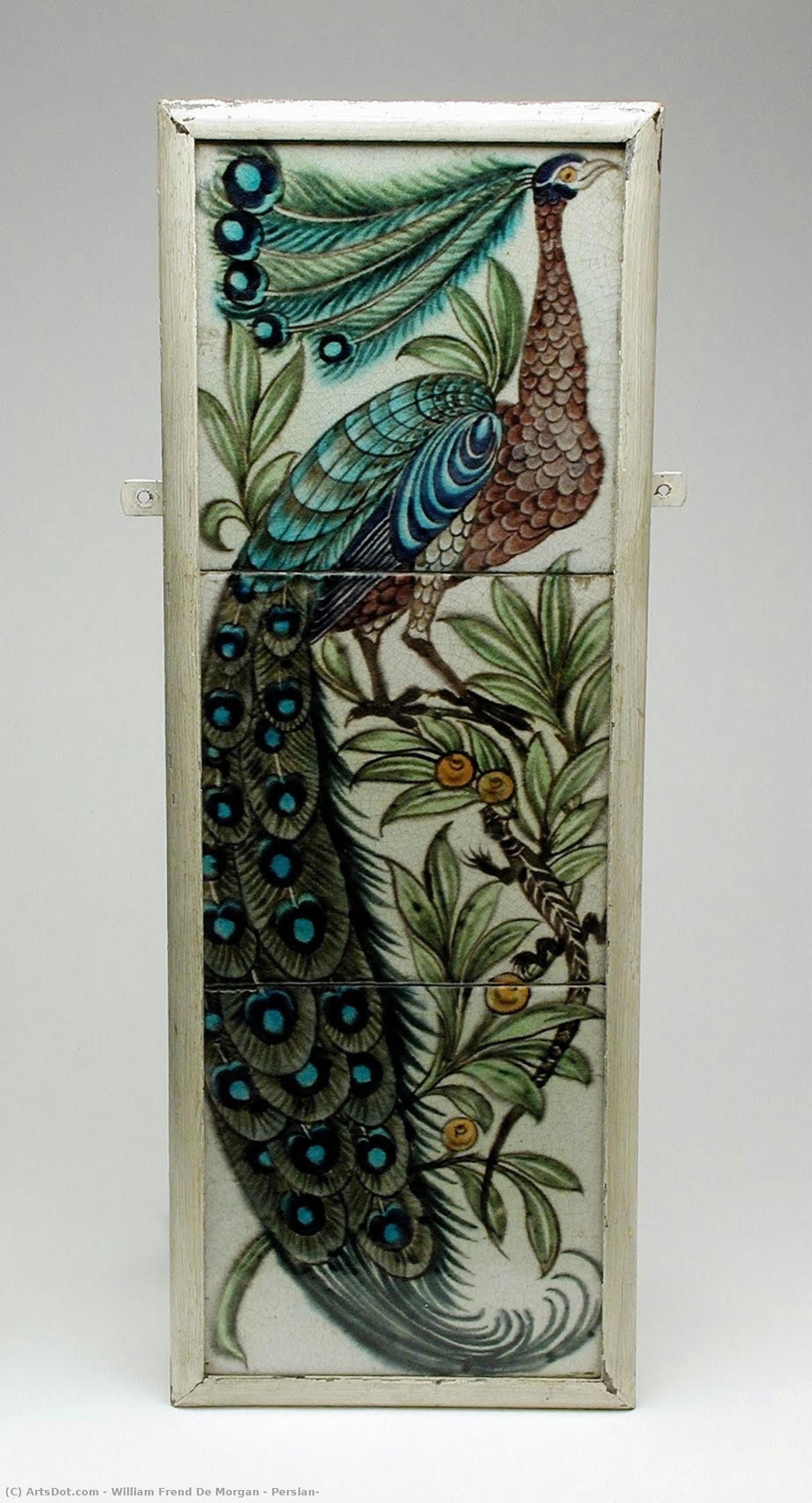
6
Persian (1897) autor William De Morgan

Persian

1897 · Ceramics · Los Angeles County Museum of Art, Los Angeles

Within the rich tapestry of 19th-century decorative arts, few pieces possess the captivating blend of artistry and exoticism as William Frend De Morgan’s “Persian” tile panel. Created in 1888-1897 during his prolific period at Merton Abbey, this work transcends mere ornamentation; it's a portal to a reimagined East, infused with Victorian sensibilities and a profound understanding of ancient artistic traditions. More than just a decorative object, it’s a testament to…

Teemad, mis püüdisid William De Morgan pilma

Neli teemat, mis esinevad neis originaalkindel kõige sagedamini, ning iga teema parim näide.

Muuseumid, kus on säilitatud William De Morgan originaalteosed

Kümne 6 muuseumi kollektsioonid, mis sisaldavad kõige rohkem sellel lehel esitatud teoseid.

Muuseumid Linn William De Morgan teosid Selle nimekirja maalid
Londoni muuseum, LondonLondoni muuseum London 1 tile
National Library of Wales, AberystwythNational Library of Wales Aberystwyth 1 The Welsh Bible
Metropolitan Museum of Art, New YorkMetropolitan Museum of Art New York 1 Plate
The Potteries Museum - Art Gallery, Stoke-on-TrentThe Potteries Museum - Art Gallery Stoke-on-Trent 1 William De Morgan Tiles
William Morris Gallery, WalthamstowWilliam Morris Gallery Walthamstow 1 Music Cabinet
Los Angeles County Museum of Art, Los AngelesLos Angeles County Museum of Art Los Angeles 1 Persian

William De Morgan aastak aegades: originaalteos, mis määratleb iga ajastu

Teosed aastakate kaupa

Vali vuosakülg, et näha selle ajastu definieerivat originaalteost.

Sammlajate küsimused William De Morgan maalide kohta

Millise teosega on William De Morgan kõige kuulsam?Paljasta vastus

tile (1900), Londoni muuseum, London. Järgnevad The Welsh Bible (1588) ja Plate (1890).

Kui vana oli William De Morgan, kui teos tile loodi?Paljasta vastus

61 aastat vanus: teos tile on pärinev aastast 1900 ning William De Morgan sündis aastal 1839.

Kui palju maali William De Morgan jäeti?Paljasta vastus

Meie kataloogist leiate 6 teost kunstnikult William De Morgan, mis on pärinevad ajastust 1880 kuni 1907.

Mitteks muuseumides rihangavad William De Morgan meistriteosed?Paljasta vastus

Peamiselt Londoni muuseum (London), National Library of Wales (Aberystwyth) ja Metropolitan Museum of Art (New York) muuseumites. Ülalpool olevate muuseumite tabelis on nendest kõik loetletud.

Millah aastades maalas William De Morgan oma kuulsamaid teoseid?Paljasta vastus

Ajal 1890s: 2 6 sellel lehel olevat teost on sellel perioodil loodud, მათart közül Plate.

Mis on William De Morgan esimene ja viimane kuuls fama originaalteos?Paljasta vastus

Sellel lehel on kõige vanem teos Music Cabinet (1880) ja kõige värskeim William De Morgan Tiles (1907).

Millist tehnikat kasutas William De Morgan kõige rohkem?Paljasta vastus

Ceramics, 2 teoseks 6 töödelt sellel lehel.

Minge pihta kunstisuunasse, kuhu William De Morgan kuulub?Paljasta vastus

Arts and crafts, seda lähtudes selle lehe originaalteostest.

William De Morgan: elu ja looming

A Life Immersed in Pattern and Innovation

William Frend De Morgan, born in London in 1839, was a figure who defied easy categorization. He wasn’t simply a potter, nor merely a tile designer, or even solely a novelist—he was a polymath whose artistic spirit permeated multiple disciplines. Born into an intellectually stimulating environment – his father, Augustus De Morgan, was a renowned mathematician, and his mother, Sophia Elizabeth Frend, a progressive thinker and writer – young William received encouragement to pursue his creative inclinations. Though he initially enrolled at the Royal Academy Schools, a sense of disillusionment soon set in, leading him toward a more collaborative and aesthetically aligned path. This pivotal shift came with his introduction to William Morris, a meeting that would profoundly shape De Morgan’s artistic trajectory and immerse him within the burgeoning Arts and Crafts movement.

From Stained Glass to Ceramic Revelation

De Morgan's early explorations centered on stained glass, working alongside Morris & Co., contributing designs imbued with medieval and mythological narratives. However, it was a fascination with lustre – that shimmering, iridescent quality found in ancient Hispano-Moresque pottery and Italian maiolica – that truly ignited his artistic passion. He dedicated himself to rediscovering the lost techniques of lustreware, meticulously experimenting with glazes and firing processes. This pursuit wasn’t merely about replicating an aesthetic; it was a scientific investigation driven by an insatiable curiosity. By 1872, De Morgan had fully committed to ceramics, establishing his own pottery in Chelsea. The decade that followed proved remarkably fruitful, though marked by technical challenges. He skillfully combined commercially produced tiles with his own creations, notably developing a high-quality biscuit tile celebrated for its irregularities and durability. His designs during this period began to coalesce around recurring motifs: fantastical creatures, galleons, fish, and intricate floral patterns, all rendered in a distinctive “Persian” palette of deep blues, turquoise, manganese purple, greens, Indian red, and lemon yellow.

Eastern Influences and Artistic Flourishing

De Morgan’s artistic vision was deeply informed by his profound interest in Eastern art, particularly Islamic tilework. This fascination wasn't superficial imitation but a genuine appreciation for the complex geometric patterns, vibrant colors, and symbolic richness of these traditions. He absorbed these influences, translating them into a unique visual language that blended medieval aesthetics with Oriental motifs. Between 1882 and 1900, De Morgan received significant commissions, most notably producing elaborate tile panels for twelve P&O liners under the direction of T.E. Colcutt, as well as earlier work for Tsar Alexander II’s yacht, Livadia. These large-scale projects showcased his ability to translate intricate designs into expansive decorative schemes. His pottery also flourished, encompassing chargers, rice dishes, and vases, often brought to life through the skilled hands of decorators like Charles Passenger, Fred Passenger, Joe Juster, and Miss Babb – artists who faithfully executed De Morgan’s visionary concepts.

A Legacy Beyond Ceramics

Though his pottery and tile designs remain his most celebrated achievements, William De Morgan's creative energy extended into the realm of literature. In his later years, he embarked on a second career as a novelist, publishing nine works between 1906 and 1917. His novels, characterized by realistic dialogue and insightful social commentary, were well-received during his lifetime. De Morgan’s impact resonates through the enduring appeal of his art. He wasn't simply replicating historical styles; he was innovating, experimenting, and forging a unique aesthetic that continues to captivate audiences today. The De Morgan Centre in London stands as a testament to his legacy, preserving and showcasing his remarkable contributions to Victorian decorative arts. His work embodies the spirit of the Arts and Crafts movement – a commitment to craftsmanship, artistic integrity, and the harmonious integration of art into everyday life.

Key Dates & Notable Works

  • 1839: Born in Gower Street, London.
  • 1863: Began experimenting with stained glass and ventured into pottery.
  • 1872: Established his own pottery in Chelsea.
  • 1882-1900: Commissioned to produce tile panels for P&O liners and the Tsar’s yacht.
  • 1906-1917: Published nine novels.
  • 1917: Passed away in London.