Wang Yuanqi portree

22 kulubumatamatum Wang Yuanqi maali, galeriiselektsioon

Uuendatud november 2026 · järjestatud meie populaarsusindeksi järgi (otsingud, külastused ja tellimused igale teosele) · 22 teost Wang Yuanqi meie kataloogis

Lühidalt

Kõigist Wang Yuanqi jäetud originaalteostest on kõige kuulsam Landscape for Zhanting (1710). Järgnevad sellest Wangchuan Villa (1711) ja Landscape (1678). Meie kataloogist löytyb 22 teost kunstnikult Wang Yuanqi; galeriist on säilitatud 22 maailmas kõige imetlustunud teost, millest iga on esitatud koos kuupäeva, museumi ja oma luguga.

1642 – 1715, Taicang Enamama teoseid: Metropolitan Museum of Art

Wang Yuanqi top 10 maalist: galeriis valitud teosed

1
Landscape for Zhanting (1710) autor Wang Yuanqi

Landscape for Zhanting

1710 · Ink

In Landscape for Zhanting, the artist Wang Yuanqi presents a vast mountain range that stretches across the entire width of the silk. Snow-capped peaks rise against the sky, their white summits catching the light amidst the rugged terrain. These mountains form a heavy, continuous boundary that defines the horizon. The scale of the landscape creates a sense of immense depth, pulling the eye through layers of stone and mist.
2
Wangchuan Villa (1711) autor Wang Yuanqi

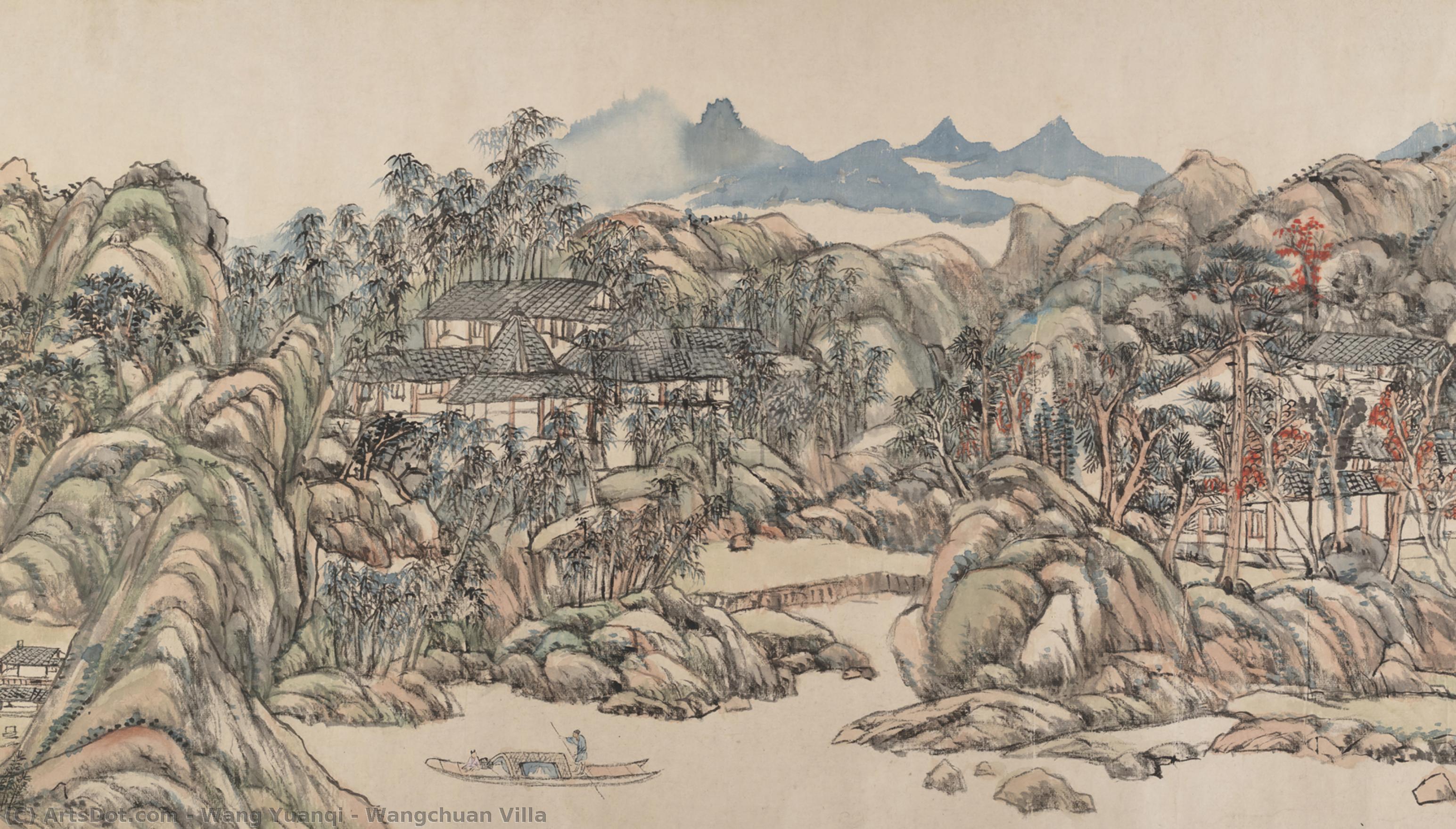
Wangchuan Villa

1711 · Ink On Paper · Metropolitan Museum of Art, New York

The handscroll titled Wangchuan Villa emerges from the brush of Wang Yuanqi, a painter who shaped the landscape traditions of the Qing Dynasty. Born in 1642 in Taicang, Jiangsu province, China, Wang Yuanqi carries the weight of a profound artistic lineage. He moves through the world of ink and color as a leading figure of the Orthodox School. His hand brings life to this specific vision of a mountain community,…

3
Landscape (1678) autor Wang Yuanqi

Landscape

1678 · Ink On Paper · Art Institute of Chicago, Chicago

In this vertical and expansive work, Wang Yuanqi organizes a vast, mountainous terrain through a high-distance perspective. The composition directs the eye from foreground rocky outcrops and trees upward through a series of receding mountain ridges. These paths lead toward distant, misty peaks that dissolve into the upper reaches of the frame. Small architectural structures are nestled among the cliffs, providing a sense of scale to the winding paths and…

4
Mountainous Landscape after Wang Meng (1678) autor Wang Yuanqi

Mountainous Landscape after Wang Meng

1678 · Ink On Paper · Art Institute of Chicago, Chicago

In Mountainous Landscape after Wang Meng, Wang Yuanqi organizes the vertical space into a series of ascending movements. The composition begins at the base with a detailed foreground of rocky outcrops and tangled trees. From this rugged foundation, the eye travels upward through a sequence of receding mountain ridges. These layers of stone and earth climb toward a towering, central peak that anchors the entire scene. This peak reaches into…

5
Free Spirits Among Streams and Mountains (1684) autor Wang Yuanqi

Free Spirits Among Streams and Mountains

1684 · Ink On Paper · Walters Art Museum, Baltimore

In 1684, Wang Yuanqi captured a classic depiction of nature in Free Spirits Among Streams and Mountains. The ink settles upon the surface to trace a landscape of rolling peaks and dense groves. Water flows through the composition, a calm body reflecting the stillness of the surrounding terrain. It is a vision of the natural world where the mountains do not merely exist but breathe through the mist.

6
清 王原祁 倣吳鎮山水圖 軸 Landscape after Wu Zhen (1695) autor Wang Yuanqi

清 王原祁 倣吳鎮山水圖 軸 Landscape after Wu Zhen

1695 · Ink On Paper · Metropolitan Museum of Art, New York

Created in 1695, this hanging scroll reflects the rigorous traditions of the Qing dynasty. Wang Yuanqi, a central figure of the Orthodox School, looks backward to the Yuan dynasty to move forward. Here, the influence of Wu Zhen is palpable, particularly in the way the landscape is constructed through rhythmic, textured movements. The composition centers on a lofty mountain range, its peaks dusted with snow, rising above a verdant landscape…

Kunstianikut Wang Yuanqi nimekiri jätkub, 11 kuni 22

Teemad, mis püüdisid Wang Yuanqi pilma

Neli teemat, mis esinevad neis originaalkindel kõige sagedamini, ning iga teema parim näide.

Muuseumid, kus on säilitatud Wang Yuanqi originaalteosed

Kümne 8 muuseumi kollektsioonid, mis sisaldavad kõige rohkem sellel lehel esitatud teoseid.

Muuseumid Linn Wang Yuanqi teosid Selle nimekirja maalid
Metropolitan Museum of Art, New YorkMetropolitan Museum of Art New York 7 Wangchuan Villa, 清 王原祁 倣吳鎮山水圖 軸 Landscape after Wu Zhen, Landscape for Zhanting
Art Institute of Chicago, ChicagoArt Institute of Chicago Chicago 3 Landscape, Mountainous Landscape after Wang Meng, Landscape after Huang Gongwang
Cleveland Museum of Art, ClevelandCleveland Museum of Art Cleveland 2 Landscape after Ni Zan, Green Peaks under Clear Sky: After Huang Gongwang
Yale University Art Gallery, New HavenYale University Art Gallery New Haven 2 Landscape in the Style of Huang Gongwang, Landscape
Walters Art Museum, BaltimoreWalters Art Museum Baltimore 1 Free Spirits Among Streams and Mountains
Detroit Institute of Arts, DetroitDetroit Institute of Arts Detroit 1 Mountain and River Landscape
The Palace Museum, PekingThe Palace Museum Peking 1 Wang Yuanqi's Thatched Cottage Ten Records
National Gallery of Victoria, MelbourneNational Gallery of Victoria Melbourne 1 The Fuchun Mountians

Wang Yuanqi aastak aegades: originaalteos, mis määratleb iga ajastu

Teosed aastakate kaupa

Vali vuosakülg, et näha selle ajastu definieerivat originaalteost.

Sammlajate küsimused Wang Yuanqi maalide kohta

Millise teosega on Wang Yuanqi kõige kuulsam?Paljasta vastus

Landscape for Zhanting (1710). Järgnevad Wangchuan Villa (1711) ja Landscape (1678).

Kui vana oli Wang Yuanqi, kui teos Landscape for Zhanting loodi?Paljasta vastus

68 aastat vanus: teos Landscape for Zhanting on pärinev aastast 1710 ning Wang Yuanqi sündis aastal 1642.

Millised on kümne kõige kuulsama Wang Yuanqi maalid?Paljasta vastus

Landscape for Zhanting, Wangchuan Villa, Landscape, Mountainous Landscape after Wang Meng, Free Spirits Among Streams and Mountains, 清 王原祁 倣吳鎮山水圖 軸 Landscape after Wu Zhen, Landscape for Zhanting, Landscape after Ni Zan, Green Peaks under Clear Sky: After Huang Gongwang ja Landscape after Huang Gongwang. Ülemine reiting näitab iga teose puhul aastat ja muuseumi.

Kui palju maali Wang Yuanqi jäeti?Paljasta vastus

Meie kataloogist leiate 22 teost kunstnikult Wang Yuanqi, mis on pärinevad ajastust 1678 kuni 1712.

Mitteks muuseumides rihangavad Wang Yuanqi meistriteosed?Paljasta vastus

Peamiselt Metropolitan Museum of Art (New York), Art Institute of Chicago (Chicago) ja Cleveland Museum of Art (Cleveland) muuseumites. Ülalpool olevate muuseumite tabelis on nendest kõik loetletud.

Millah aastades maalas Wang Yuanqi oma kuulsamaid teoseid?Paljasta vastus

Ajal 1700s: 5 22 sellel lehel olevat teost on sellel perioodil loodud, მათart közül Landscape after Ni Zan.

Mis on Wang Yuanqi esimene ja viimane kuuls fama originaalteos?Paljasta vastus

Sellel lehel on kõige vanem teos Landscape (1678) ja kõige värskeim Landscape in the Style of Huang Gongwang (1712).

Milliseid teemasid Wang Yuanqi kõige sagedamini valis?Paljasta vastus

Mountains (7), Trees (6) ja Landscape (3), kogu selle lehekülje 22 teose kohta.

Millist tehnikat kasutas Wang Yuanqi kõige rohkem?Paljasta vastus

Ink On Paper, 5 teoseks 22 töödelt sellel lehel.

Millised Wang Yuanqi teosed on Metropolitan Museum of Art näituses?Paljasta vastus

Wangchuan Villa, 清 王原祁 倣吳鎮山水圖 軸 Landscape after Wu Zhen ja Landscape for Zhanting: Metropolitan Museum of Art, New York säilitab 7 selle lehel olevat teost.

Wang Yuanqi: elu ja looming

Wang Yuanqi: A Master of Qing Dynasty Landscape

Early Life and Education

  • Wang Yuanqi (王原祁) was born in 1642 in Taicang, Jiangsu province, China.
  • He came from a family with a strong artistic tradition; his grandfather, Wang Shimin, was a renowned painter of the early Qing dynasty.
  • Yuanqi received rigorous training in painting from his grandfather, laying the foundation for his future artistic endeavors.
  • His style name was 'Mao-ching' and his sobriquet was 'Lu-t’ai'.

Career as a Court Official

  • Wang Yuanqi rose to prominence as a court official during the Qing dynasty, beginning shortly after its establishment in 1644.
  • He served with distinction and was eventually appointed curator of the imperial collection under the Kangxi Emperor.
  • This position granted him access to a vast array of artworks, further enriching his artistic knowledge and influencing his style.
  • He remained a court official throughout his long career, balancing administrative duties with his passion for painting until his death in 1715 at age 73.

Artistic Style and Influences

  • Wang Yuanqi is considered one of the “Six Masters of the early Qing period,” also known as the ‘Four Wangs, a Wu and a Yun’.
  • He was a leading figure in the 'Orthodox School' (正统派) of Chinese landscape painting.
  • His landscapes drew inspiration from Yuan dynasty artists who moved away from the highly realistic depictions favored during the Northern Song period.
  • A key influence on his work was Huang Gongwang, particularly in the use of dry brush strokes, ink washes, and a sophisticated approach to color.
  • He skillfully integrated color patterns into his compositions, complementing abstract designs with rhythmic color flows.

Major Works and Achievements

  • Notable works include Landscape in the Style of Huang Gongwang (1711), currently held in Singapore’s Asian Civilisations Museum.
  • His rendition of Wang Wei's eighth-century hand scroll, The Wang River Villa, is housed in the Metropolitan Museum of Art, New York City.
  • Other significant paintings include “The Fuchun Mountains”, “Landscape for Zhanting” and numerous landscapes after the Four Great Yuan Masters.
  • He excelled at recreating the styles of earlier masters while imbuing his works with a unique personal touch.

Historical Significance

  • Wang Yuanqi played a crucial role in shaping the development of Chinese landscape painting during the Qing dynasty.
  • His adherence to and refinement of the Orthodox School established a standard for generations of artists.
  • He helped preserve and promote traditional artistic values while also demonstrating innovative techniques in composition and color usage.
  • His work continues to be celebrated for its technical mastery, aesthetic beauty, and historical importance within the context of Chinese art history.