Otto Dix portree

Otto Dix maalid: 100 kuulsumat teost galeriin läbi

Uuendatud oktoober 2026 · järjestatud meie populaarsusindeksi järgi (otsingud, külastused ja tellimused igale teosele) · 373 teost Otto Dix meie kataloogis

Lühidalt

Galleriist vaadatuna on Otto Dix kõige kuulsam teos Sylvia von Hardeni portree Otto Dix (1926), mille originaal ripub Centre Pompidou-is, Pariis. Flanders ja The Skat Players (1920) täidavad kolmikut, mille iga silm tunnistab. Kunstnii Otto Dix 373 teose põhjal esitleb galeriis allpool 100 kõige kuulsumat, kus iga originaal on märgitud aastaga, muuseumiga ja kirjeldatud, mis teeb selle unikaalseks.

1891 – 1969, Untermhaus Neue sachlichkeit Enamama teoseid: Bavaria riiklikud maalidema kogumikud

Galeria 10 parimat Otto Dix maali

1
Sylvia von Hardeni portree Otto Dix (1926) autor Otto Dix

Sylvia von Hardeni portree Otto Dix

1926 · Õli paneelil · Centre Pompidou, Pariis

Otto Dixi "Journalist Sylvia von Hardeni portree" on ikooniline meistriteos, mis tabab Weimari vabariigi ajastu olemust. See silmapaistev portree, mis loodi aastal 1926, kujutab tuntud saksa ajakirjanikku ja luuletajat Sylvia von Hardeni istumas kohvikulaudal, käes sigarett ja ees cocktail. Dixi kompromissitu realism ja detailide täpsus tuuavad von Hardeni androgüünsed näojooned ja modernne riietus ellu, muutes selle teose kaasahaaravaks lisanduseks igale kunstikolektsioonile või interjööri disainile.

2
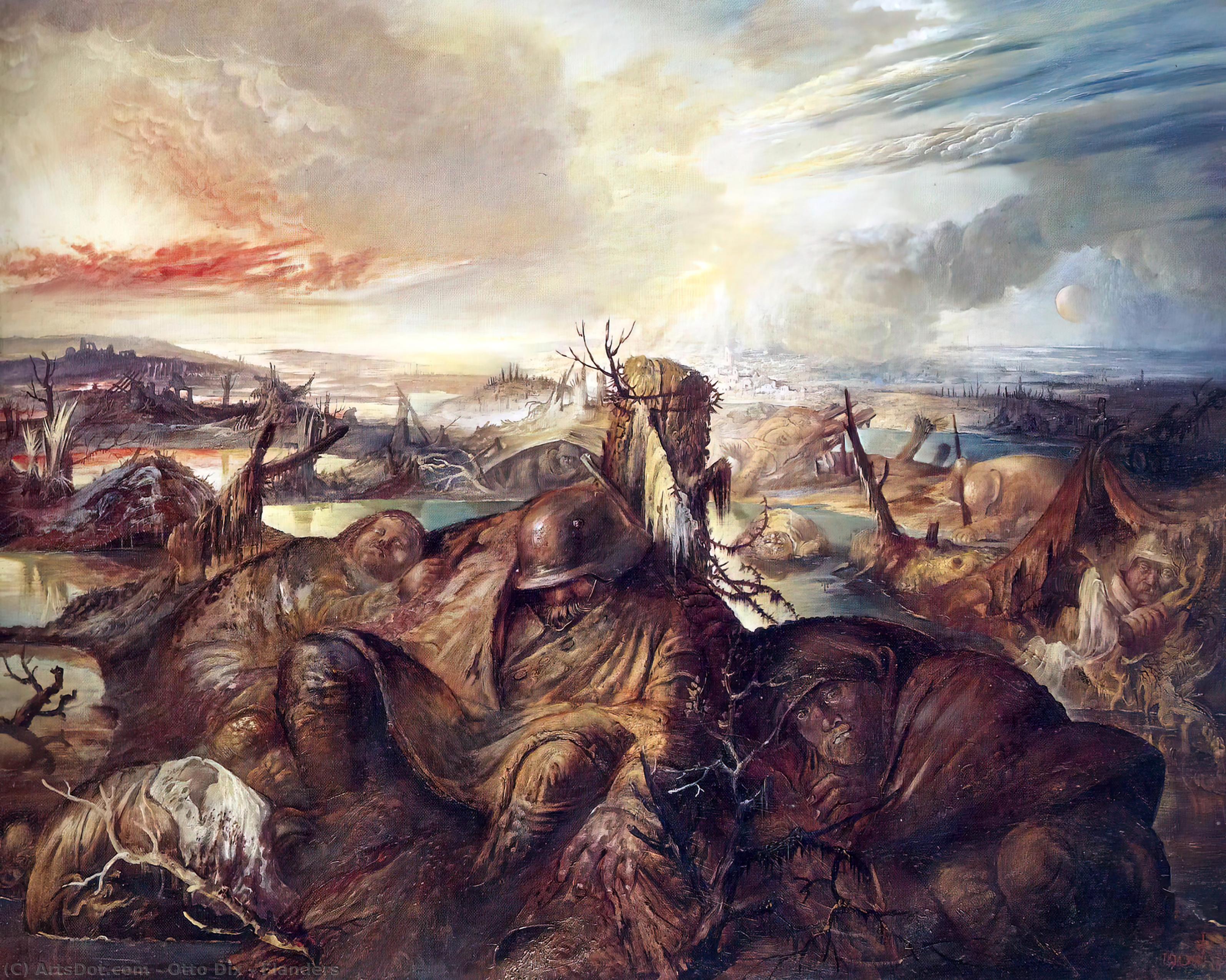
Flanders autor Otto Dix

Flanders

Õlimaal kangaruumil

Käes Koestatud Kaan: Muistosepise ja Tunne "Flanders" ei ole pelkkõ pilt; see on tunnete salat, vangitud õlimaali pinnile. Otto Dixi käe all sündinud teos viib vaataja otse 1. maaild sõjale, selle hirmu ja lõhkemisele. See pole lihtsalt dokumentatsioon – see on emotsionaalne kokandumine, mis on saanud tema kaudu oma tugeva positsiooni kunstiteaduslikus uurimuses. Dix oli osa "Neue Sachlichkeit" (Uue Selgesuse) liikumisest, mis pidas kunagist realistlikku maalikunstile tänu oma otsusele, et…

3
The Skat Players (1920) autor Otto Dix

The Skat Players

1920 · Acrylic On Canvas

Otto Dix's "The Skat Players," created in 1920, is a profoundly unsettling and powerful artwork that serves as a stark commentary on the aftermath of World War I. This oil-on-canvas painting (87 x 110 cm) embodies the Dadaist style, capturing the despair, social upheaval, and struggle for survival prevalent in post-war Germany.

4
Trench Warfare autor Otto Dix

Trench Warfare

Oil

is an oil painting by Otto Dix. The canvas captures the heavy, suffocating darkness of a battlefield, focusing on the visceral reality of war and its devastating consequences. A lone soldier emerges from a turbulent background of smoke and fire, his form highlighted by dramatic light against the surrounding gloom. The scene is a landscape of grit and unrest.

5
Nelly among Flowers autor Otto Dix

Nelly among Flowers

Acrylic On Canvas · Museum Folkwang, Essen

Otto Dix’s Tender Reverie: Nelly Among Flowers The painting “Nelly Among Flowers” by Otto Dix stands as an arresting paradox—a glimpse into the artist's deeply personal world juxtaposed against the stark, uncompromising aesthetic of Neue Sachlichkeit. Created in 1924, shortly after Dix’s daughter Nelly was born, it represents a significant departure from his characteristic depictions of war and societal critique, offering instead a serene tableau bathed in soft light and…

6
Metropolis autor Otto Dix

Metropolis

Oil On Panel

The triptych Metropolis by the German artist Otto Dix captures the fractured pulse of the Weimar Republic. Executed between 1927 and 1928, the work presents three nighttime city scenes. It focuses on the nightlife of a German big city during the golden twenties. The panels act as windows into a world of decadence, femininity, and sexuality. This modern city is a place of sharp contrasts and restless energy.

7
The Seven Cardinal Sins autor Otto Dix

The Seven Cardinal Sins

Oil

Introduction to the Artist and Painting Title Otto Dix, a prominent German artist known for his powerful and thought-provoking works, created "The Seven Cardinal Sins" in 1933. This captivating painting is an exceptional example of the Neue Sachlichkeit (New Objectivity) movement, which emerged in Germany during the 1920s and 1930s as a response to the country's turbulent socio-political climate. Symbolism and Meaning In "The Seven Cardinal Sins," Dix masterfully employs…

8
Newborn Baby on Hands autor Otto Dix

Newborn Baby on Hands

In this quiet composition titled Newborn Baby on Hands, the artist Otto Dix turns his gaze toward a moment of profound intimacy. The work presents a departure from the more turbulent social critiques often associated with his name, focusing instead on the delicate connection between a mother and her newborn child. It is a study of tenderness, captured through the simple, protective presence of a mother's hands.

9
Pragerstrasse (1920) autor Otto Dix

Pragerstrasse

1920 · Oil On Canvas

Executed in July 1920, Pragerstrasse is an oil and collage on canvas that captures a scene on Prager Straße in Dresden, Germany, shortly after the First World War. The composition presents a fragmented view of urban life, featuring several distinct figures. In the foreground, a character from the middle or upper class is depicted without legs, moving with the assistance of a skateboard and canes; this figure wears a bowler…

10
To Beauty (1922) autor Otto Dix

To Beauty

1922 · Oil On Canvas

Otto Dix's "To Beauty," painted in 1922, stands as a stark and unsettling critique of the moral decay and superficiality that permeated post-World War I Germany. Housed within the Von der Heydt Museum in Wuppertal, Germany, this oil on canvas masterpiece is more than just a painting; it's a historical document capturing an era defined by disillusionment and decadence through the lens of Expressionism.

Otto Dix maalid, järjestus 11 kuni 100

11War (1932) autor Otto DixWar1932 12Portrait of Dr Heinrich Stadelmann (1922) autor Otto DixPortrait of Dr Heinrich Stadelmann1922 13Plague German (1919) autor Otto DixPlague German1919 14Prager Straße (Prague Street) autor Otto DixPrager Straße (Prague Street) 15Portrait of the Lawyer Hugo Simons 1 autor Otto DixPortrait of the Lawyer Hugo Simons 1 16Suleika, the Tatooed Wonder autor Otto DixSuleika, the Tatooed Wonder 17Sunrise autor Otto DixSunrise 18Shock Troops Advance under Gas (1924) autor Otto DixShock Troops Advance under Gas1924 · MoMA - Museum of Modern Art 19Triptychon Der Krieg (War Triptych) autor Otto DixTriptychon Der Krieg (War Triptych) 20Randegg in the snow with ravens autor Otto DixRandegg in the snow with ravens 21How I Looked As A Soldier autor Otto DixHow I Looked As A Soldier 22Portrait of Mrs. Martha Dix autor Otto DixPortrait of Mrs. Martha DixMuseum Folkwang 23Mother with Child (1921) autor Otto DixMother with Child1921 24Sappenkopf (1920) autor Otto DixSappenkopf1920 · Bavaria riiklikud maalidema kogumikud 25Fritz Perls autor Otto DixFritz Perls 26prisoners of war autor Otto Dixprisoners of war 27Portrait of Dr. Heinrich Stadelmann autor Otto DixPortrait of Dr. Heinrich Stadelmann 28Self-Portrait as a Soldier autor Otto DixSelf-Portrait as a Soldier 29Portrait of Paul F. Schmidt (1921) autor Otto DixPortrait of Paul F. Schmidt1921 30Nelly with Toy autor Otto DixNelly with Toy 31War cripples autor Otto DixWar cripples 32Still Life with Widow's Veil (1925) autor Otto DixStill Life with Widow's Veil1925 33Dream of the sadist autor Otto DixDream of the sadist 34The Dancer Anita Berber autor Otto DixThe Dancer Anita Berber 35Portrait of Heinrich George autor Otto DixPortrait of Heinrich George 36Half-Nude autor Otto DixHalf-Nude 37House by the Stream (1912) autor Otto DixHouse by the Stream1912 38The Declaration of War (1914) autor Otto DixThe Declaration of War1914 39Portrait of the Poet Alfred Günther (1919) autor Otto DixPortrait of the Poet Alfred Günther1919 · Bavaria riiklikud maalidema kogumikud 40Female Worker in Sunday Dress (1920) autor Otto DixFemale Worker in Sunday Dress1920 41Fit for service (1919) autor Otto DixFit for service1919 42Portrait of the Photographer Hugo Erfurth (1925) autor Otto DixPortrait of the Photographer Hugo Erfurth1925 · Bavaria riiklikud maalidema kogumikud 43The Widow (1925) autor Otto DixThe Widow1925 44Woman with Infant (1924) autor Otto DixWoman with Infant1924 45Self-Portrait with Wife (1923) autor Otto DixSelf-Portrait with Wife1923 46Family of the Painter Adalbert Trillhaase (1923) autor Otto DixFamily of the Painter Adalbert Trillhaase1923 47Old Lovers (1923) autor Otto DixOld Lovers1923 48Son of the Artist (1928) autor Otto DixSon of the Artist1928 · Bavaria riiklikud maalidema kogumikud 49Portrait of the Dancer Marianne Vogelsang (1931) autor Otto DixPortrait of the Dancer Marianne Vogelsang1931 50untitled (1685) autor Otto Dixuntitled (1685) 51The Resurrection autor Otto DixThe Resurrection 52untitled (4922) autor Otto Dixuntitled (4922) 53war triptych (1932) autor Otto Dixwar triptych1932 54Der Triumph des Todes, Triumph of death autor Otto DixDer Triumph des Todes, Triumph of death 55Uneven couple autor Otto DixUneven couple 56Little Girl autor Otto DixLittle Girl 57Family Portrait autor Otto DixFamily Portrait 58St. Christopher IV autor Otto DixSt. Christopher IV 59Self-Portrait autor Otto DixSelf-Portrait 60untitled (238) autor Otto Dixuntitled (238) 61Parents of the Artist autor Otto DixParents of the Artist 62Apotheosis autor Otto DixApotheosis 63Mediterranean Sailor autor Otto DixMediterranean Sailor 64Flare illuminates the farm at Monacu autor Otto DixFlare illuminates the farm at Monacu 65Crater field near Dontrien lit up by flares autor Otto DixCrater field near Dontrien lit up by flares 66Dance of death 1917 - (Dead Man's Hill) autor Otto DixDance of death 1917 - (Dead Man's Hill) 67untitled (7119) autor Otto Dixuntitled (7119) 68Annunciation autor Otto DixAnnunciation 69Mother and Child (Irmgard Bahle) autor Otto DixMother and Child (Irmgard Bahle) 70The God of confectioners autor Otto DixThe God of confectioners 71Skull autor Otto DixSkull 72The Businessman Max Roesberg, Dresden autor Otto DixThe Businessman Max Roesberg, Dresden 73Dr. Mayer-Hermann autor Otto DixDr. Mayer-Hermann 74Man and Woman (Nocturnal scene) autor Otto DixMan and Woman (Nocturnal scene) 75Family of the painter Adalbert Trillhaase autor Otto DixFamily of the painter Adalbert Trillhaase 76The War Cripples autor Otto DixThe War Cripples 77Laughing Girl autor Otto DixLaughing Girl 78Wounded autor Otto DixWounded 79Self Portrait autor Otto DixSelf Portrait 80Forenoon autor Otto DixForenoon 81This is Ursus Dix autor Otto DixThis is Ursus Dix 82Old man autor Otto DixOld man 83Girl with sunflower autor Otto DixGirl with sunflower 84Old Woman autor Otto DixOld Woman 85Trenches autor Otto DixTrenches 86Battle weary troops retreating - Battle of the Somme autor Otto DixBattle weary troops retreating - Battle of the Somme 87Street Fight autor Otto DixStreet Fight 88Stormtroopers go ahead into the gas (Assault under Gas) autor Otto DixStormtroopers go ahead into the gas (Assault under Gas) 89untitled (8348) autor Otto Dixuntitled (8348) 90untitled (7198) autor Otto Dixuntitled (7198) 91shelter autor Otto Dixshelter 92Child with Doll autor Otto DixChild with Doll 93untitled (3407) autor Otto Dixuntitled (3407) 94Gas Victims autor Otto DixGas Victims 95untitled (1737) autor Otto Dixuntitled (1737) 96Erna I, standing, hand under chin autor Otto DixErna I, standing, hand under chin 97Zirkusszene autor Otto DixZirkusszene 98Sketch of 'Melancholy' autor Otto DixSketch of 'Melancholy' 99Mealtime in the Trenches autor Otto DixMealtime in the Trenches 100At the Café autor Otto DixAt the Café

Teemad, mis püüdisid Otto Dix pilma

Neli teemat, mis esinevad neis originaalkindel kõige sagedamini, ning iga teema parim näide.

Muuseumid, kus on säilitatud Otto Dix originaalteosed

Kümne 4 muuseumi kollektsioonid, mis sisaldavad kõige rohkem sellel lehel esitatud teoseid.

Muuseumid Linn Otto Dix teosid Selle nimekirja maalid
Bavaria riiklikud maalidema kogumikud, MünchenBavaria riiklikud maalidema kogumikud München 4 Sappenkopf, Portrait of the Poet Alfred Günther, Portrait of the Photographer Hugo Erfurth
Museum Folkwang, EssenMuseum Folkwang Essen 2 Nelly among Flowers, Portrait of Mrs. Martha Dix
Centre Pompidou, PariisCentre Pompidou Pariis 1 Sylvia von Hardeni portree Otto Dix
MoMA - Museum of Modern Art, New YorkMoMA - Museum of Modern Art New York 1 Shock Troops Advance under Gas

Otto Dix, iga kümnendiga üks signatuurpilt

Teosed aastakate kaupa

Vali vuosakülg, et näha selle ajastu definieerivat originaalteost.

Otto Dix maalid: galerii vastused

Milline Otto Dix maal on kõige kuulsam?Paljasta vastus

Sylvia von Hardeni portree Otto Dix (1926), Centre Pompidou, Pariis. Järgnevad Flanders ja The Skat Players (1920).

Kui vana Otto Dix oli teose Sylvia von Hardeni portree Otto Dix valmimisel?Paljasta vastus

35 aastat vanus: teos Sylvia von Hardeni portree Otto Dix on pärinev aastast 1926 ning Otto Dix sündis aastal 1891.

Millised on Otto Dix top 10 maali?Paljasta vastus

Sylvia von Hardeni portree Otto Dix, Flanders, The Skat Players, Trench Warfare, Nelly among Flowers, Metropolis, The Seven Cardinal Sins, Newborn Baby on Hands, Pragerstrasse ja To Beauty. Ülemine reiting näitab iga teose puhul aastat ja muuseumi.

Kui palju teoseid Otto Dix lõi?Paljasta vastus

Meie kataloogist leiate 373 teost kunstnikult Otto Dix, mis on pärinevad ajastust 1912 kuni 1932.

Kust leiad Otto Dix kõige kuulsamad originaalteosed?Paljasta vastus

Peamiselt Bavaria riiklikud maalidema kogumikud (München), Museum Folkwang (Essen) ja Centre Pompidou (Pariis) muuseumites. Ülalpool olevate muuseumite tabelis on nendest kõik loetletud.

Millal lõi Otto Dix oma kuulsamad maalid?Paljasta vastus

Ajal 1920s: 18 100 sellel lehel olevat teost on sellel perioodil loodud, მათart közül Sylvia von Hardeni portree Otto Dix.

Millised on Otto Dix varased ja hilised kuulsad teosed?Paljasta vastus

Sellel lehel on kõige vanem teos House by the Stream (1912) ja kõige värskeim War (1932).

Millist teemat Otto Dix kõige rohkem käsitledas?Paljasta vastus

Portraits (8), Wars (7) ja German art (6), kogu selle lehekülje 100 teose kohta.

Millises tehnikas töötas Otto Dix kõige rohkem?Paljasta vastus

Oil, 4 teoseks 100 töödelt sellel lehel.

Millise suunaga on Otto Dix seotud?Paljasta vastus

Neue sachlichkeit ja Expressionism, seda lähtudes selle lehe originaalteostest.

Milliseid Otto Dix originaalte Bavaria riiklikud maalidema kogumikud kogumuses on?Paljasta vastus

Sappenkopf, Portrait of the Poet Alfred Günther ja Portrait of the Photographer Hugo Erfurth: Bavaria riiklikud maalidema kogumikud, München säilitab 4 selle lehel olevat teost.

Otto Dix: kunstnik

Early Life, Family and Artistic Training

Untermhaus, Germany, 2 December 1891. The environment shaping Otto Dix is one of stark industrial labor and quiet, poetic undertones. His father, Franz Dix, works in an iron foundry, a setting defined by heavy toil. His mother, Louise, a seamstress, carries a history of writing poetry. This domestic landscape provides the first, subtle friction between the grit of manual labor and the impulse toward creative expression.

The path toward professional training begins in 1906. Dix enters an apprenticeship under the painter Carl Senff, a period of study that lasts until 1910. This formative training moves him away from the domestic sphere and into the technical discipline of the craft. By 1910, he moves to Dresden to enter the Kunstgewerbeschule, the institution known today as the Dresden Academy of Fine Arts. His early focus remains on applied arts and crafts rather than the fine painting that would later define his reputation.

The Brutal Reality of World War I

August 1914. The outbreak of World War I triggers a surge of patriotic fervor. Dix volunteers for the German army, trading the studio for the front lines. He serves as a machine gunner, facing the mechanized slaughter of both the Eastern and Western Fronts. The war is a landscape of mud, decay, and relentless suffering. He survives the carnage, eventually earning an Iron Cross for his service.

The trenches leave a psychological wound that refuses to heal. The experience of mechanized warfare becomes a central, haunting presence in his psyche. He witnesses the grotesque reality of combat—not the sanitized heroism of propaganda, but the visceral truth of destruction. These harrowing memories provide the raw material for his later work. After 1920, he begins to translate this trauma into a relentless, anti-war visual language.

Technique and Artistic Style

Dix operates through a lens of ruthless and harshly realistic depictions. He rejects the soft edges of romanticism, opting instead for a stylized realism that confronts the viewer with the grit of German society. His hand moves with clinical precision, whether he is applying glaze techniques to a canvas or scratching into a metal plate. This technical rigor allows him to document the physical and psychological decay of the Weimar era without the buffer of abstraction.

The medium often dictates the intensity of the message. In his printmaking, he employs a sophisticated combination of drypoint, aquatint, and etching to achieve deep, tonal shadows and sharp, biting lines. These methods allow for a granular level of detail in his depictions of war and urban life. Beyond the heavy textures of print, he utilizes silverpoint on prepared paper, a demanding technique requiring absolute control and leaving no room for error. His work oscillates between the broad application of paint and the meticulous, almost surgical precision of fine drawing.

Key Works and Masterpieces

The aftermath of the Great War finds its most unsettling reflection in 1920 with The Skat Players. This oil-on-canvas work captures the despair and social upheaval of post-war Germany through a Dadaist lens. It moves the viewer into a world of struggle and survival. By 1923, the focus shifts from social tension to the visceral carnage of the front lines. The Trench causes immediate controversy when it is first exhibited in Cologne. The graphic portrayal of the conflict strips away any sense of heroism, replacing it with the raw reality of the battlefield.

In 1924, the intensity of the war is distilled into The War, a series of 50 drypoint and aquatint etchings. These prints offer a relentless look at the madness of mechanized warfare. The precision of the graphic art confronts the viewer with the physical and psychological scars of the era. This period of unflinching observation continues into the urban landscape. Portrait of the Journalist Sylvia Von Harden, painted in 1926, captures the specific character of the era. By 1928, the gaze turns toward the decadence of the city. Metropolis makes its first appearance in Dresden, presenting a scathing indictment of urban life, filled with scenes of social alienation and debauchery.

Persecution and Later Years

The political climate shifts violently in 1933. The Nazi-affiliated German Art Society targets Dix, labeling his work as "degenerate." This designation carries immediate consequences: he is dismissed from his teaching position at the Dresden Academy of Fine Arts. The artist retreats from the political vitriol of the era, seeking seclusion in the small town of Hemmenhofen on Lake Constance. Even in this quietude, the tension remains. He paints religious allegories, often using them as a way to secretly criticize the regime.

The pressure intensifies in 1939. The Gestapo arrests Dix on suspicion of involvement in a plot to kill Hitler. He spends two weeks in interrogation before being released. The shadow of the Second World War looms large, and Dix finds himself conscripted into the Volkssturm during the waning months of the conflict. He survives the chaos of the war, eventually finding a period of renewed recognition in post-war Germany. He remains a significant figure in the cultural landscape until his death on 25 July 1969 in Singen, Hohentwiel (DE).

Legacy and Global Influence

Otto Dix remains a central figure in 20th-century German painting. His presence in the permanent collections of major institutions, such as the Museum of Modern Art in New York, confirms his lasting importance. He did not merely document the era; he forced a confrontation with the physical and psychological wreckage of war and the moral decay of the Weimar Republic. His etchings, particularly the series The War, are recognized as significant achievements in graphic art, utilizing drypoint and aquatint to capture the visceral reality of the trenches.

The impact of his work extends through subsequent generations of artists. Those who seek to challenge societal norms or confront difficult truths find a precedent in his uncompromising realism. He moved beyond the emotional abstraction of Expressionism to embrace a clinical, often harsh, clarity. This approach ensured that the struggles of the marginalized and the scars of conflict remained visible long after the political landscapes that birthed them had shifted.

Where to See His Works Today

The physical presence of Dix’s vision remains scattered across major international institutions. In London, the British Museum preserves a complete set of the folio prints from his series The War. These etchings offer a direct encounter with the graphic intensity of his wartime observations. Across the channel in Paris, the Centre Pompidou holds the 1926 Portrait of the Journalist Sylvia Von Harden, a work that captures the specific social atmosphere of the Weimar era.

The reach of his output extends to the United States, where the Museum of Modern Art in New York City maintains Shock Troops Advance under Gas. This piece brings the visceral tension of the front lines into a contemporary museum setting. In Germany, the Museum Folkwang in Essen houses Nelly among Flowers, providing a different perspective on his ability to handle intimate subject matter.

Kõik 373 teost Otto Dix →