Hiroshige portree

Hiroshige maalid: 100 kuulsumat teost galeriin läbi

Uuendatud oktoober 2026 · järjestatud meie populaarsusindeksi järgi (otsingud, külastused ja tellimused igale teosele) · 353 teost Hiroshige meie kataloogis

Lühidalt

Galleriist vaadatuna on Hiroshige kõige kuulsam teos Early Department from a Daimyo, mille originaal ripub Nakagawa-machi Bato Hiroshige muuseum-is, Nagasaki. The maple leaves of Mama, Tekona shrine and Tsugi bridge (1857) ja Hakone (1834) täidavad kolmikut, mille iga silm tunnistab. Kunstnii Hiroshige 353 teose põhjal esitleb galeriis allpool 100 kõige kuulsumat, kus iga originaal on märgitud aastaga, muuseumiga ja kirjeldatud, mis teeb selle unikaalseks.

1797 – 1858, Edo Ukiyo-e Enamama teoseid: Nakagawa-machi Bato Hiroshige muuseum

Galeria 10 parimat Hiroshige maali

1
Early Department from a Daimyo autor Hiroshige

Early Department from a Daimyo

Woodblock Print · Nakagawa-machi Bato Hiroshige muuseum, Nagasaki

In the delicate dance of lines and muted pigments, Utagawa Hiroshige’s Early Department from a Daimyo invites us to step through a portal into the heart of Edo-period Japan. This exquisite woodblock print captures a moment of vibrant communal life along a bustling riverside, where the rigid structures of social hierarchy melt into the shared leisure of a sunny afternoon. As we gaze upon the scene, we are not merely…

2
The maple leaves of Mama, Tekona shrine and Tsugi bridge (1857) autor Hiroshige

The maple leaves of Mama, Tekona shrine and Tsugi bridge

1857 · Woodblock Print · Van Gogh muuseum, Amsterdam

Utagawa Hiroshige (1797-1858), arguably the last titan of *ukiyo-e*, didn't merely depict landscapes; he crafted them into meditations on beauty and impermanence. “The Maple Leaves of Mama, Tekona Shrine and Tsugi Bridge,” created in 1857 during a period of significant societal transformation—the waning influence of feudal Japan as Western ideas crept in—stands as a testament to his enduring artistic legacy. More than just a visual record, it’s an embodiment of…

3
Hakone (1834) autor Hiroshige

Hakone

1834 · Woodblock Print · Indianapolis Kunstimuuseum, Indianapolis

Utagawa Hiroshige’s “Hakone,” created in 1834, is more than just a landscape; it's a poetic meditation on the beauty and transience of nature within Edo-period Japan. This woodblock print, part of his renowned series "The Fifty-three Stations of the Tōkaidō," captures a specific moment along the vital trade route connecting Tokyo (then Edo) with Kyoto. However, Hiroshige elevates this seemingly simple depiction of a mountain pass into something profoundly evocative,…

4
Station 36, Goyu; Kyoka Tokaido Series (1855) autor Hiroshige

Station 36, Goyu; Kyoka Tokaido Series

1855 · Woodblock Print · Indianapolis Kunstimuuseum, Indianapolis

In the delicate interplay of ink and paper, Utagawa Hiroshige’s "Station 36, Goyu; Kyoka Tokaido Series" offers much more than a mere topographical record of a journey. Completed in 1855, this exquisite woodblock print serves as a profound distillation of Edo-period sensibilities, capturing a yearning for tranquility amidst the burgeoning dynamism of a Japan in transition. As the nation stood at a pivotal crossroads between ancient feudal traditions and the…

5
Fushimi Staadion #51 (1842) autor Hiroshige

Fushimi Staadion #51

1842 · Puidugraafika · Indianapolis Kunstimuuseum, Indianapolis

Fushimi, Station # 51 – A Symphony of Tranquility Amidst Edo’s Urban Pulse Utagawa Hiroshige's "Fushimi Station #51" transcends mere depiction; it embodies the spirit of Edo Japan—a period characterized by refined aesthetics and a deep appreciation for nature interwoven with daily life. Published in 1842 during the reign of Emperor Tokugawa Minhō, this woodblock print captures a fleeting moment along the Tokaido Road, one of Japan’s most important pilgrimage…

6
Ichikoku Bridge in the Eastern Capital (Tōto: Ichikoku bashi) (1858) autor Hiroshige

Ichikoku Bridge in the Eastern Capital (Tōto: Ichikoku bashi)

1858 · Woodblock Print · Indianapolis Kunstimuuseum, Indianapolis

The Ichikoku Bridge spans a quiet stretch of water in the Eastern Capital. Beneath its wooden arch, two boats drift through the current. People move across the structure, some carrying backpacks and others clutching small handbags. A mountain rises in the distance, watching over the scene. Trees frame the edges of the view, their leaves casting shadows near the water's edge.

7
Shinagawa Sunrise from the series Fifty-three Stations on the Tokaido Road (1834) autor Hiroshige

Shinagawa Sunrise from the series Fifty-three Stations on the Tokaido Road

1834 · Woodblock Print · Hill-Stead Museum, Farmington

In the soft, burgeoning light of a nineteenth-century morning, Utagawa Hiroshige invites us to witness a moment of profound stillness along the Tōkaidō road. Shinagawa Sunrise is not merely a depiction of a coastal village; it is a masterclass in the art of atmosphere. As the sun begins its ascent, the boundary between the heavens and the earth dissolves into a luminous haze. The water of the bay reflects a…

8
The Rokugo River Ferry, Kawasaki, from the series the Fifty-three Stations of the Tokaido (Hoeido edition ) autor Hiroshige

The Rokugo River Ferry, Kawasaki, from the series the Fifty-three Stations of the Tokaido (Hoeido edition )

Woodblock Print · Nakagawa-machi Bato Hiroshige muuseum, Nagasaki

In the delicate dance of woodblock printing, few masters captured the ephemeral beauty of Japanese life as profoundly as Utagawa Hiroshige. His masterpiece, The Rokugo River Ferry, Kawasaki, serves as a breathtaking window into the Edo period, inviting the viewer to step onto the bustling banks of one of the most vital crossings on the Tokaido road. This evocative scene from his legendary series, The Fifty-three Stations of the Tokaido,…

9
Itsukushima in Aki Province (1858) autor Hiroshige

Itsukushima in Aki Province

1858 · Woodblock Print · Brooklyn Museum, Brooklyn

In the delicate interplay of mist and water, Itsukushima in Aki Province offers more than a mere glimpse of a Japanese landmark; it provides a profound meditation on the ephemeral nature of existence. Created by the legendary ukiyo-e master Ando Hiroshige in 1858, this woodcut print captures the spiritual essence of the Itsukushima shrine area with a poetic sensitivity that remains unparalleled. As one gazes upon the composition, the eye…

10
Tenryu River Ferry Crossing, Mitsuke, from the series The Fifty-three Stations of the Tokaido (Gyosho Edition) autor Hiroshige

Tenryu River Ferry Crossing, Mitsuke, from the series The Fifty-three Stations of the Tokaido (Gyosho Edition)

Woodblock Print · Nakagawa-machi Bato Hiroshige muuseum, Nagasaki

The woodblock print depicts a section of the Tenryu River near the station of Mitsuke. In the center of the composition, a large sandbank divides the water into two distinct currents. Several small wooden boats occupy the river, with figures positioned within them to manage the crossing. Some vessels are moored directly against the central sandbank, while others navigate the moving water. The far shore is visible in the distance,…

Hiroshige maalid, järjestus 11 kuni 100

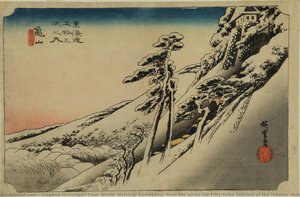
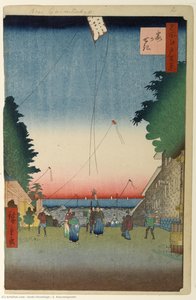
11Kadupuu ja õielised päiküvad (1800) autor HiroshigeKadupuu ja õielised päiküvad1800 · Indianapolis Kunstimuuseum 12The Pine Woods of Miho in Suruga Province (Suruga Miho no matsubara) (1858) autor HiroshigeThe Pine Woods of Miho in Suruga Province (Suruga Miho no matsubara)1858 · Indianapolis Kunstimuuseum 1362 (55) Komakata Hall and Azuma Bridge (1857) autor Hiroshige62 (55) Komakata Hall and Azuma Bridge1857 · Brooklyn Museum 14Evening Snow at Kanbara (1834) autor HiroshigeEvening Snow at Kanbara1834 · Los Angeles County Museum of Art 15Dawn in the licensed quarters (1857) autor HiroshigeDawn in the licensed quarters1857 · Art Gallery of New South Wales 16Night View of Saruwakacho autor HiroshigeNight View of Saruwakacho 17Station 28, Fukuroi (1855) autor HiroshigeStation 28, Fukuroi1855 · Indianapolis Kunstimuuseum 18Evening Snow at Asakusa or Woman with Umbrella from the series Eight Views of the Environs of Edo (1800) autor HiroshigeEvening Snow at Asakusa or Woman with Umbrella from the series Eight Views of the Environs of Edo1800 · Hill-Stead Museum 19Keishi (Kyoto), Capital (1834) autor HiroshigeKeishi (Kyoto), Capital1834 · Indianapolis Kunstimuuseum 20Hara: View of Ashitakayama and Fuji (1855) autor HiroshigeHara: View of Ashitakayama and Fuji1855 · Indianapolis Kunstimuuseum 21Yokkaichi (Station #44) (1834) autor HiroshigeYokkaichi (Station #44)1834 · Indianapolis Kunstimuuseum 22Desolate Wintry Scene, Hamamatsu, from the series the Fifty-three Stations of the Tokaido (Hoeido edition) autor HiroshigeDesolate Wintry Scene, Hamamatsu, from the series the Fifty-three Stations of the Tokaido (Hoeido edition)Nakagawa-machi Bato Hiroshige muuseum 23Noge and Yokohama in Musashi Province (Musashi, Noge, Yokohama) (1858) autor HiroshigeNoge and Yokohama in Musashi Province (Musashi, Noge, Yokohama)1858 · Indianapolis Kunstimuuseum 24Wild sea breaking on the rocks (1856) autor HiroshigeWild sea breaking on the rocks1856 25Шиомуза шиомидзука зу (1833) autor HiroshigeШиомуза шиомидзука зу1833 · Indianapolis Kunstimuuseum 26Mt.Fuji on the Left, Yoshiwara, from the series the Fifty-three Stations of the Tokaido (Hoeido edition) autor HiroshigeMt.Fuji on the Left, Yoshiwara, from the series the Fifty-three Stations of the Tokaido (Hoeido edition)Nakagawa-machi Bato Hiroshige muuseum 27Tsukuda Offing in the Eastern Capital (Tōto: Tsukuda oki) (1858) autor HiroshigeTsukuda Offing in the Eastern Capital (Tōto: Tsukuda oki)1858 · Indianapolis Kunstimuuseum 28Kawachi (1853) autor HiroshigeKawachi1853 · Indianapolis Kunstimuuseum 29The Dye Craft Shops of Arimatsu, Narumi, from the series The Fifty-three Stations of the Tokaido (Gyosho edition) autor HiroshigeThe Dye Craft Shops of Arimatsu, Narumi, from the series The Fifty-three Stations of the Tokaido (Gyosho edition)Nakagawa-machi Bato Hiroshige muuseum 30View of Shiomi Slope, Shirasuka, from the series The Fifty-three Stations of the Tokaido (Gyosho edition) autor HiroshigeView of Shiomi Slope, Shirasuka, from the series The Fifty-three Stations of the Tokaido (Gyosho edition)Nakagawa-machi Bato Hiroshige muuseum 31Entrance to Enoshima in Sagami Province (Sagami Enoshima iriguchi) (1858) autor HiroshigeEntrance to Enoshima in Sagami Province (Sagami Enoshima iriguchi)1858 · Indianapolis Kunstimuuseum 32Morning Mist, Mishima, from the series the Fifty-three Stations of the Tokaido (Hoeido edition ) autor HiroshigeMorning Mist, Mishima, from the series the Fifty-three Stations of the Tokaido (Hoeido edition )Nakagawa-machi Bato Hiroshige muuseum 33The Imagire Sea Ferry, Maisaka, from the series The Fifty-three Stations of the Tokaido (Gyosho edition) autor HiroshigeThe Imagire Sea Ferry, Maisaka, from the series The Fifty-three Stations of the Tokaido (Gyosho edition)Nakagawa-machi Bato Hiroshige muuseum 34Sukiya Riverbank in the Eastern Capital (Tōto sukiya kaigan) (1858) autor HiroshigeSukiya Riverbank in the Eastern Capital (Tōto sukiya kaigan)1858 · Indianapolis Kunstimuuseum 35Satta Pass, Yui, from the series the Fifty-three Stations of the Tokaido (Hoeido edition) autor HiroshigeSatta Pass, Yui, from the series the Fifty-three Stations of the Tokaido (Hoeido edition)Nakagawa-machi Bato Hiroshige muuseum 36True View of Imagire, Maisaka, from the series the Fifty-three Stations of the Tokaido (Hoeido edition) autor HiroshigeTrue View of Imagire, Maisaka, from the series the Fifty-three Stations of the Tokaido (Hoeido edition)Nakagawa-machi Bato Hiroshige muuseum 37Clear Winter Morning, Kameyama, from the series the Fifty-three Stations of the Tokaido (Hoeido edition) autor HiroshigeClear Winter Morning, Kameyama, from the series the Fifty-three Stations of the Tokaido (Hoeido edition)Nakagawa-machi Bato Hiroshige muuseum 38The Tenryu River, Mitsuke, from the series the Fifty-three Stations of the Tokaido (Hoeido edition) autor HiroshigeThe Tenryu River, Mitsuke, from the series the Fifty-three Stations of the Tokaido (Hoeido edition)Nakagawa-machi Bato Hiroshige muuseum 39The Seven-ri Ferry Crossing, Kuwana, from the series the Fifty-three Stations of the Tokaido (Hoeido edition) autor HiroshigeThe Seven-ri Ferry Crossing, Kuwana, from the series the Fifty-three Stations of the Tokaido (Hoeido edition)Nakagawa-machi Bato Hiroshige muuseum 40Aronia and Bullfinch autor HiroshigeAronia and Bullfinch 41Kadaka kohustus jõudnud tüübid (1834) autor HiroshigeKadaka kohustus jõudnud tüübid1834 · Indianapolis Kunstimuuseum 42Yugyoji Temple, Fujisawa, from the series the Fifty-three Stations of the Tokaido (Hoeido edition) autor HiroshigeYugyoji Temple, Fujisawa, from the series the Fifty-three Stations of the Tokaido (Hoeido edition)Nakagawa-machi Bato Hiroshige muuseum 43Travellers and Soliciting Women, Goyu, from the series the Fifty-three Stations of the Tokaido (Hoeido edition) autor HiroshigeTravellers and Soliciting Women, Goyu, from the series the Fifty-three Stations of the Tokaido (Hoeido edition)Nakagawa-machi Bato Hiroshige muuseum 44The Totoumi Bank of the Oi River, Kanaya, from the series the Fifty-three Stations of the Tokaido (Hoeido edition) autor HiroshigeThe Totoumi Bank of the Oi River, Kanaya, from the series the Fifty-three Stations of the Tokaido (Hoeido edition)Nakagawa-machi Bato Hiroshige muuseum 45The Suruga Bank of the Oi River, Shimada, from the series the Fifty-three Stations of the Tokaido (Hoeido edition) autor HiroshigeThe Suruga Bank of the Oi River, Shimada, from the series the Fifty-three Stations of the Tokaido (Hoeido edition)Nakagawa-machi Bato Hiroshige muuseum 46Kyoka Tokaido Series, Kanagawa (Yokohama) autor HiroshigeKyoka Tokaido Series, Kanagawa (Yokohama)Indianapolis Kunstimuuseum 47Distant View of Miho, Ejiri, from the series the Fifty-three Stations of the Tokaido (Hoeido edition) autor HiroshigeDistant View of Miho, Ejiri, from the series the Fifty-three Stations of the Tokaido (Hoeido edition)Nakagawa-machi Bato Hiroshige muuseum 48Mt. Fuji in the Morning, Hara, from the series the Fifty-three Stations of the Tokaido (Hoeido edition) autor HiroshigeMt. Fuji in the Morning, Hara, from the series the Fifty-three Stations of the Tokaido (Hoeido edition)Nakagawa-machi Bato Hiroshige muuseum 49A Horse Fair, Chiriu, from the series the Fifty-three Stations of the Tokaido (Hoeido edition) autor HiroshigeA Horse Fair, Chiriu, from the series the Fifty-three Stations of the Tokaido (Hoeido edition)Nakagawa-machi Bato Hiroshige muuseum 50Wakasa (1853) autor HiroshigeWakasa1853 · Indianapolis Kunstimuuseum 51Distant View of Mt.Akiba, Kakegawa, from the series the Fifty-three Stations of the Tokaido (Hoeido edition) autor HiroshigeDistant View of Mt.Akiba, Kakegawa, from the series the Fifty-three Stations of the Tokaido (Hoeido edition)Nakagawa-machi Bato Hiroshige muuseum 52The Ichiri-Han Sea Ferry, Arai, from the series The Fifty-three Stations of the Tokaido (Gyosho edition) autor HiroshigeThe Ichiri-Han Sea Ferry, Arai, from the series The Fifty-three Stations of the Tokaido (Gyosho edition)Nakagawa-machi Bato Hiroshige muuseum 53Gateway Entrance to the Atsuta Shrine on the Beach, Miya, from the series The Fifty-three Stations of the Tokaido (Gyosho edition) autor HiroshigeGateway Entrance to the Atsuta Shrine on the Beach, Miya, from the series The Fifty-three Stations of the Tokaido (Gyosho edition)Nakagawa-machi Bato Hiroshige muuseum 54Akasaka, from the series The Fifty-three Stations of the Tokaido (Gyosho edition) autor HiroshigeAkasaka, from the series The Fifty-three Stations of the Tokaido (Gyosho edition)Nakagawa-machi Bato Hiroshige muuseum 55The Sakawa River, Odawara, from the series the Fifty-three Stations of the Tokaido (Hoeido edition) autor HiroshigeThe Sakawa River, Odawara, from the series the Fifty-three Stations of the Tokaido (Hoeido edition)Nakagawa-machi Bato Hiroshige muuseum 56A Footpath between Ricefield, Hiratsuka, from the series the Fifty-three Stations of the Tokaido (Hoeido edition) autor HiroshigeA Footpath between Ricefield, Hiratsuka, from the series the Fifty-three Stations of the Tokaido (Hoeido edition)Nakagawa-machi Bato Hiroshige muuseum 57Awa Province: Whirlpool at Naruto (1853) autor HiroshigeAwa Province: Whirlpool at Naruto1853 5873 The City Flourishing, the Tanabata Festival (1857) autor Hiroshige73 The City Flourishing, the Tanabata Festival1857 59Sarugababa Plain, Futagawa, from the series the Fifty-three Stations of the Tokaido (Hoeido edition) autor HiroshigeSarugababa Plain, Futagawa, from the series the Fifty-three Stations of the Tokaido (Hoeido edition)Nakagawa-machi Bato Hiroshige muuseum 60Local Specialty Teahouse, Mariko, from the series the Fifty-three Stations of the Tokaido (Hoeido edition) autor HiroshigeLocal Specialty Teahouse, Mariko, from the series the Fifty-three Stations of the Tokaido (Hoeido edition)Nakagawa-machi Bato Hiroshige muuseum 61Sakanoshita autor HiroshigeSakanoshitaIndianapolis Kunstimuuseum 62Станция 23, Фуджида autor HiroshigeСтанция 23, ФуджидаIndianapolis Kunstimuuseum 63Marsh Grasses and Mandarin Ducks autor HiroshigeMarsh Grasses and Mandarin Ducks 6450th station, Minakuchi autor Hiroshige50th station, Minakuchi 65Sakanoshita: the Throwing Away the Brush Peak (1834) autor HiroshigeSakanoshita: the Throwing Away the Brush Peak1834 · Brooklyn Museum 66Shibaura Bay of Musashi Province (801) autor HiroshigeShibaura Bay of Musashi Province801 · Metropolitan Museum of Art 67Koyurugi Beach of Sagami Province (801) autor HiroshigeKoyurugi Beach of Sagami Province801 · Metropolitan Museum of Art 68Honmoku Bay of Musashi Province (801) autor HiroshigeHonmoku Bay of Musashi Province801 · Metropolitan Museum of Art 69Untitled (Two Rabbits, Pampas Grass, and Full Moon) (1851) autor HiroshigeUntitled (Two Rabbits, Pampas Grass, and Full Moon)1851 7011. Kiyomizu Hall and Shinobazu Pond at Ueno (1857) autor Hiroshige11. Kiyomizu Hall and Shinobazu Pond at Ueno1857 7185. Kinokuni Hill and Distant View of Akasaka and the Tameike Pond (1857) autor Hiroshige85. Kinokuni Hill and Distant View of Akasaka and the Tameike Pond1857 7276 Bamboo Quay by Kyōbashi Bridge (1857) autor Hiroshige76 Bamboo Quay by Kyōbashi Bridge1857 7358 (52) Sudden Shower over Shin-Ōhashi bridge and Atake (1857) autor Hiroshige58 (52) Sudden Shower over Shin-Ōhashi bridge and Atake1857 · Tokyo Fuji Art Museum 74103. Senju Great Bridge (1857) autor Hiroshige103. Senju Great Bridge1857 7518. The Ōji Inari Shrine (1857) autor Hiroshige18. The Ōji Inari Shrine1857 76113. Aoi Slope Outside Toranomon Gate (1857) autor Hiroshige113. Aoi Slope Outside Toranomon Gate1857 77114. Bikuni Bridge in Snow (1857) autor Hiroshige114. Bikuni Bridge in Snow1857 7870 (60) The Mouth of the Nakagawa River (1857) autor Hiroshige70 (60) The Mouth of the Nakagawa River1857 792. Kasumigaseki (1857) autor Hiroshige2. Kasumigaseki1857 8015. Suwa Bluff in Nippori (1857) autor Hiroshige15. Suwa Bluff in Nippori1857 8163 (69) The Ayase River and Kanegafuchi (1857) autor Hiroshige63 (69) The Ayase River and Kanegafuchi1857 82115. The Takata Riding Grounds (1857) autor Hiroshige115. The Takata Riding Grounds1857 8386. Naitō Shinjuku in Yotsuya (1857) autor Hiroshige86. Naitō Shinjuku in Yotsuya1857 8416. Flower Park and Dangozaka Slope in Sendagi (1857) autor Hiroshige16. Flower Park and Dangozaka Slope in Sendagi1857 8568 (59) Open Garden at the Hachiman Shrine in Fukagawa (1857) autor Hiroshige68 (59) Open Garden at the Hachiman Shrine in Fukagawa1857 8610. Sunrise at Kanda Myōjin Shrine (1857) autor Hiroshige10. Sunrise at Kanda Myōjin Shrine1857 87Peach and Long-tailed Bird autor HiroshigePeach and Long-tailed Bird 88Golden Pheasant in Bracken autor HiroshigeGolden Pheasant in Bracken 89The Imado Bridge at the Foot of Mount Matsuchi (801) autor HiroshigeThe Imado Bridge at the Foot of Mount Matsuchi801 · Metropolitan Museum of Art 90Dog (1858) autor HiroshigeDog1858 · Indianapolis Kunstimuuseum 91118. Kitsunebi on New Year's Night Under the Enoki Tree near Ōji (1857) autor Hiroshige118. Kitsunebi on New Year's Night Under the Enoki Tree near Ōji1857 92109. Minami Shinagawa and Samezu Coast (1857) autor Hiroshige109. Minami Shinagawa and Samezu Coast1857 93Night View of Matsuchiyama and the San (1857) autor HiroshigeNight View of Matsuchiyama and the San1857 · Los Angeles County Museum of Art 94Akasaka, No. 37 autor HiroshigeAkasaka, No. 37Indianapolis Kunstimuuseum 95Shiojiri Pass in Shinano Province (Shinano Shiojiritōge) (1858) autor HiroshigeShiojiri Pass in Shinano Province (Shinano Shiojiritōge)1858 · Indianapolis Kunstimuuseum 96Yoshiwara autor HiroshigeYoshiwaraIndianapolis Kunstimuuseum 97Fuchu, No. 20 autor HiroshigeFuchu, No. 20Indianapolis Kunstimuuseum 98Woman Walking in the Snow (1850) autor HiroshigeWoman Walking in the Snow1850 · Metropolitan Museum of Art 9982. Moon Viewing (1857) autor Hiroshige82. Moon Viewing1857 100Station 27, Kakegawa (1855) autor HiroshigeStation 27, Kakegawa1855 · Indianapolis Kunstimuuseum

Hiroshige kuulsaimad maalid ajastult ajastule

Teemad, mis püüdisid Hiroshige pilma

Neli teemat, mis esinevad neis originaalkindel kõige sagedamini, ning iga teema parim näide.

Muuseumid, kus on säilitatud Hiroshige originaalteosed

Kümne 8 muuseumi kollektsioonid, mis sisaldavad kõige rohkem sellel lehel esitatud teoseid.

Muuseumid Linn Hiroshige teosid Selle nimekirja maalid
Nakagawa-machi Bato Hiroshige muuseum, NagasakiNakagawa-machi Bato Hiroshige muuseum Nagasaki 30 Early Department from a Daimyo, The Rokugo River Ferry, Kawasaki, from the series the Fifty-three Stations of the Tokaido (Hoeido edition ), Tenryu River Ferry Crossing, Mitsuke, from the series The Fifty-three Stations of the Tokaido (Gyosho Edition)
Indianapolis Kunstimuuseum, IndianapolisIndianapolis Kunstimuuseum Indianapolis 35 Hakone, Station 36, Goyu; Kyoka Tokaido Series, Fushimi Staadion #51
Metropolitan Museum of Art, New YorkMetropolitan Museum of Art New York 8 Shibaura Bay of Musashi Province, Koyurugi Beach of Sagami Province, Honmoku Bay of Musashi Province
Brooklyn Museum, BrooklynBrooklyn Museum Brooklyn 4 Itsukushima in Aki Province, 62 (55) Komakata Hall and Azuma Bridge, Sakanoshita: the Throwing Away the Brush Peak
Hill-Stead Museum, FarmingtonHill-Stead Museum Farmington 3 Shinagawa Sunrise from the series Fifty-three Stations on the Tokaido Road, Evening Snow at Asakusa or Woman with Umbrella from the series Eight Views of the Environs of Edo
Los Angeles County Museum of Art, Los AngelesLos Angeles County Museum of Art Los Angeles 2 Evening Snow at Kanbara, Night View of Matsuchiyama and the San
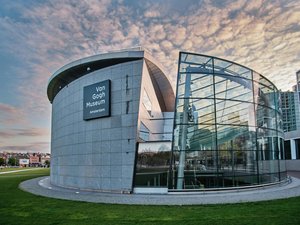
Van Gogh muuseum, AmsterdamVan Gogh muuseum Amsterdam 1 The maple leaves of Mama, Tekona shrine and Tsugi bridge
Art Gallery of New South Wales, SydneyArt Gallery of New South Wales Sydney 1 Dawn in the licensed quarters

Hiroshige, iga kümnendiga üks signatuurpilt

Teosed aastakate kaupa

Vali vuosakülg, et näha selle ajastu definieerivat originaalteost.

Hiroshige maalid: galerii vastused

Milline Hiroshige maal on kõige kuulsam?Paljasta vastus

Early Department from a Daimyo, Nakagawa-machi Bato Hiroshige muuseum, Nagasaki. Järgnevad The maple leaves of Mama, Tekona shrine and Tsugi bridge (1857) ja Hakone (1834).

Millised on Hiroshige top 10 maali?Paljasta vastus

Early Department from a Daimyo, The maple leaves of Mama, Tekona shrine and Tsugi bridge, Hakone, Station 36, Goyu; Kyoka Tokaido Series, Fushimi Staadion #51, Ichikoku Bridge in the Eastern Capital (Tōto: Ichikoku bashi), Shinagawa Sunrise from the series Fifty-three Stations on the Tokaido Road, The Rokugo River Ferry, Kawasaki, from the series the Fifty-three Stations of the Tokaido (Hoeido edition ), Itsukushima in Aki Province ja Tenryu River Ferry Crossing, Mitsuke, from the series The Fifty-three Stations of the Tokaido (Gyosho Edition). Ülemine reiting näitab iga teose puhul aastat ja muuseumi.

Kui palju teoseid Hiroshige lõi?Paljasta vastus

Meie kataloogist leiate 353 teost kunstnikult Hiroshige, mis on pärinevad ajastust 1833 kuni 1858.

Kust leiad Hiroshige kõige kuulsamad originaalteosed?Paljasta vastus

Peamiselt Nakagawa-machi Bato Hiroshige muuseum (Nagasaki), Indianapolis Kunstimuuseum (Indianapolis) ja Metropolitan Museum of Art (New York) muuseumites. Ülalpool olevate muuseumite tabelis on nendest kõik loetletud.

Millal lõi Hiroshige oma kuulsamad maalid?Paljasta vastus

Ajal 1850s: 44 100 sellel lehel olevat teost on sellel perioodil loodud, მათart közül The maple leaves of Mama, Tekona shrine and Tsugi bridge.

Millised on Hiroshige varased ja hilised kuulsad teosed?Paljasta vastus

Sellel lehel on kõige vanem teos Шиомуза шиомидзука зу (1833) ja kõige värskeim Ichikoku Bridge in the Eastern Capital (Tōto: Ichikoku bashi) (1858).

Millist teemat Hiroshige kõige rohkem käsitledas?Paljasta vastus

Landscape (33), Edo period (31) ja Japanese landscape (27), kogu selle lehekülje 100 teose kohta.

Millises tehnikas töötas Hiroshige kõige rohkem?Paljasta vastus

Woodblock Print, 62 teoseks 100 töödelt sellel lehel.

Millise suunaga on Hiroshige seotud?Paljasta vastus

Ukiyo-e, seda lähtudes selle lehe originaalteostest.

Milliseid Hiroshige originaalte Nakagawa-machi Bato Hiroshige muuseum kogumuses on?Paljasta vastus

Early Department from a Daimyo, The Rokugo River Ferry, Kawasaki, from the series the Fifty-three Stations of the Tokaido (Hoeido edition ) ja Tenryu River Ferry Crossing, Mitsuke, from the series The Fifty-three Stations of the Tokaido (Gyosho Edition): Nakagawa-machi Bato Hiroshige muuseum, Nagasaki säilitab 29 selle lehel olevat teost.

Hiroshige: kunstnik

Edo Jaapani poetiline visioon: Utagawa Hiroshige elu ja kunst

Utagawa Hiroshige, kes sündis 1797. aastal Edo puldavas linnas (tänapäeva Tokyo) kui Andō Tokutarō, seisab ukiyo-e ehk "ujuvate maailmade piltide" maailmas kui murdiliseks kujundajaks. Kuigi Hiroshige oli sügavalt juurdunud Jaapani puutrintide traditsioonides, suutis ta astuda üle pelgast kopeerimise piiri, täites oma maastikud poetilise tundlikusega, mis kõlastas nii Jaapanit kui hiljem ka Lääne kunstimaailma. Tema elu lavastus toimus Tokugawa šogunaadi ajastul, mis oli suhteeliselt rahupaiga ja prosperiteedi aeg, kuid samas ka sotsiaalse muutuse ja lõplikust ländistumise periood – jõud, mis lõpuks aitas kaasa ukiyo-e lagunemisele, kuid samas võimendades Hiroshigi püsivat pärandit. Algul oli samurai perekonnas sündinud mehel ette nähtud konventsionaalne tee – tema isa teenis tulevapi inspektorina –, kuid Hiroshigi kunstiline kalduvus juhtis ta õpilasse kudu alla Utagawa kooli meistrile Utagawa Toyohirole. See tõitus oli otsustav pöördepunkt, suunates teda eemale paljude ukiyo-e kunstnike eelistatud kurvidide ja näitlejate populaarsetest kujutlustest ja viies teda maastikugendri poole, mille ta lõpuks uuesti defineeris.

žanriteenedest kütklevate maastikudeni

Hiroshide varajased tööd järgnesid oma koolkonnad konventsioonidele, pakkudes portrette ja igapäevast elu stseene. Kuid just tema armastus maastiku vastu eristas teda teistest tõeliselt. Olles mõjutatud varasematest meistritest nagu Hokusai – kelle "Fuji mäe kolmkümmend kuus vaadet" oli juba publikut lummamas – arendas Hiroshige unikaalset stiili, mida iseloomustas atmosfääriline perspektiiv, peened värvipaletid ja sügav tundlikkus muutuvatele jahistustele. Ta ei kujutanud lihtsalt kohti; ta kutsumustas nende meeleolu, tabades konkreetse hetke olemust. Seeria "Tōkaidō ellukakski asemikuks" (1833–1834), kes on ehk tema kõige pidustatatum saavutus, illustreerib seda lähenemist. See monumentaalne teos dokumenteeris Teekonks Tōkaidō reisitud teel, mis oli peamine marsruut Edo ja Kyoto vahel, mitte lihtsalt reisikiri, vaid kütklevate viinetite kogum – äkiline vihmavale Shonos, kauge vaade Fuji mäele Kanayast või Odawaras puldikas elu. Iga trükis on tunda ajalisuse ja vaikse ilu tunnet, kutsumates vaatajat kogema seda teekonda koos reisijatega. Ta kasutas meisterlikult bokashi-tehnikat, mis hõlmas mitmeid trükke peente värvigradientide loomiseks, lisades oma kompositsioonidele sügavust ja atmosfääri.

Atmosfääri ja tehnika meistari

Hiroshige tehniline oskus oli sama hämmastav kui tema kunstiline visioon. Ta ei olnud huvitatud pelgalt täpsest esitlusest; ta püüdis tabada kohale asja *tunde*. Tema värvide kasutamine, ehkki sageli kergelt piiratud võrreldes mõne tema kaaslasega, oli selle efekti saavutamisel määrav. Ta kasutas tihti mitut trükilatti üksi värv, võimaldades luua nüansseeritud toonid ja atmosfäärseid efekte, mida oli uskumatult raske kopeerida. Delikaatsed sinised lavedad tema vihma või udu kujutlustes, sügislehe soojad toonid – need ei olnud juhuslikud; need olid hoolikalt läbi mõeldud elemendid, mis olid loodud tekitama konkreetseid emotsioone ja tundeid. Lisaks bokashi-tehnikale oli Hiroshige osav kasutama tühja ruumi ehk ma-d – kontsepti, mis on Jaapani esteetika keskne element –, võimaldades trükil olevatel aladel "hingata" ja tõstes ülevat rahu tunnet. Tema seeria "Edo sada kuulsat vaadet" (1856–1858) näitas tema meistriklassi veelgi suuremalt, pakkudes intiimseid pilkusid tema armastatud linna elule ja maastikule.

Püsiv pärand: Japonisme ja edasi

Kuigi ukiyo-e traditsioon hakkas pärast Hiroshige surma 1858. aastal vähenema – seda langust kiirendas Meiji restaureerimine ja järgnev Lääne kultuuri voog –, tõtus tema mõju kunstimaailmale uskumatult püsivaks. 19. sajandi lõpus tulid Jaapani trükid Euroopasse, tekitades nähtuse, mida tuntakse kui japonism. Kunstnikud nagu Édouard Manet, Claude Monet ja Edgar Degas olid lummatuses ukiyo-e julgete kompositsioonide, lamedate perspektiivide ja ebatraditsiooniliste värgiskeemide üle, integreerides neid elemente oma töödesse. Vincent van Gogh oli eriti vapustatud Hiroshige trükkidest, luues mitmeid koopiaid, sealhulgas teost "Kameido kirsipuupark", demonstreerides oma sügavat imetlust Jaapani meistri värvikasutuse ja kompositsiooni vastu. Hiroshide mõju ulatus kaugemale kui ainult maalidust; seda võib näha arhitektuuris, disainis ja isegi kirjanduses. Täna mäletatakse Utagawa Hiroshiget mitte ainult geniaalse kunstnikuna, vaid ka kultuuriambassadorina, kes aitas sulgada tühikut ida ja läpi, jättes tematu jälje kunstile. Tema rahustavad maastikud inspireerivad edasi kummardust ja mõtlemist, tuletades meid meel inimklassikaga maailma ilu ja ajalisuse vastu.

Olulised teosed

  • Tōkaidō ellukakski asemikku: Hiroshige kuulsim seeria, mis kujutab Teekonda Tōkaidō Edo ja Kyoto vahel.
  • Edo sada kuulsat vaadet: Kütklev kujutis tema armastatud linna elust ja maastikutest.
  • Mõju Vincent van Goghi Japonaiserie seerial: Sealhulgas teos "Kirsipuu pärast Hiroshiget", mis demonstreerib Van Goghi sügavat imetlust Jaapani meistri vastu.