

1

Uuendatud oktoober 2026 · järjestatud meie populaarsusindeksi järgi (otsingud, külastused ja tellimused igale teosele) · 15 teost Clarence John Laughlin meie kataloogis
Lühidalt
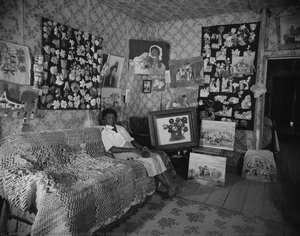
Galleriist vaadatuna on Clarence John Laughlin kõige kuulsam teos The World of a Primitive Painter, Number Two. Clementine Hunter at Home (1952), mille originaal ripub The Historic New Orleans Collection-is, New Orleans. Fairyland in Iron and Glass (1973) ja Around a Hole in Space (Circus World Museum) (1973) täidavad kolmikut, mille iga silm tunnistab. Kunstnii Clarence John Laughlin 15 teose põhjal esitleb galeriis allpool 15 kõige kuulsumat, kus iga originaal on märgitud aastaga, muuseumiga ja kirjeldatud, mis teeb selle unikaalseks.


Neli teemat, mis esinevad neis originaalkindel kõige sagedamini, ning iga teema parim näide.
Kümne 2 muuseumi kollektsioonid, mis sisaldavad kõige rohkem sellel lehel esitatud teoseid.
| Muuseumid | Linn | Clarence John Laughlin teosid | Selle nimekirja maalid |
|---|---|---|---|
 Ogden Museum of Southern Art |
New Orleans | 2 | The Unending Stream, Apparition of Disaster 1 (Belle Grove Plantation) |
 The Historic New Orleans Collection |
New Orleans | 1 | The World of a Primitive Painter, Number Two. Clementine Hunter at Home |
Vali vuosakülg, et näha selle ajastu definieerivat originaalteost.
The World of a Primitive Painter, Number Two. Clementine Hunter at Home (1952), The Historic New Orleans Collection, New Orleans. Järgnevad Fairyland in Iron and Glass (1973) ja Around a Hole in Space (Circus World Museum) (1973).
47 aastat vanus: teos The World of a Primitive Painter, Number Two. Clementine Hunter at Home on pärinev aastast 1952 ning Clarence John Laughlin sündis aastal 1905.
The World of a Primitive Painter, Number Two. Clementine Hunter at Home, Fairyland in Iron and Glass, Around a Hole in Space (Circus World Museum), The Door of the Strong Headed Cherub (Chicago, Ill.), The Unending Stream, Untitled (Girl in Window), The Mirror of Long Ago, Black Floating over White, Language of American Victorianism (Chicago, Ill.) ja The Tree of Immensity (Baton Rouge, La.). Ülemine reiting näitab iga teose puhul aastat ja muuseumi.
Meie kataloogist leiate 15 teost kunstnikult Clarence John Laughlin, mis on pärinevad ajastust 1941 kuni 1973.
Peamiselt Ogden Museum of Southern Art (New Orleans) ja The Historic New Orleans Collection (New Orleans) muuseumites. Ülalpool olevate muuseumite tabelis on nendest kõik loetletud.
Ajal 1940s: 5 15 sellel lehel olevat teost on sellel perioodil loodud, მათart közül The Unending Stream.
Sellel lehel on kõige vanem teos The Unending Stream (1941) ja kõige värskeim Fairyland in Iron and Glass (1973).
Surrealism, seda lähtudes selle lehe originaalteostest.
The Unending Stream ja Apparition of Disaster 1 (Belle Grove Plantation): Ogden Museum of Southern Art, New Orleans säilitab 2 selle lehel olevat teost.
Clarence John Laughlin (1905 – 1985) wasn’t merely a photographer; he was an architect of atmosphere, a conjurer of forgotten landscapes and spectral narratives. Born in Lake Charles, Louisiana, into a family grappling with the sudden loss of their rice-growing fortune, Laughlin's early life instilled within him a profound sense of melancholy and a deep connection to the evocative spirit of the American South. This formative period—marked by his father’s death at a young age and the subsequent relocation to New Orleans—shaped his artistic vision, imbuing his work with an undercurrent of nostalgia, mystery, and a haunting beauty that continues to resonate today.
Laughlin's creative journey began unexpectedly in his mid-twenties. Initially aspiring to be a writer, influenced by the stylistic flourishes of French symbolism—a passion nurtured by his father’s literary pursuits—he found himself drawn to the art of photography. Self-taught and meticulously observant, he quickly mastered the basics of a 2½ by 2¼ view camera, transforming it into a tool for capturing not just images, but entire worlds. His early work focused on architectural details, showcasing a keen eye for composition and an appreciation for geometric forms. However, Laughlin soon abandoned these constraints, embracing a more ambitious approach—staging elaborate allegories populated with models, costumes, and props, creating surreal scenes that blurred the lines between reality and fantasy.
Laughlin’s most enduring legacy lies in his exploration of Southern folklore, history, and the intangible essence of place. He wasn't interested in simply documenting landscapes; he sought to evoke a feeling—a sense of longing for a bygone era, a whisper of ghostly encounters, and an appreciation for the region’s complex and often contradictory identity. His photographs frequently featured decaying mansions, overgrown cemeteries, and shadowy figures, creating a distinctly melancholic atmosphere that became his signature style. He drew inspiration from Eugène Atget, whose documentation of Parisian street life offered a model for capturing the fading beauty of urban spaces, but Laughlin uniquely applied this lens to the rural South.
A pivotal moment in Laughlin’s career came with the publication of *Ghosts Along the Mississippi* (1948), a collection of 100 black and white images that cemented his reputation as a visionary artist. This book, a meticulously crafted exploration of Louisiana's plantation architecture, wasn’t just a visual record; it was an attempt to capture the lingering memories embedded within these structures—the echoes of generations past, the weight of history, and the enduring power of storytelling. Laughlin deliberately layered historical narratives with imagined scenarios, creating a dreamlike quality that blurred the boundaries between fact and fiction.
Throughout his career, Laughlin cultivated close relationships with fellow artists and photographers. Dody Weston Thompson, a talented model and photographer in her own right, became a frequent collaborator, lending her beauty and presence to many of his staged compositions. His work also benefited from the influence of Edward Steichen, whose time at Vogue magazine provided Laughlin with valuable exposure and experience. However, he ultimately rejected the constraints of commercial photography, prioritizing personal projects that allowed him to fully realize his artistic vision.
Laughlin’s photographic style was characterized by a deliberate use of light and shadow, often employing dramatic contrasts to heighten the sense of mystery and drama. He frequently utilized techniques such as double exposure and multiple printing processes to create layered images with complex textures and visual effects. His meticulous attention to detail—from the careful selection of props to the precise positioning of models—contributed to the overall atmosphere of his photographs, transforming them into immersive experiences for the viewer.
Clarence John Laughlin’s impact on American photography is profound and enduring. He is widely considered one of the pioneers of surrealist photography in the United States, a genre that challenged conventional notions of representation and explored the realm of dreams and imagination. His work continues to be exhibited and studied by art historians and enthusiasts alike, captivating audiences with its haunting beauty and evocative storytelling. Following his death in 1985, Louisiana State University acquired his vast collection of over 30,000 books, a testament to Laughlin’s intellectual curiosity and the breadth of his artistic interests—ranging from science fiction and fantasy to European architecture and the occult.
A particularly notable example of Laughlin's work is the pair of photographs depicting a 1939 Ford, where the photographer's reflection appears within the image. These photographs were appraised at $7,000 - $9,000 in 2013 and are now considered priceless artifacts, offering a glimpse into the artist’s unique vision and his masterful manipulation of light and shadow.


