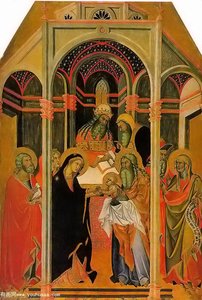
Bartolo Di Fredi portree

Bartolo Di Fredi maalid: 29 kuulsumat teost galeriin läbi

Uuendatud november 2026 · järjestatud meie populaarsusindeksi järgi (otsingud, külastused ja tellimused igale teosele) · 32 teost Bartolo Di Fredi meie kataloogis

Lühidalt

Galleriist vaadatuna on Bartolo Di Fredi kõige kuulsam teos The Annunciation to Joachim (1383), mille originaal ripub Vatikani Pinakoteek-is, Vatikan. The Holy Trinity (Trinity Altarpiece) (1350) ja Saint Dominic (Trinity altarpiece) (1350) täidavad kolmikut, mille iga silm tunnistab. Kunstnii Bartolo Di Fredi 32 teose põhjal esitleb galeriis allpool 29 kõige kuulsumat, kus iga originaal on märgitud aastaga, muuseumiga ja kirjeldatud, mis teeb selle unikaalseks.

1330 – 1410, Siena Sienese school Enamama teoseid: Vatikani Pinakoteek

Galeria 10 parimat Bartolo Di Fredi maali

1
The Annunciation to Joachim (1383) autor Bartolo Di Fredi

The Annunciation to Joachim

1383 · Tempera On Panel · Vatikani Pinakoteek, Vatikan

In the delicate interplay of light and shadow within The Annunciation to Joachim, we are transported back to the year 1383, into the heart of a spiritual awakening. This exquisite work by the Sienese master Bartolo di Fredi captures a moment of profound celestial communication, where the earthly and the divine converge. The scene unfolds with a rhythmic grace, presenting a landscape populated not just by figures, but by a…

2
The Holy Trinity (Trinity Altarpiece) (1350) autor Bartolo Di Fredi

The Holy Trinity (Trinity Altarpiece)

1350 · Tempera On Panel · Musée des beaux-arts de Chambéry, Chambery

The composition is structured around a rigid, symmetrical hierarchy that defines the spiritual order of the late Gothic period. At the center, God the Father sits upon a stepped, architectural throne, supporting the weight of the wooden cross. Upon this cross, Christ is crucified, a central focus of the theological narrative. Flanking this central group are the figures of Mary and Saint John the Evangelist, their presence framing the sacrifice.…

3
Saint Dominic (Trinity altarpiece) (1350) autor Bartolo Di Fredi

Saint Dominic (Trinity altarpiece)

1350 · Tempera On Panel · Musée des beaux-arts de Chambéry, Chambery

The Saint Dominic (Trinity altarpiece) emerges from the late fourteenth century, a period where the Sienese School continues to whisper its sacred traditions. Painted by Bartolo di Fredi, this work exists as a polyptych of four panels, a structure that organizes the divine into distinct, readable moments. The artist, a prominent figure in the artistic life of Siena, Italy, brings a specific sense of order to this devotional object. It…

5
The crucifixion (1377) autor Bartolo Di Fredi

The crucifixion

1377 · Tempera On Panel · Lindenau museum, Altenburg

The crucifixion, executed by Bartolo di Fredi in 1377, represents a significant contribution to the Sienese School. Working from Siena, Italy, the artist developed a style that moved away from the heavy, concrete figures of his predecessors. Instead, Fredi favored flatter, decorative compositions that emphasized an otherworldly quality. This approach allowed for a focus on symbolic beauty rather than strict physical realism.

7
The Adoration of the Magi (1385) autor Bartolo Di Fredi

The Adoration of the Magi

1385 · Tempera On Panel · Polesden Lacey

The scene unfolds through The Adoration of the Magi, a work that carries the hand of the Sienese painter Bartolo di Fredi. Created around 1385, the painting captures a moment of profound spiritual encounter. Within this sacred space, the Magi offer their reverence to the infant Jesus, a central event that anchors the entire composition. The figures move through a landscape that feels both physical and celestial, drawing the eye…

8
Seven Saints in Adoration (1385) autor Bartolo Di Fredi

Seven Saints in Adoration

1385 · Tempera On Panel · Library of Virginia, Richmond

The tempera on panel depicts seven holy figures arranged in a dense, overlapping composition. These figures are positioned within a shallow space, creating a sense of layered depth through their physical placement. Each saint is rendered with a distinct profile or three-quarter view, their gazes directed upward in a gesture of prayerful adoration. The background consists of a flat, gilded surface, where gold leaf forms both the setting and the…

9
Scenes from the Life of Sacred Hermits (1385) autor Bartolo Di Fredi

Scenes from the Life of Sacred Hermits

1385 · Tempera On Panel · Gemäldegalerie, Berliin

The panel unfolds in three distinct vignettes, a narrative sequence carved from the ruggedness of the Sienese landscape. Dark, jagged outcroppings of rock rise like teeth against a sky of luminous gold leaf. Within these stony enclosures, ascetic figures dwell in quiet contemplation. The earth is rendered in deep ochres and browns, a somber stage for the spiritual drama of the hermits. A lion rests near a figure, its presence…

10
Scenes from the Life of Sacred Hermits (1380) autor Bartolo Di Fredi

Scenes from the Life of Sacred Hermits

1380 · Tempera On Panel · Gemäldegalerie, Berliin

The panel titled Scenes from the Life of Sacred Hermits presents a series of quiet, spiritual vignettes. This work is attributed to the workshop of Bartolo di Fredi, a painter active in Siena, Italy. The scenes likely emerged from the artist's studio around 1380. Within the busy movement of the workshop, the hand of the artist's son, Andrea, may have brushed these surfaces alongside his father.

Bartolo Di Fredi maalid, järjestus 11 kuni 29

Bartolo Di Fredi kuulsaimad maalid ajastult ajastule

Teemad, mis püüdisid Bartolo Di Fredi pilma

Neli teemat, mis esinevad neis originaalkindel kõige sagedamini, ning iga teema parim näide.

Muuseumid, kus on säilitatud Bartolo Di Fredi originaalteosed

Kümne 8 muuseumi kollektsioonid, mis sisaldavad kõige rohkem sellel lehel esitatud teoseid.

Muuseumid Linn Bartolo Di Fredi teosid Selle nimekirja maalid
Vatikani Pinakoteek, VatikanVatikani Pinakoteek Vatikan 2 The Annunciation to Joachim, Nativity and Adoration of the Shepherds
Musée des beaux-arts de Chambéry, ChamberyMusée des beaux-arts de Chambéry Chambery 2 The Holy Trinity (Trinity Altarpiece), Saint Dominic (Trinity altarpiece)
Gemäldegalerie, BerliinGemäldegalerie Berliin 2 Scenes from the Life of Sacred Hermits, Scenes from the Life of Sacred Hermits
Metropolitan Museum of Art, New YorkMetropolitan Museum of Art New York 2 Saint Mary Magdalen, Untitled (D2XAHZ)
Museo Civico e Diocesano d'Arte Sacra, MontalcinoMuseo Civico e Diocesano d'Arte Sacra Montalcino 2 The Coronation of the Virgin, The Coronation of the Virgin (detail)
Musée du Petit Palais, AvignonMusée du Petit Palais Avignon 1 The Virgin of the Annunciation
Lindenau museum, AltenburgLindenau museum Altenburg 1 The crucifixion
Rhode Island School of Design Museum of Art, ProvidenceRhode Island School of Design Museum of Art Providence 1 Madonna and Child

Bartolo Di Fredi, iga kümnendiga üks signatuurpilt

Teosed aastakate kaupa

Vali vuosakülg, et näha selle ajastu definieerivat originaalteost.

Bartolo Di Fredi maalid: galerii vastused

Milline Bartolo Di Fredi maal on kõige kuulsam?Paljasta vastus

The Annunciation to Joachim (1383), Vatikani Pinakoteek, Vatikan. Järgnevad The Holy Trinity (Trinity Altarpiece) (1350) ja Saint Dominic (Trinity altarpiece) (1350).

Kui vana Bartolo Di Fredi oli teose The Annunciation to Joachim valmimisel?Paljasta vastus

53 aastat vanus: teos The Annunciation to Joachim on pärinev aastast 1383 ning Bartolo Di Fredi sündis aastal 1330.

Millised on Bartolo Di Fredi top 10 maali?Paljasta vastus

The Annunciation to Joachim, The Holy Trinity (Trinity Altarpiece), Saint Dominic (Trinity altarpiece), The Virgin of the Annunciation, The crucifixion, Madonna and Child, The Adoration of the Magi, Seven Saints in Adoration, Scenes from the Life of Sacred Hermits ja Scenes from the Life of Sacred Hermits. Ülemine reiting näitab iga teose puhul aastat ja muuseumi.

Kui palju teoseid Bartolo Di Fredi lõi?Paljasta vastus

Meie kataloogist leiate 32 teost kunstnikult Bartolo Di Fredi, mis on pärinevad ajastust 1350 kuni 1400.

Kust leiad Bartolo Di Fredi kõige kuulsamad originaalteosed?Paljasta vastus

Peamiselt Vatikani Pinakoteek (Vatikan), Musée des beaux-arts de Chambéry (Chambery) ja Gemäldegalerie (Berliin) muuseumites. Ülalpool olevate muuseumite tabelis on nendest kõik loetletud.

Millal lõi Bartolo Di Fredi oma kuulsamad maalid?Paljasta vastus

Ajal 1380s: 11 29 sellel lehel olevat teost on sellel perioodil loodud, მათart közül The Annunciation to Joachim.

Millised on Bartolo Di Fredi varased ja hilised kuulsad teosed?Paljasta vastus

Sellel lehel on kõige vanem teos The Holy Trinity (Trinity Altarpiece) (1350) ja kõige värskeim Saint Mary Magdalen (1400).

Millist teemat Bartolo Di Fredi kõige rohkem käsitledas?Paljasta vastus

Gold background (9), Woman (7) ja Religious scene (5), kogu selle lehekülje 29 teose kohta.

Millises tehnikas töötas Bartolo Di Fredi kõige rohkem?Paljasta vastus

Tempera On Panel, 15 teoseks 29 töödelt sellel lehel.

Millise suunaga on Bartolo Di Fredi seotud?Paljasta vastus

Sienese school, seda lähtudes selle lehe originaalteostest.

Milliseid Bartolo Di Fredi originaalte Vatikani Pinakoteek kogumuses on?Paljasta vastus

The Annunciation to Joachim ja Nativity and Adoration of the Shepherds: Vatikani Pinakoteek, Vatikan säilitab 2 selle lehel olevat teost.

Bartolo Di Fredi: kunstnik

The Luminous Legacy of Bartolo di Fredi

In the heart of fourteenth-century Tuscany, a period defined by the transition from the ethereal grace of the Gothic era to the burgeoning humanism of the Renaissance, Bartolo di Fredi emerged as a master of light and narrative. Born in Siena around 1330, he was more than just a painter; he was a bridge between two worlds. His work, often characterized by an otherworldly luminosity and a meticulous devotion to detail, captured the spiritual fervor of his age while introducing a decorative complexity that would leave an indelible mark on the Sienese School. To gaze upon a Fredi masterpiece is to enter a realm where the sacred and the ornamental dance in perfect, gilded harmony.

The foundations of his career were deeply rooted in the prestigious guilds of Siena. By 1355, he had officially entered the Arte dei Maestri di Tavola e Dipinto, a milestone that granted him access to the most significant patronage networks in Italy. This professional stability allowed him to collaborate with other luminaries of the era, such as Andrea Varga, on monumental projects like the decoration of the Siena Cathedral. These early years were formative, as he absorbed the aristocratic elegance of Simone Martini and the foundational traditions of Duccio, refining a style that rejected the coldness of strict realism in favor of a more emotive, symbolic beauty.

A Master of Fresco and Narrative Drama

Perhaps the most breathtaking testament to Fredi’s genius is found within the walls of the San Gimignano Cathedral. Between 1356 and 1367, he undertook an ambitious cycle of frescoes that transformed the left aisle into a vivid biblical tapestry. In these works, such as the visceral Killing of the Servants of Job, one can witness his ability to command large-scale compositions with intense dramatic tension. He did not merely depict scenes; he orchestrated them, using color and movement to guide the viewer through stories of profound suffering and divine intervention. His technique in these frescoes showcased an early mastery of illusionistic space, pushing the boundaries of what the Gothic style could achieve.

Beyond the monumental scale of his frescoes, Fredi excelled in the intimate medium of altarpieces. His Annunciation (1383) serves as a quintessential example of his ability to blend the sacred with the exquisite. In this work, the use of light is not merely a technical feat but a theological tool, illuminating the delicate details of the Virgin’s surroundings and creating an atmosphere of profound sanctity. His approach to panel painting allowed for a level of ornamentation—gold leaf, intricate patterns, and fine linework—that satisfied the era's craving for splendor while maintaining a deep, spiritual focus.

Historical Significance and Artistic Influence

The historical importance of Bartolo di Fredi lies in his role as a stylistic pivot. While he remained loyal to the decorative traditions that defined Sienese art, he possessed an innate curiosity for the evolving techniques of his time. He stood at the crossroads of history, preserving the delicate, dreamlike qualities of the late Gothic period while preparing the ground for the more structured, human-centric approach of the Renaissance. His ability to synthesize these opposing forces created a unique visual language that was both nostalgic and forward-looking.

Today, his contributions are recognized as essential components of the Tuscan artistic identity. The legacy of Bartolo di Fredi can be summarized through several key pillars of his impact:

  • Stylistic Synthesis: He successfully merged the aristocratic elegance of the Sienese tradition with a new, more dynamic narrative energy.
  • Narrative Innovation: His fresco cycles in San Gimignano redefined how biblical stories could be told through large-scale, emotionally charged imagery.
  • Decorative Mastery: He elevated the use of color and ornamentation, making the altarpiece a vessel for both devotion and aesthetic wonder.
  • Cultural Continuity: As a prominent member of the Sienese guilds, he helped maintain the prestige of Tuscan art during a period of significant social and artistic transition.

Though the tides of art history eventually moved toward the intense realism of later masters, the luminous, enchanted world created by Bartolo di Fredi remains a vital chapter in the story of Western art, reminding us of a time when painting was a window into the divine.