


1


Uuendatud oktoober 2026 · järjestatud meie populaarsusindeksi järgi (otsingud, külastused ja tellimused igale teosele) · 36 teost Alan Davie meie kataloogis
Lühidalt
Galleriile on Alan Davie kõige kuulsam teos Woman Arranging Flowers (1945). Untitled Abstract ja Self Portrait with Brushes (1937) täidavad kolmikut, mille iga silm tunnistab. Kunstnii Alan Davie 36 teose põhjal esitleb galeriis allpool 36 kõige kuulsumat, kus iga originaal on märgitud aastaga, muuseumiga ja kirjeldatud, mis teeb selle unikaalseks.


 Joe's Magic Lantern1961
12
 Joe's Lucky Dip1961
13
 Keep Your Fingers Crossed1961
14
 Hopi Studies No.32, Opus 0.11731991 · University of Hertfordshire
15
 Hopi Studies No.30 (Big Blue) (Opus O.1171)1991
16
 Homage to an Earth Goddess No.61992
17
 Symbols in a Landscape1994 · The Pier Arts Centre
18
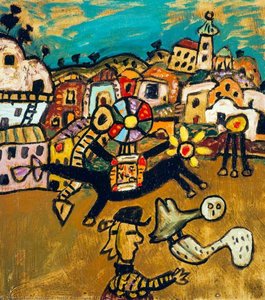 Village Witch (Opus O.1263)1994
19
 Magic Casket1997 · Šoti Rahvusgalerii
20
 Celtic Landscape (Dreamscape)1996 · The Pier Arts Centre
21
 Magic Landscape (Opus O.1337)1996
22
 The Alchemist's Mirror No.1 (Opus 1357)1997
23
 Cosmic Signals I2000
24
 Cosmic Signals No.72000
25
 The Golden Palace1999
26
 Magician's Mirror No.22000 · The Mercer Art Gallery
27
 Serpent's Idea of a Horse2000
28
 The Magician's Mirror No.3 (Opus 1450)2000
29
 Without Devices2004 · Pembroke College Oxford Jcr Art Collection
30
 Around and Around in the PinkKanada Rahvusgalerii
31
 Kaleidoscope for a Parrot
32
 Prize for a Serpent
33
 Flowers on a TableThe Fleming Collection
34Prophet in a Tree, 1963Fitzwilliam College
35
 Double MonumentRobinson College
36
 Hallucination with Monster and Cock
Kümne 8 muuseumi kollektsioonid, mis sisaldavad kõige rohkem sellel lehel esitatud teoseid.
| Muuseumid | Linn | Alan Davie teosid | Selle nimekirja maalid |
|---|---|---|---|
 The Pier Arts Centre |
Stromness | 2 | Symbols in a Landscape, Celtic Landscape (Dreamscape) |
 University of Hertfordshire |
North Hatley | 1 | Hopi Studies No.32, Opus 0.1173 |
 Šoti Rahvusgalerii |
Edinburgh | 1 | Magic Casket |
 The Mercer Art Gallery |
Harrogate | 1 | Magician's Mirror No.2 |
 Pembroke College Oxford Jcr Art Collection |
Oxford | 1 | Without Devices |
 Kanada Rahvusgalerii |
Ottawa | 1 | Around and Around in the Pink |
 The Fleming Collection |
London | 1 | Flowers on a Table |
 Fitzwilliam College |
Cambridge | 1 | Prophet in a Tree, 1963 |
Vali vuosakülg, et näha selle ajastu definieerivat originaalteost.
Woman Arranging Flowers (1945). Järgnevad Untitled Abstract ja Self Portrait with Brushes (1937).
25 aastat vanus: teos Woman Arranging Flowers on pärinev aastast 1945 ning Alan Davie sündis aastal 1920.
Woman Arranging Flowers, Untitled Abstract, Self Portrait with Brushes, The Saint, Entrance to a Paradise, Jingling Space, Ram Grip, Piggy Chain, Joy Bag No. 1 ja Entrance For A Red Temple No. 4. Ülemine reiting näitab iga teose puhul aastat ja muuseumi.
Meie kataloogist leiate 36 teost kunstnikult Alan Davie, mis on pärinevad ajastust 1937 kuni 2004.
Peamiselt The Pier Arts Centre (Stromness), University of Hertfordshire (North Hatley) ja Šoti Rahvusgalerii (Edinburgh) muuseumites. Ülalpool olevate muuseumite tabelis on nendest kõik loetletud.
Ajal 1990s: 10 36 sellel lehel olevat teost on sellel perioodil loodud, მათart közül Hopi Studies No.32, Opus 0.1173.
Sellel lehel on kõige vanem teos Self Portrait with Brushes (1937) ja kõige värskeim Without Devices (2004).
Abstract expressionism, seda lähtudes selle lehe originaalteostest.
Symbols in a Landscape ja Celtic Landscape (Dreamscape): The Pier Arts Centre, Stromness säilitab 2 selle lehel olevat teost.

