


1


Uuendatud november 2026 · järjestatud meie populaarsusindeksi järgi (otsingud, külastused ja tellimused igale teosele) · 10 teost Ottilie Roederstein meie kataloogis
Lühidalt
Galleriist vaadatuna on Ottilie Roederstein kõige kuulsam teos Portrait of a Painter in a Parisian Studio (1887), mille originaal ripub Städel Museum-is, Frankfurt. Self-Portrait with a Hat (1904) ja Le Mois de Marie (1905) täidavad kolmikut, mille iga silm tunnistab. Kunstnii Ottilie Roederstein 10 teose põhjal esitleb galeriis allpool 10 kõige kuulsumat, kus iga originaal on märgitud aastaga, muuseumiga ja kirjeldatud, mis teeb selle unikaalseks.


Old Man with Pipe is an oil on canvas painting by the artist Ottilie Roederstein. This work measures 16 1/8 x 12 7/8 in. (41 x 32.7 cm). The piece was created about 1898.


This oil on canvas portrait depicts Albert Clifford Barney, a male subject presented in a waist-length composition. The work was executed by the German-Swiss painter Ottilie Wilhelmina Roederstein about 1900. The subject is positioned centrally, facing the viewer with a steady gaze. He is dressed in a heavy, dark coat featuring a thick fur trim and a white formal shirt visible at the collar.

Neli teemat, mis esinevad neis originaalkindel kõige sagedamini, ning iga teema parim näide.
Kümne 3 muuseumi kollektsioonid, mis sisaldavad kõige rohkem sellel lehel esitatud teoseid.
| Muuseumid | Linn | Ottilie Roederstein teosid | Selle nimekirja maalid |
|---|---|---|---|
 Städel Museum |
Frankfurt | 5 | Portrait of a Painter in a Parisian Studio, Self-Portrait with a Hat, Portrait of the Painter Jakob Nussbaum |
 Smithsonian American Art Museum |
Washington, D.C. | 2 | Old Man with Pipe, Albert Clifford Barney |
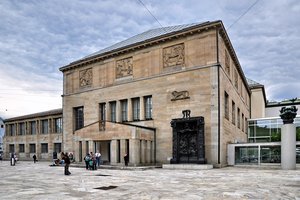 Kunsthaus Zürich |
Zürich | 1 | Self-Portrait with Brushes |
Vali vuosakülg, et näha selle ajastu definieerivat originaalteost.
Old Man with Pipe is an oil on canvas painting by the artist Ottilie Roederstein. This work measures 16 1/8 x 12 7/8 in. (41 x 32.7 cm). The piece was created about 1898.
Portrait of a Painter in a Parisian Studio (1887), Städel Museum, Frankfurt. Järgnevad Self-Portrait with a Hat (1904) ja Le Mois de Marie (1905).
28 aastat vanus: teos Portrait of a Painter in a Parisian Studio on pärinev aastast 1887 ning Ottilie Roederstein sündis aastal 1859.
Portrait of a Painter in a Parisian Studio, Self-Portrait with a Hat, Le Mois de Marie, Their Daily Bread, Portrait of the Painter Jakob Nussbaum, Self-portrait with Folded Arms, Old Man with Pipe, Self-portrait with keys, Albert Clifford Barney ja Self-Portrait with Brushes. Ülemine reiting näitab iga teose puhul aastat ja muuseumi.
Meie kataloogist leiate 10 teost kunstnikult Ottilie Roederstein, mis on pärinevad ajastust 1887 kuni 1936.
Peamiselt Städel Museum (Frankfurt), Smithsonian American Art Museum (Washington, D.C.) ja Kunsthaus Zürich (Zürich) muuseumites. Ülalpool olevate muuseumite tabelis on nendest kõik loetletud.
Ajal 1900s: 5 10 sellel lehel olevat teost on sellel perioodil loodud, მათart közül Self-Portrait with a Hat.
Sellel lehel on kõige vanem teos Portrait of a Painter in a Parisian Studio (1887) ja kõige värskeim Self-portrait with keys (1936).
Portrait (3) ja Man (2), kogu selle lehekülje 10 teose kohta.
Oil On Canvas, 3 teoseks 10 töödelt sellel lehel.
Portrait of a Painter in a Parisian Studio, Self-Portrait with a Hat ja Portrait of the Painter Jakob Nussbaum: Städel Museum, Frankfurt säilitab 5 selle lehel olevat teost.
In the grand, often male-dominated tapestry of nineteenth-century European art, few threads shine with as much quiet resilience and technical brilliance as that of Ottilie Wilhelmine Roederstein. Born in Frankfurt, Germany, in 1859, Roederstein emerged during an era when the path for female artists was fraught with systemic barriers. Yet, through an unwavering dedication to her craft, she transcended these limitations to become a celebrated German-Swiss painter whose work continues to resonate with profound emotional depth and technical mastery. Her journey was not merely one of personal ambition, but a pioneering voyage that helped redefine the presence of women in the fine arts of Germany and Switzerland.
Roederstein’s artistic development was characterized by a sophisticated command of oil on canvas, a medium she utilized to explore the nuances of light, texture, and human character. Her style, often noted for its evocative nature, moved beyond simple representation to capture the psychological essence of her subjects. Whether through delicate portraiture or more complex figurative compositions, her brushwork possessed a unique ability to convey depth and nuance, inviting the viewer into a contemplative dialogue with the painted image. This mastery allowed her to navigate the transition between traditional academic styles and the burgeoning expressive movements of her time.
The life of Roederstein was as rich and complex as the paintings she produced. Beyond the studio, her personal history played a significant role in shaping her worldview and artistic perspective. She shared a long-term, profound companionship with Elisabeth Winterhalter, a figure of great importance as one of the first female doctors in Germany. This relationship provided Roederstein with a stable emotional foundation and a connection to the progressive intellectual circles of her day. Such intimacy and support likely nurtured the introspective qualities found within her work, allowing her to approach portraiture with a level of empathy and insight that was rare among her contemporaries.
Her legacy is not only found in the pigments on canvas but in the historical significance of her role as a trailblazer. By establishing a successful professional career during a period of intense social transition, she served as a vital precursor for future generations of women artists. Her ability to command respect within the European art scene ensured that her voice—and the voices of those who followed—could be heard in the prestigious galleries and museums of Germany and Switzerland.
Today, the works of Ottilie Roederstein serve as a window into a bygone era of artistic refinement. While her paintings are held within various esteemed museum collections, such as the Gemäldegalerie Alte Meister in Germany, her influence extends far beyond the gallery walls. For those seeking to connect with her enduring spirit, high-quality reproductions offer a way to bring her evocative mastery into the modern home.
The appreciation of her art involves recognizing several key elements of her contribution to history:
Through the careful preservation and reproduction of her works, the legacy of Roederstein remains vibrant, ensuring that her contribution to the history of European painting is never forgotten.


