Nicolas Tarkhoff portree

Nicolas Tarkhoff maalid: 42 kuulsumat teost galeriin läbi

Uuendatud november 2026 · järjestatud meie populaarsusindeksi järgi (otsingud, külastused ja tellimused igale teosele) · 42 teost Nicolas Tarkhoff meie kataloogis

Lühidalt

Galleriile on Nicolas Tarkhoff kõige kuulsam teos Madame Tarkhoff with Her Two Children Jean and Boris (1907). Madame Tarkhoff and Her Child (1906) ja La Place du Maine, Paris täidavad kolmikut, mille iga silm tunnistab. Kunstnii Nicolas Tarkhoff 42 teose põhjal esitleb galeriis allpool 42 kõige kuulsumat, kus iga originaal on märgitud aastaga, muuseumiga ja kirjeldatud, mis teeb selle unikaalseks.

1871 – 1930, Moskva Post-impressionism

Galeria 10 parimat Nicolas Tarkhoff maali

1
Madame Tarkhoff with Her Two Children Jean and Boris (1907) (autor) Nicolas Tarkhoff

Madame Tarkhoff with Her Two Children Jean and Boris

1907 · Oil

The composition centers on a woman reclining within the confines of a bed. She is positioned toward the left side of the frame, her body angled to accommodate two children. One child is situated more centrally, appearing awake, while the second child lies toward the right side of the bed in a state of sleep. The woman’s hand is visible in the lower portion of the scene, making contact with…

2
Madame Tarkhoff and Her Child (1906) (autor) Nicolas Tarkhoff

Madame Tarkhoff and Her Child

1906 · Oil

The room holds a heavy, peaceful stillness as a woman reclines upon a bed, her form draped in a deep blue dress. She cradles her infant close to her chest, the two of them sharing a private, soft space amidst the folds of bedding. Sunlight or perhaps a soft lamp filters through the room, catching the texture of the fabric and the gentle curve of a neck adorned with a…

3
La Place du Maine, Paris (autor) Nicolas Tarkhoff

La Place du Maine, Paris

Oil

The canvas depicts a street scene within La Place du Maine in Paris. A horse-drawn carriage occupies the right side of the composition, moving along a paved road. Two horses are positioned toward the left, one leading the other in a staggered formation. Several figures are scattered throughout the urban environment. Some individuals stand near the carriage, while others walk or remain stationary at varying distances from the center of…

4
Merry Go Round in Montmarnasse (1901) (autor) Nicolas Tarkhoff

Merry Go Round in Montmarnasse

1901 · Oil On Canvas

The scene unfolds in the bustling heart of Paris through the work titled Merry Go Round in Montmarnasse. Painted by Nicolas Tarkhoff in 1901, this piece captures a fleeting snapshot of Parisian daily life. The energy of the city pulses through the composition, freezing a moment of public spectacle amidst the urban rush. It is a glimpse into a bygone era, where the excitement of modern life gathers around the…

5
Goats in the Sunshine (1904) (autor) Nicolas Tarkhoff

Goats in the Sunshine

1904 · Oil On Canvas

The canvas presents a group of white goats gathered closely around a basket. This basket contains hay or grain, positioned at the center of the animals' activity. The goats are densely packed, their forms overlapping to create a sense of immediate movement within the frame. Sunlight hits the white coats of the animals, creating bright highlights that contrast against the darker shadows cast by their bodies. The background consists of…

6
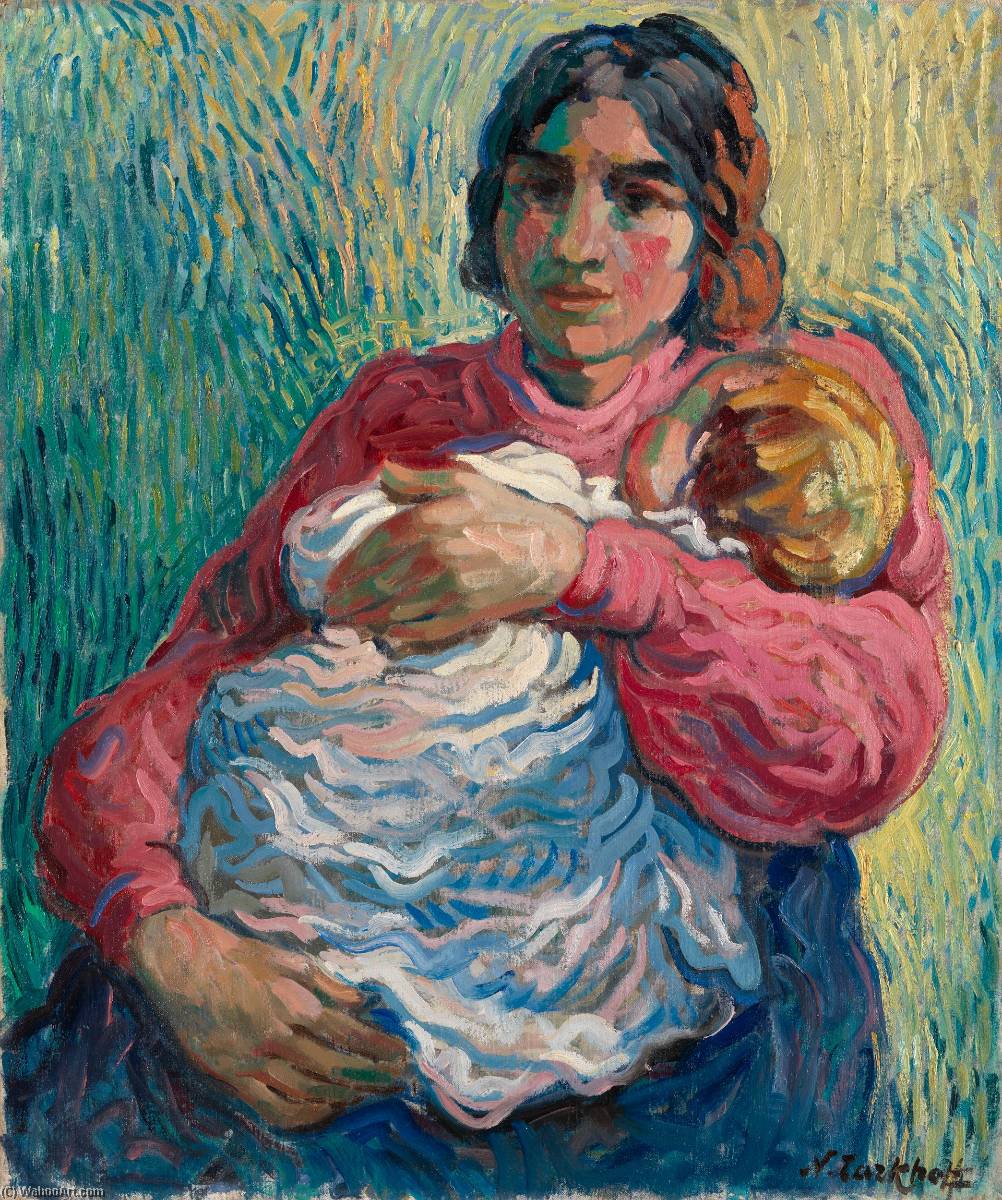
Motherhood (1906) (autor) Nicolas Tarkhoff

Motherhood

1906 · Oil On Canvas

A woman holds her infant child in this 1906 oil painting, creating an intimate connection through a centered, shallow composition. The figures emerge from a textured, vertical green field that provides a stark contrast to the organic forms of the subjects. Thick, visible brushstrokes define the contours of the mother and child, emphasizing movement and energy over precise realism. The impasto technique creates a tactile surface, where layers of paint…

7
The Kiss (autor) Nicolas Tarkhoff

The Kiss

Oil

The painting moves beyond mere depiction to capture a specific atmosphere. Through the use of bold color and varied brushwork, the artist imbues the scene with a sense of warmth and stillness. The interplay between the light hitting the mother and the shadows within the room creates a sense of movement within a frozen moment. It is a work that prioritizes the feeling of the encounter—the weight of the child,…

8
Street Carnival, Paris (autor) Nicolas Tarkhoff

Street Carnival, Paris

Oil

The bustling energy of a Parisian celebration finds its expression in Street Carnival, Paris, a work by the artist Nicolas Tarkhoff. This oil painting captures a moment of urban life, existing now in the public domain. The scene pulses with the movement of a city in flux, frozen in a way that invites the viewer to step directly into the crowd.

9
Faubourg Saint Antoine (1905) (autor) Nicolas Tarkhoff

Faubourg Saint Antoine

1905 · Oil

Painted in 1905, Faubourg Saint Antoine presents a vibrant street scene set within an urban environment. The composition is framed by buildings lining both sides of a road, their facades punctuated by numerous windows, some of which remain open to the street. The scene captures a bustling atmosphere where various elements of city life coexist in a single moment.

10
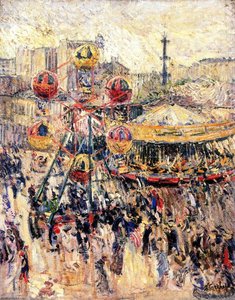
Fair (1905) (autor) Nicolas Tarkhoff

Fair

1905 · Oil

The canvas presents a crowded carnival scene centered around a large, multi-level Ferris wheel. This central structure dominates the composition, its circular frame populated by several figures seated at various heights. Around the base of the wheel, a collection of at least thirteen people are distributed throughout the space. Some individuals stand in close proximity to the machinery, while others are scattered toward the periphery of the scene. To the…

Nicolas Tarkhoff maalid, järjestus 11 kuni 42

Nicolas Tarkhoff kuulsaimad maalid ajastult ajastule

Teemad, mis püüdisid Nicolas Tarkhoff pilma

Neli teemat, mis esinevad neis originaalkindel kõige sagedamini, ning iga teema parim näide.

Nicolas Tarkhoff, iga kümnendiga üks signatuurpilt

Teosed aastakate kaupa

Vali vuosakülg, et näha selle ajastu definieerivat originaalteost.

Nicolas Tarkhoff maalid: galerii vastused

Milline Nicolas Tarkhoff maal on kõige kuulsam?Paljasta vastus

Madame Tarkhoff with Her Two Children Jean and Boris (1907). Järgnevad Madame Tarkhoff and Her Child (1906) ja La Place du Maine, Paris.

Kui vana Nicolas Tarkhoff oli teose Madame Tarkhoff with Her Two Children Jean and Boris valmimisel?Paljasta vastus

36 aastat vanus: teos Madame Tarkhoff with Her Two Children Jean and Boris on pärinev aastast 1907 ning Nicolas Tarkhoff sündis aastal 1871.

Millised on Nicolas Tarkhoff top 10 maali?Paljasta vastus

Madame Tarkhoff with Her Two Children Jean and Boris, Madame Tarkhoff and Her Child, La Place du Maine, Paris, Merry Go Round in Montmarnasse, Goats in the Sunshine, Motherhood, The Kiss, Street Carnival, Paris, Faubourg Saint Antoine ja Fair. Ülemine reiting näitab iga teose puhul aastat ja muuseumi.

Kui palju teoseid Nicolas Tarkhoff lõi?Paljasta vastus

Meie kataloogist leiate 42 teost kunstnikult Nicolas Tarkhoff, mis on pärinevad ajastust 1899 kuni 1912.

Millal lõi Nicolas Tarkhoff oma kuulsamad maalid?Paljasta vastus

Ajal 1900s: 21 42 sellel lehel olevat teost on sellel perioodil loodud, sellest Madame Tarkhoff with Her Two Children Jean and Boris.

Millised on Nicolas Tarkhoff varased ja hilised kuulsad teosed?Paljasta vastus

Sellel lehel on kõige vanem teos Landscape with Houses (1899) ja kõige värskeim Landscape with Trees, Flowers and Peasant with Plough (1912).

Millist teemat Nicolas Tarkhoff kõige rohkem käsitledas?Paljasta vastus

People (12), Woman (6) ja Child (6), kogu selle lehekülje 42 teose kohta.

Millises tehnikas töötas Nicolas Tarkhoff kõige rohkem?Paljasta vastus

Oil, 22 teoseks 42 töödelt sellel lehel.

Millise suunaga on Nicolas Tarkhoff seotud?Paljasta vastus

Post-impressionism, seda lähtudes selle lehe originaalteostest.

Nicolas Tarkhoff: kunstnik

Early Life and Artistic Awakening

Nicolas Alexandrovich Tarkhoff, born in Moscow on January 20, 1871, emerged from a family of prosperous merchants—a background that initially seemed destined for commerce rather than canvas. However, the young Tarkhoff possessed an innate artistic inclination, described as a “fervent desire to be a painter.” Tragedy marked his childhood; he lost his mother at age three and his father eight years later, experiences that perhaps fostered a sensitivity reflected in his later work. Despite this early loss, his passion for art persisted, though it faced initial resistance from his family who favored more conventional paths. He briefly fulfilled military obligations before finding employment with the Brest-Litovsk Railways—a period of deferment before fully embracing his artistic calling. In 1894, he bravely attempted entry into the School of Painting, Sculpture and Architecture in Moscow, but was rejected due to what was perceived as a “revolutionary temperament.” This rejection didn’t deter him; instead, it propelled him towards Konstantin Korovin's studio in 1897, where he found mentorship within Moscow’s vibrant artistic circles.

Parisian Influences and the Embrace of Post-Impressionism

The late 1890s witnessed a pivotal shift as Tarkhoff journeyed to Paris, a city already pulsating with avant-garde energy. He initially settled in Munich before permanently relocating to the French capital in November 1898. Paris offered not just a change of scenery but an immersion into a world brimming with artistic innovation. Though he enrolled at the Académie Julian under Jean-Paul Laurens, his independent spirit soon led him away from strict academic constraints. He also studied with Luc-Olivier Merson, yet it was the works of Van Gogh, Gauguin, and Cézanne that truly ignited his artistic evolution. These masters revealed “hidden talents” and charted a new course for Tarkhoff’s style—one characterized by expressive brushstrokes, bold color palettes, and an exploration of subjective experience. He quickly absorbed the lessons of Impressionism but moved beyond its purely optical concerns, embracing a more emotionally charged approach that would define his Post-Impressionist identity.

Themes and Techniques: Capturing Light and Emotion

Tarkhoff’s oeuvre is remarkably diverse, encompassing landscapes, genre scenes, still lifes, and portraits. However, certain themes consistently emerge—the bustling life of Paris, the tranquility of rural settings, and intimate moments of family connection. His Parisian paintings capture the energy of boulevards, carnivals, and racing cabs, while his later works reflect a settled life in Orsay, where he resided with his family from 1911. He masterfully employed oil paint to convey not just visual reality but also atmosphere and feeling. Textured brushwork became a hallmark of his style, creating surfaces that shimmered with light and movement. He wasn’t merely depicting scenes; he was translating emotions onto canvas. His use of color was equally significant—vibrant hues were often juxtaposed to create dynamic contrasts and evoke specific moods. Works like “Goats in the Sunshine” exemplify this approach, showcasing a rural idyll bathed in warm light and imbued with a sense of peacefulness. “My Family,” painted during his Russian Post-Impressionist period, reveals a heartwarming tenderness through its expressive style and careful attention to detail.

Recognition and Legacy

Nicolas Tarkhoff achieved considerable recognition during his lifetime, participating in numerous exhibitions across Europe. His work resonated with audiences who appreciated his unique blend of Impressionistic techniques and Post-Impressionist sensibilities. He exhibited at La Libre Esthétique in Paris, showcasing pieces like “Un Jour de neige” and “Notre-Dame,” alongside other prominent artists. Although not as widely celebrated as some of his contemporaries, Tarkhoff’s paintings continue to captivate viewers with their evocative power and emotional depth. His work is represented in various collections, including the Musée du Petit Palais, ensuring that his artistic vision endures for future generations. He stands as a testament to the enduring appeal of Post-Impressionism—a style that prioritized subjective experience and paved the way for modern art movements. His ability to capture serene moments and natural beauty through a unique artistic lens solidifies his place within the rich tapestry of early 20th-century Expressionism, offering a compelling glimpse into the heart and soul of an artist deeply connected to both the world around him and the emotions within.