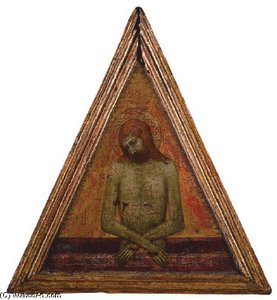
Naddo Ceccarelli emerged onto the artistic landscape of Siena in the mid-14th century, a period marked by fervent religious devotion and burgeoning urban sophistication. Precise biographical details remain elusive, shrouded in the mists of medieval documentation—information about his birth year is uncertain, estimated to be around 1320. However, what we know with relative confidence is that he received his formative artistic education under the tutelage of Simone Martini (ca. 1284–1344), arguably Siena’s most celebrated painter of the era. Martini's workshop was a crucible for innovation and stylistic refinement, attracting ambitious young artists eager to absorb his mastery. Ceccarelli’s association with Martini extended beyond mere instruction; he traveled alongside Martini to Avignon in 1330, immersing himself in the papal court’s artistic milieu—a pivotal experience that undoubtedly broadened his horizons and influenced his subsequent oeuvre.Simone Martini's influence is palpable in Ceccarelli's stylistic choices, particularly evident in his predilection for delicate color palettes and meticulous attention to detail.
Style and Technique
Ceccarelli’s artistic style can be characterized as a harmonious blend of Martini’s expressive grandeur and the more restrained elegance of the master of Palazzo Venezia and Memmi. He excelled in capturing the luminous quality of tempera paint, skillfully layering translucent glazes over gold leaf to achieve breathtaking effects of shimmering brilliance—a technique that mirrored the advancements occurring in goldsmithing at the time. This masterful manipulation of light was particularly evident in depictions of chain mail and other metallic embellishments, demonstrating a keen understanding of how to convey texture and materiality through pigment alone.His compositions are often characterized by serene stillness, reflecting the spiritual ethos of his era. Ceccarelli’s paintings frequently portray Madonna and Child figures—a motif deeply rooted in Marian devotion—often accompanied by saints. These small-scale panels stand apart from Martini's monumental works, suggesting a stylistic divergence driven by individual artistic sensibilities.
Notable features include:
Precise delineation of drapery folds
Subtle gradations of color
Delicate rendering of facial expressions
Major Works and Patronage
Two signed paintings by Ceccarelli’s hand—the Madonna and Child (formerly in the Cook Collection in Richmond, Surrey) dated to 1347 and Christ The Man Of Sorrows (Liechtenstein Collection, Vaduz)—provide invaluable insight into his artistic output. These masterpieces exemplify Ceccarelli's stylistic prowess and underscore his position as one of Martini’s workshop’s most accomplished pupils.
The Madonna and Child,
displays a masterful use of color and texture, capturing the ethereal beauty of Mary and Jesus with remarkable sensitivity.
is distinguished by its solemn expression and evocative depiction of sorrow—a testament to Ceccarelli’s ability to convey profound emotion through visual imagery.
Ceccarelli's work was commissioned primarily by ecclesiastical patrons,
reflecting the pervasive influence of religious faith on artistic production during the fourteenth century. The Madonna and Child with Saints (Pinacoteca Nazionale Siena) represents a larger-scale altarpiece, showcasing Ceccarelli’s ambition to undertake ambitious projects that would elevate his reputation.
Historical Significance
Naddo Ceccarelli's contribution to Sienese art is significant not only for its stylistic refinement but also for its embodiment of a broader cultural trend—the fusion of painting and goldsmithing. Like Martini and Memmi, Ceccarelli pioneered the innovative practice of incorporating gold leaf into panel paintings, transforming them into objects of devotional splendor.This approach reflects a shift away from traditional sculptural representations of saints, prioritizing visual narratives that conveyed spiritual meaning through luminous color and intricate ornamentation. Ceccarelli’s legacy endures as an exemplar of medieval artistic excellence—a painter who skillfully navigated the stylistic currents of his time while forging a distinctive artistic voice.His work serves as a reminder of Siena's role as a center for artistic innovation during the High Gothic period, securing its place in art history.