A Titan of Philippine Romanticism
Juan Luna de San Pedro y Novicio Ancheta (1857–1899) stands as one of the Philippines’s most celebrated artists, a figure whose dramatic canvases captured the spirit of his era and cemented his place in the annals of European art history. Born in Bacnotan, Pangadamente, Luna possessed an innate talent for visual storytelling from a young age—a passion nurtured by early studies at Escuela de Derecho in Manila before he decisively embraced the path of artistic excellence at Academia de Artes y Letras. His journey to Spain in 1877 marked a pivotal moment, propelling him into the orbit of the Real Academia de Bellas Artes de San Fernando where he honed his skills under luminaries like José María Sertor and Eduardo Hibbert Palmer, absorbing the stylistic precepts of European Romanticism and Academic painting.
Luna’s formative years were steeped in classical tradition yet simultaneously receptive to burgeoning Romantic ideals. He diligently studied anatomy and perspective—skills that would prove invaluable in his subsequent artistic endeavors. However, it was the 1884 Madrid Exposition of Fine Arts where Luna truly ascended to international prominence. Alongside Félix Resurrección Hidalgo, he secured a remarkable double victory – gold for ‘La Batalla de Mactan’ and silver for ‘Spoliarium’, marking an unprecedented achievement for Filipino artists abroad. These monumental paintings captivated audiences with their grandeur, theatrical composition, and masterful depiction of historical events—specifically Magellan's conquest of Cebu and the Roman Forum respectively—demonstrating Luna’s command of technique and his ability to convey profound emotion through visual imagery.
Mastery of Light and Emotion
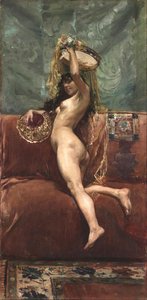
Luna’s artistic style is characterized by a striking blend of European academic conventions and Romantic fervor. He meticulously rendered anatomical detail with an intensity that breathed life into his subjects, often utilizing dramatic chiaroscuro to heighten the emotional stakes of his narratives. His work frequently moved between the epic scale of historical allegories and the intimate, soulful essence of portraiture. In pieces such as 'Feminine Figure', one can witness a contemplative stillness, where the artist captures the delicate textures of hair and skin, inviting the viewer into a moment of timeless beauty and quiet introspection.
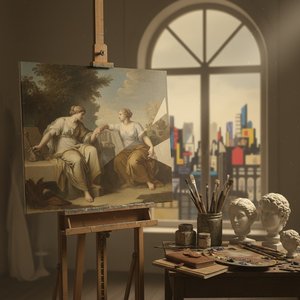
Beyond the purely aesthetic, Luna’s work often carried deep political and symbolic weight. His ability to weave complex themes of identity and colonial struggle into his compositions allowed him to speak to both the Filipino struggle for sovereignty and the broader human condition. A prime example is ‘España y Filipinas’ (Spain and the Philippines), a stunning 1884 oil painting that utilizes the romanticized imagery of two women to explore the intricate, often turbulent relationship between the colonizer and the colonized. Through rich textures and a masterful use of color, Luna transformed historical commentary into high art.
Legacy and Historical Significance
The legacy of Juan Luna extends far beyond the borders of the Philippines. As a pioneer who conquered the European art scene, he provided a sense of dignity and intellectual parity for Filipino artists during a period of intense colonial tension. His achievements served as a beacon of pride, proving that the artistry emerging from the archipelago could stand toe-to-toe with the masters of the West. His life, though marked by both immense triumph and personal tragedy, remains an essential chapter in the story of 19th-century art.
To understand Luna is to understand the intersection of art, politics, and national identity. His contributions can be summarized through several key pillars:
- Technical Excellence: His mastery of the Academic style, particularly in anatomy and perspective.
- Cultural Bridge: His role in bringing Filipino talent to the forefront of the international stage in Madrid and beyond.
- Symbolic Depth: The use of historical and allegorical themes to reflect contemporary political realities.
- Romantic Influence: The infusion of dramatic emotion and light into classical compositions.