Georges D'Espagnat portree

Georges D'Espagnat maalid: 50 kuulsumat teost galeriin läbi

Uuendatud november 2026 · järjestatud meie populaarsusindeksi järgi (otsingud, külastused ja tellimused igale teosele) · 50 teost Georges D'Espagnat meie kataloogis

Lühidalt

Galleriile on Georges D'Espagnat kõige kuulsam teos Untitled (A Set of Seven Decorative Panels) (1900). Tuna Vessels Saint-gilles Croix De Vié ja Girl Painting at an Easel (1910) täidavad kolmikut, mille iga silm tunnistab. Kunstnii Georges D'Espagnat 50 teose põhjal esitleb galeriis allpool 50 kõige kuulsumat, kus iga originaal on märgitud aastaga, muuseumiga ja kirjeldatud, mis teeb selle unikaalseks.

1870 – 1950, Melun Impressionism Enamama teoseid: Petit Palais

Galeria 10 parimat Georges D'Espagnat maali

1
Untitled (A Set of Seven Decorative Panels) (1900) autor Georges D'Espagnat

Untitled (A Set of Seven Decorative Panels)

1900 · Painting

A set of seven decorative panels captures a quiet moment of feminine connection. Within the composition, two women occupy the foreground; one sits upon a bench while the other stands beside her, their long dresses suggesting a bygone era of formal grace. A third figure lingers in the background, partially obscured, adding a layer of depth to the social tableau. The arrangement of figures creates a sense of private conversation,…

2
Tuna Vessels Saint-gilles Croix De Vié autor Georges D'Espagnat

Tuna Vessels Saint-gilles Croix De Vié

Oil On Canvas

The artwork Tuna Vessels Saint-gilles Croix De Vié is an impressionistic oil painting on canvas that captures a lively harbor scene. The composition is horizontally oriented, featuring a horizon line positioned near the center of the frame. In the foreground, several figures are situated near smaller boats, while the midground is occupied by larger vessels and various activities. The background shows additional boats receding into the distance, which creates a…

3
Girl Painting at an Easel (1910) autor Georges D'Espagnat

Girl Painting at an Easel

1910 · Oil

In this 1910 work, we find ourselves in a private, domestic space where time seems to have slowed. A woman sits before an easel, her attention entirely consumed by the canvas before her. There is a profound sense of focus in her posture, a stillness that suggests the world outside the room has ceased to exist. On the dining table nearby, a simple arrangement of two apples and a vase…

4
Woman Reading autor Georges D'Espagnat

Woman Reading

Oil On Canvas

We are looking at Woman Reading, a work by the French artist Georges D'Espagnat. This piece offers a quiet glimpse into the artist's ability to capture a private, domestic moment. D'Espagnat was born in Melun in 1870 and spent much of his life immersed in the French art scene, eventually passing away in Paris in 1950.

5
Femmes et enfants dans la terrasse du moulin de Beaulieu à Villennes sur Seine (1898) autor Georges D'Espagnat

Femmes et enfants dans la terrasse du moulin de Beaulieu à Villennes sur Seine

1898 · Oil On Canvas

The oil painting depicts a group of figures gathered on a terrace within a lush garden setting. In the center, four children and an adult woman are positioned together, focused on the act of collecting flowers. Nearby, another woman sits in a relaxed posture. A small dog is situated within the composition, adding to the domestic atmosphere. The scene is framed by trees that create a sense of enclosure around…

6
Woman and Child (1925) autor Georges D'Espagnat

Woman and Child

1925 · Oil On Canvas

In the quietude of a grassy landscape, the figures of Woman and Child emerge through the soft, hazy light of a distant afternoon. This work, painted by Georges D'Espagnat, captures a tender moment of connection set against a backdrop of rolling hills and a far-off castle. The scene feels suspended in time, as if the air itself holds its breath around the mother and her young one. It is a…

7
Woman and Children in an Orchard: Sketch for the Cloister of the Girls' School of Avenue Simon-Bolivar, 19th Arrondissement of Paris (1933) autor Georges D'Espagnat

Woman and Children in an Orchard: Sketch for the Cloister of the Girls' School of Avenue Simon-Bolivar, 19th Arrondissement of Paris

1933 · Oil · Petit Palais, Pariis

This landscape sketch, created in 1933, depicts a serene outdoor scene within an orchard. The composition is characterized by a roughly symmetrical arrangement, framed by two slender, arching trees that establish a natural border on the left and right sides of the image. Within this verdant setting, human figures are integrated into the lush vegetation: a woman is positioned on the left holding a child, while a young girl stands…

8
The Sewing: Sketch for the cloister of the girls' school on avenue Simon-Bolivar, 19th arrondissement of Paris (1933) autor Georges D'Espagnat

The Sewing: Sketch for the cloister of the girls' school on avenue Simon-Bolivar, 19th arrondissement of Paris

1933 · Oil · Petit Palais, Pariis

In this 1933 oil painting, a woman and a child are seated together on a bench within an outdoor setting. They are positioned beneath a canopy formed by the arching branches of trees, which frame the central figures. The woman and child appear engaged in a quiet activity, specifically sewing. The scene is rendered with loose, gestural lines and visible, textured brushstrokes that prioritize the play of light and atmosphere…

9
Maisonette by the Sea (1900) autor Georges D'Espagnat

Maisonette by the Sea

1900 · Oil On Canvas

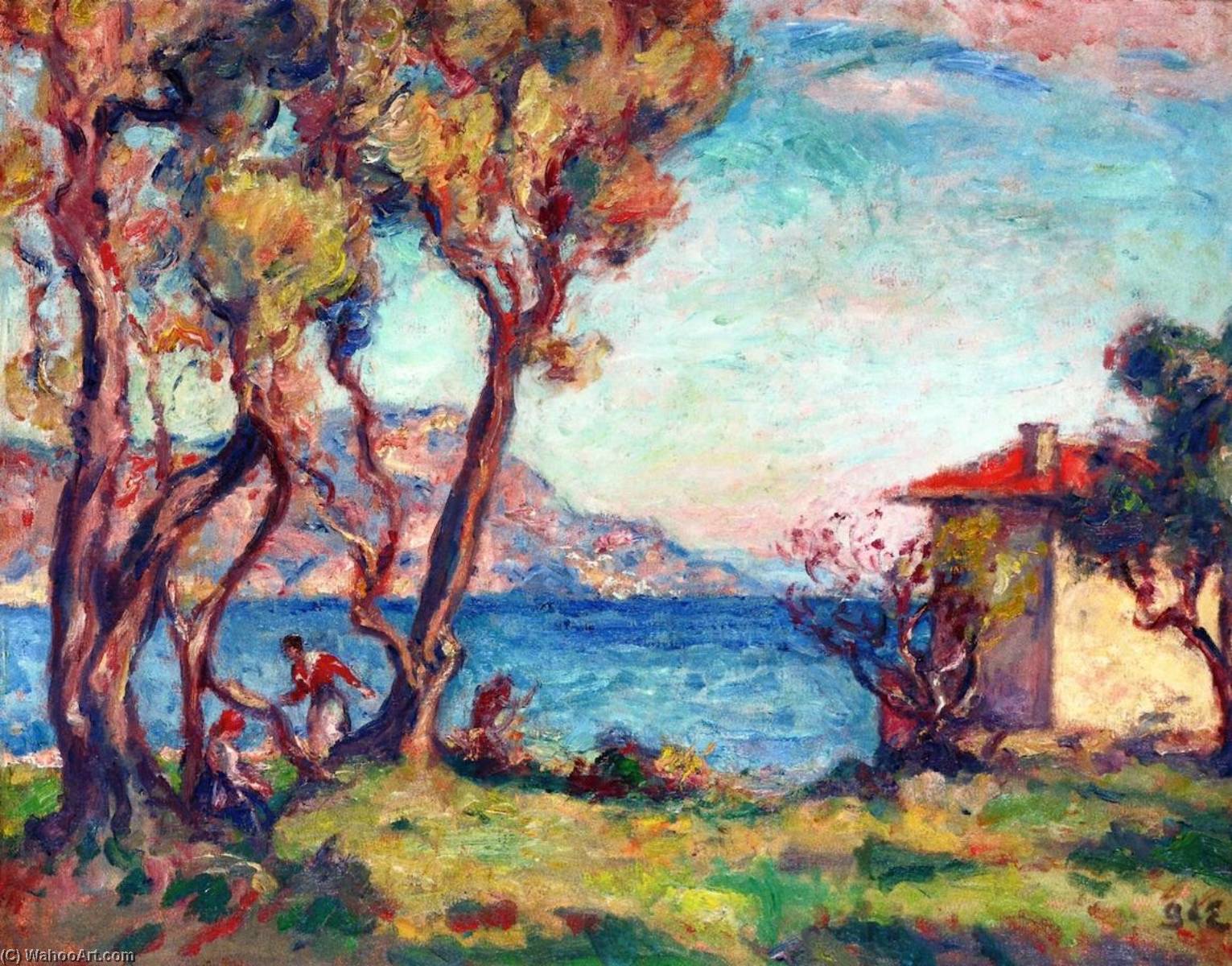
A solitary figure stands near a tree, pausing to observe the sea. This 1900 oil on canvas captures a quiet afternoon where life moves at the pace of the tide. Scattered figures populate the shoreline, some near the water's edge and others further back, creating a sense of lived-in space. A single boat rests upon the water, anchoring the composition within a peaceful maritime setting. The scene is framed by…

10
Naked Styling autor Georges D'Espagnat

Naked Styling

Oil

The soft glow of early light spills into a private room, catching the curve of a woman's shoulder as she prepares for the day. She sits amidst the quiet intimacy of a domestic setting, her dark hair swept up in a loose, elegant style. A red headscarf provides a sudden, sharp pulse of color against the muted, earthy tones that surround her. There is a stillness here, a suspended moment…

Georges D'Espagnat maalid, järjestus 11 kuni 50

Teemad, mis püüdisid Georges D'Espagnat pilma

Neli teemat, mis esinevad neis originaalkindel kõige sagedamini, ning iga teema parim näide.

Muuseumid, kus on säilitatud Georges D'Espagnat originaalteosed

Kümne 4 muuseumi kollektsioonid, mis sisaldavad kõige rohkem sellel lehel esitatud teoseid.

Muuseumid Linn Georges D'Espagnat teosid Selle nimekirja maalid
Petit Palais, PariisPetit Palais Pariis 2 Woman and Children in an Orchard: Sketch for the Cloister of the Girls' School of Avenue Simon-Bolivar, 19th Arrondissement of Paris, The Sewing: Sketch for the cloister of the girls' school on avenue Simon-Bolivar, 19th arrondissement of Paris
Wallraf-Richartz-Museum, KölnWallraf-Richartz-Museum Köln 1 Garden in Verneuil
Belgia Kuninglikud Fine Artsi muuseumid, BrüsselBelgia Kuninglikud Fine Artsi muuseumid Brüssel 1 Portrait Of Andrée
Dallas Museum of Art, DallasDallas Museum of Art Dallas 1 Jeune Fille Assise

Georges D'Espagnat, iga kümnendiga üks signatuurpilt

Teosed aastakate kaupa

Vali vuosakülg, et näha selle ajastu definieerivat originaalteost.

Georges D'Espagnat maalid: galerii vastused

Milline Georges D'Espagnat maal on kõige kuulsam?Paljasta vastus

Untitled (A Set of Seven Decorative Panels) (1900). Järgnevad Tuna Vessels Saint-gilles Croix De Vié ja Girl Painting at an Easel (1910).

Kui vana Georges D'Espagnat oli teose Untitled (A Set of Seven Decorative Panels) valmimisel?Paljasta vastus

30 aastat vanus: teos Untitled (A Set of Seven Decorative Panels) on pärinev aastast 1900 ning Georges D'Espagnat sündis aastal 1870.

Millised on Georges D'Espagnat top 10 maali?Paljasta vastus

Untitled (A Set of Seven Decorative Panels), Tuna Vessels Saint-gilles Croix De Vié, Girl Painting at an Easel, Woman Reading, Femmes et enfants dans la terrasse du moulin de Beaulieu à Villennes sur Seine, Woman and Child, Woman and Children in an Orchard: Sketch for the Cloister of the Girls' School of Avenue Simon-Bolivar, 19th Arrondissement of Paris, The Sewing: Sketch for the cloister of the girls' school on avenue Simon-Bolivar, 19th arrondissement of Paris, Maisonette by the Sea ja Naked Styling. Ülemine reiting näitab iga teose puhul aastat ja muuseumi.

Kui palju teoseid Georges D'Espagnat lõi?Paljasta vastus

Meie kataloogist leiate 50 teost kunstnikult Georges D'Espagnat, mis on pärinevad ajastust 1893 kuni 1933.

Kust leiad Georges D'Espagnat kõige kuulsamad originaalteosed?Paljasta vastus

Peamiselt Petit Palais (Pariis), Wallraf-Richartz-Museum (Köln) ja Belgia Kuninglikud Fine Artsi muuseumid (Brüssel) muuseumites. Ülalpool olevate muuseumite tabelis on nendest kõik loetletud.

Millal lõi Georges D'Espagnat oma kuulsamad maalid?Paljasta vastus

Ajal 1900s: 10 50 sellel lehel olevat teost on sellel perioodil loodud, მათart közül Untitled (A Set of Seven Decorative Panels).

Millised on Georges D'Espagnat varased ja hilised kuulsad teosed?Paljasta vastus

Sellel lehel on kõige vanem teos Garden in Verneuil (1893) ja kõige värskeim Woman and Children in an Orchard: Sketch for the Cloister of the Girls' School of Avenue Simon-Bolivar, 19th Arrondissement of Paris (1933).

Millist teemat Georges D'Espagnat kõige rohkem käsitledas?Paljasta vastus

Flowers (8), Woman (6) ja Vase (6), kogu selle lehekülje 50 teose kohta.

Millises tehnikas töötas Georges D'Espagnat kõige rohkem?Paljasta vastus

Oil On Canvas, 5 teoseks 50 töödelt sellel lehel.

Millise suunaga on Georges D'Espagnat seotud?Paljasta vastus

Impressionism ja Post-impressionism, seda lähtudes selle lehe originaalteostest.

Milliseid Georges D'Espagnat originaalte Petit Palais kogumuses on?Paljasta vastus

Woman and Children in an Orchard: Sketch for the Cloister of the Girls' School of Avenue Simon-Bolivar, 19th Arrondissement of Paris ja The Sewing: Sketch for the cloister of the girls' school on avenue Simon-Bolivar, 19th arrondissement of Paris: Petit Palais, Pariis säilitab 2 selle lehel olevat teost.

Georges D'Espagnat: kunstnik

Valgus pärand: Georges D’Espagnati elu ja kunst

19. sajandi lõpus ja 20. sajandi alguses Prantsuse kunstis vibreerivas kanga, on vähegi tegelasi, kes kehastab üleminekut traditsioonist modernismile nii graatsiliselt kui Georges D’Espende. Sündinud Melunis aastal 1870, oli D’Espagnat mõeldud elule, mis on uputatud ilu esteetikasse. Tema isa asestab legendaarse Durand-Ruel Gallery galerii, mis avas talle võretamatu vaate modernismi evolutsioonile, asetades ta Pariisi kunstimaailma südamesse. See varajane kokkupuude võimaldas tal olla otsekohtane tunnistaja kunstiajaloo muutuvaid laineid, kuid ka arusaatuse, mis võimaldas teda hiljem sillata barbaaronikooli ranget realismi ja impressionismi luminatsioonset, ajutist tunnetust.

D’Espagnati kunstiline teekond oli sügav sündmuslik süntees. Kuigi tema kujundavate aastate vundament laadikus ja ausas maaelu kujutluses vormisid neid meistrid nagu Gustave Courbet ja Jean-François Millet, kallas tema süda rohkem lüürilisse ja atmosfäärilisse väljendusviisile. 1888. aastal liikus ta Pariisi, kus algas tema iseseisev õppimine, saadades aeg-ajalt juhiseid kunstnikult nagu Gustave-Claude-Etienne Courtois. Tema stiil õitsines lõpuks sofisteeritud postimpressionistlikuks keeleks, mis oli sügavalt võluna Pierre-Auguste Renoiri pehmel, laigulise valguse ja Alfred Sisley kerge tekstuuriga. See stiililine dualismi — realismi struktuuriline tervik koos värvi emotiivse jõuga — sai tema loomingulise vaimu kaubamärgiks.

Teema ja vaimu meistrilikkus

D’Espagnati teemade laius peegeldab sügavat austust nii inimvormi kui ka looduse vastu. Tema maastikud ei ole pelgalt topograafilised dokumentid, vaid Prantsuse maapiirkonna emotsionaalsed kutsumised. Töödes nagu tema 1900. aasta meistriteos "Maastik", saab nähata, kuidas vabad, tantsivad pintoonid loovad liikumise illusiooni, tabades mööduva tuule või muutuva päikesevala olemust. Tema võime edastada rahu läbi vibrantsete toonide ja tekstuursete rakenduste võimaldab vaatajal astuda otse sisse rahulikku, looduslikku hetki.

Lisaks looduse horisondile uurinud D’Espagnat avas inimkoguemuse intiimsust oma aktsusid ja kodusteskeenides. Tema inimvormide kujutused on tuntud oma anatomilise täpsuse poolest, kuid need ei ole kunagi kliinilised; vastupidi, neil on graatsiline, poeetiline kvaliteet, mis saavutatakse peened varjud ja pehme valgus. See õrnus ulatub ka tema žanripiltide juurde, nagu "Naistest ja lastest Moulin de Beaulieu terrasse'il Villennes sur Seine'is," kus ta tabab pereelu vaikset maagiat lopsakates, rohelistes aiandites. Olgu see siis stillifeit nagu vibrantne "Punased lilled ja puuvilid" või emali kallis hetk teoses "Naine ja laps," tema töö jääb alati tervislikult juurde anud atmosfääri ja emotsiooni tunnetele.

Ajalooline tähendus ja püsiv mõju

D’Espagnat oli palju enema kui lihtsalt maalari; ta oli oma ajastu kultuurilise kanga elutähtne osa. Tema karjäär võimaldas tal näidata teoseid prestiižsena Salon des Refusés näitusel ja hiljem panustada Salon d’Automne aluse panemisel, kus ta tegutses lõpuks ka vastu presidendina. Tema intellektuaalne ulatus ulatus kirjandusse ja skeenograafia, kuna ta illustreeris tuntud autorite, nagu Alphonse Daudet ja Rémy de Gourmont teoseid, tõestades, et tema kunstiline visioon oli sügavalt seotud Prantsuse laiemate kirjandusliikumistega.

Tänapäeval on Georges D’Espagnati ajalooline tähtsus kinnitatud tema teoste kohalolekuga maailma kõige austatumates institutsioonides. Tema pärand elab edasi sellistes kogumustes nagu:

  • Musée d’Orsay Pariisis, mis säilitab tema panust Prantsuse impressionistlikku traditsiooni.
  • Metropolitan Museum of Art New Yorkis, mis demonstreerib tema rahvusvahelist ulatust.
  • Chicago Kunstinstituut, kus tema valguse ja vormi meisterlikkus jätkub inspireerimust.
  • Museo Thyssen-Bornemisza, mis rõhutab tema kohta postimpressionismi oluliste esponentide seas.

Kui me vaatame tagasi elule, mis ulatus Barbizonikooli mõju kõrgemast ajast kuni modernse abstraktsiooni koiteni, jääb D’Espagnat säravaks kujundiks. Ta õpetas meile, et kunst võib austada traditsiooni kaalutust, samas kui omarmaks praeguse hetke ajutust ilu, jättes järele teoseid, mis jätavad edasi hingama valgusega ja eluga.