Frederick William Macmonnies portree

25 kulubumatamatum Frederick William Macmonnies maali, galeriiselektsioon

Uuendatud november 2026 · järjestatud meie populaarsusindeksi järgi (otsingud, külastused ja tellimused igale teosele) · 25 teost Frederick William Macmonnies meie kataloogis

Lühidalt

Kõigist Frederick William Macmonnies jäetud originaalteostest on kõige kuulsam Diana (1890). Järgnevad sellest Young Chevalier (1898) ja May Suydam Palmer (1903). Meie kataloogist löytyb 25 teost kunstnikult Frederick William Macmonnies; galeriist on säilitatud 25 maailmas kõige imetlustunud teost, millest iga on esitatud koos kuupäeva, museumi ja oma luguga.

1863 – 1937, Brooklyn Heights Enamama teoseid: Metropolitan Museum of Art

Frederick William Macmonnies top 10 maalist: galeriis valitud teosed

1
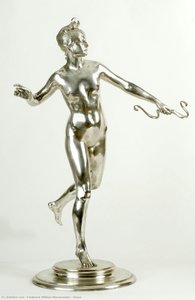
Diana (1890) autor Frederick William Macmonnies

Diana

1890 · Bronze

In this mythological scene, the goddess Diana emerges from the stillness of the bronze. Created by Frederick William Macmonnies about 1890, the sculpture captures a moment of divine purpose. She is the goddess of the hunt and the moon, a figure of mythic power caught in a single, decisive stride. Every line of her form suggests a creature of the wild, moving with a grace that feels both sudden and…

2
Young Chevalier (1898) autor Frederick William Macmonnies

Young Chevalier

1898 · Oil On Canvas · Virginia Museum of Fine Arts, Richmond

The oil painting Young Chevalier by Frederick William Macmonnies captures a fleeting moment of childhood play. Created about 1898, the work presents a young boy lost in a world of imagination. He wears an elaborate military costume, gripping a hobby horse as if preparing for a grand charge. The scene feels intimate, as if we have just stepped into a private corner of a grand, classical interior where time has…

3
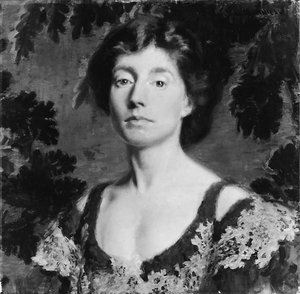
May Suydam Palmer (1903) autor Frederick William Macmonnies

May Suydam Palmer

1903 · Oil On Canvas · Metropolitan Museum of Art, New York

In this intimate oil painting on canvas, Frederick William Macmonnies turns his attention to the likeness of May Suydam Palmer. Created about 1903, the work captures the subject in a moment of quiet presence. The portrait focuses on the woman's upper body, presenting her in a way that feels both formal and deeply personal. There is a sense of stillness here, as if we have caught her in a private…

4
Stephen S. Palmer, Trustee 1908-1913, Donor of Palmer Hall  (1853-1913) (1915) autor Frederick William Macmonnies

Stephen S. Palmer, Trustee 1908-1913, Donor of Palmer Hall (1853-1913)

1915 · Oil

A single light source descends from the upper left, carving a face out of the shadows. The subject sits in a quiet, dark space, his presence defined by the stark contrast between a crisp white collar and the deep, somber tones of a formal suit. There is a stillness here, the kind found in a room where the air has settled. His gaze is steady, caught in a moment of…

5
Kit Carson (1915) autor Frederick William Macmonnies

Kit Carson

1915 · Bronze · Sagamore Hill National Historic Site, Oyster Bay

In this bronze work, Frederick William Macmonnies captures Kit Carson on horseback. The sculpture portrays the frontiersman as a significant figure from American history, presented in a moment of action. It was unveiled in 1911 as a large public sculpture celebrating the pioneers of the American Old West. Macmonnies, a sculptor known for his ability to imbue bronze with a sense of vitality, focuses here on the physical presence of…

6
Self-Portrait (1898) autor Frederick William Macmonnies

Self-Portrait

1898 · Oil On Canvas · Art Institute of Chicago, Chicago

is an oil painting by the American artist Frederick William Macmonnies. Born in New York in 1863, Macmonnies was a figure of the Beaux-Arts era who achieved significant recognition in both France and the United States. This specific work, executed in 1898, captures the artist in a bust-length composition.

Kunstianikut Frederick William Macmonnies nimekiri jätkub, 11 kuni 25

Teemad, mis püüdisid Frederick William Macmonnies pilma

Neli teemat, mis esinevad neis originaalkindel kõige sagedamini, ning iga teema parim näide.

Muuseumid, kus on säilitatud Frederick William Macmonnies originaalteosed

Kümne 8 muuseumi kollektsioonid, mis sisaldavad kõige rohkem sellel lehel esitatud teoseid.

Muuseumid Linn Frederick William Macmonnies teosid Selle nimekirja maalid
Metropolitan Museum of Art, New YorkMetropolitan Museum of Art New York 3 May Suydam Palmer, Self portrait, Madonna of Giverny
Sagamore Hill National Historic Site, Oyster BaySagamore Hill National Historic Site Oyster Bay 2 Kit Carson, Rough Rider
Virginia Museum of Fine Arts, RichmondVirginia Museum of Fine Arts Richmond 1 Young Chevalier
Art Institute of Chicago, ChicagoArt Institute of Chicago Chicago 1 Self-Portrait
Terra Fondation für Amerikanische Kunst, ChicagoTerra Fondation für Amerikanische Kunst Chicago 1 Mabel Conkling
Smithsonian American Art Museum, Washington, D.C.Smithsonian American Art Museum Washington, D.C. 1 Miss Anne Mills Archbold
Palmer Museum of Art, Centre CountyPalmer Museum of Art Centre County 1 The French Chevalier
Reading Public Museum, ReadingReading Public Museum Reading 1 Diana

Frederick William Macmonnies aastak aegades: originaalteos, mis määratleb iga ajastu

Teosed aastakate kaupa

Vali vuosakülg, et näha selle ajastu definieerivat originaalteost.

Sammlajate küsimused Frederick William Macmonnies maalide kohta

Millise teosega on Frederick William Macmonnies kõige kuulsam?Paljasta vastus

Diana (1890). Järgnevad Young Chevalier (1898) ja May Suydam Palmer (1903).

Kui vana oli Frederick William Macmonnies, kui teos Diana loodi?Paljasta vastus

27 aastat vanus: teos Diana on pärinev aastast 1890 ning Frederick William Macmonnies sündis aastal 1863.

Millised on kümne kõige kuulsama Frederick William Macmonnies maalid?Paljasta vastus

Diana, Young Chevalier, May Suydam Palmer, Stephen S. Palmer, Trustee 1908-1913, Donor of Palmer Hall (1853-1913), Kit Carson, Self-Portrait, Nathan Hale, Horse Leaping, Rip Van Winkle ja Nathan Hale. Ülemine reiting näitab iga teose puhul aastat ja muuseumi.

Kui palju maali Frederick William Macmonnies jäeti?Paljasta vastus

Meie kataloogist leiate 25 teost kunstnikult Frederick William Macmonnies, mis on pärinevad ajastust 1873 kuni 1930.

Mitteks muuseumides rihangavad Frederick William Macmonnies meistriteosed?Paljasta vastus

Peamiselt Metropolitan Museum of Art (New York), Sagamore Hill National Historic Site (Oyster Bay) ja Virginia Museum of Fine Arts (Richmond) muuseumites. Ülalpool olevate muuseumite tabelis on nendest kõik loetletud.

Millah aastades maalas Frederick William Macmonnies oma kuulsamaid teoseid?Paljasta vastus

Ajal 1890s: 8 25 sellel lehel olevat teost on sellel perioodil loodud, მათart közül Diana.

Mis on Frederick William Macmonnies esimene ja viimane kuuls fama originaalteos?Paljasta vastus

Sellel lehel on kõige vanem teos Horse Leaping (1873) ja kõige värskeim Charles Augustus Lindberg (1930).

Milliseid teemasid Frederick William Macmonnies kõige sagedamini valis?Paljasta vastus

Man (3), Woman (2) ja Bronze (2), kogu selle lehekülje 25 teose kohta.

Millist tehnikat kasutas Frederick William Macmonnies kõige rohkem?Paljasta vastus

Oil On Canvas, 3 teoseks 25 töödelt sellel lehel.

Millised Frederick William Macmonnies teosed on Metropolitan Museum of Art näituses?Paljasta vastus

May Suydam Palmer, Self portrait ja Madonna of Giverny: Metropolitan Museum of Art, New York säilitab 3 selle lehel olevat teost.

Frederick William Macmonnies: elu ja looming

The Sculptor of Light and Bronze: The Life of Frederick William MacMonnies

In the vibrant intersection of American ambition and European refinement, the name Frederick William MacMonnies resonates as a symbol of the Beaux-Arts era. Born in Brooklyn Heights in 1863, MacMonnies was a child prodigy of stone carving, possessing an innate ability to breathe life into cold medium from a remarkably young age. His journey was not merely one of personal growth but a transatlantic odyssey that would eventually see him become the most celebrated expatriate sculptor of his generation. He possessed a rare, dual mastery over both the fluid strokes of painting and the structural permanence of sculpture, allowing him to approach form with a unique sensitivity to light and movement that few of his contemporaries could replicate.

The foundations of his greatness were laid in the prestigious studio of Augustus Saint-Gaudens. Entering the studio as an apprentice at just eighteen, MacMonnies transitioned from a humble assistant—running errands and maintaining models—to a vital collaborator. It was within this crucible of talent that he forged lifelong connections with other titans of the era, such as the architect Stanford White. This period of his life was defined by a rigorous immersion in the principles of classical form, supplemented by nocturnal studies at the National Academy of Design and the Art Students League of New York. These early years instilled in him a profound respect for the weight and texture of materials, a discipline that would later allow him to execute works of both monumental scale and delicate intimacy.

A Parisian Renaissance and the Beaux-Arts Triumph

Driven by an insatiable hunger for artistic excellence, MacMonnies departed for Paris in 1884, a move that would irrevocably alter the trajectory of his career. Enrolling at the École des Beaux-Arts, he quickly distinguished himself, earning the highest honors available to foreign students. The Parisian Salon became his stage, a place where he presented works that synthesized classical mythology with a modern, rhythmic vitality. In Paris, MacMonnies did not merely study; he thrived, establishing his own studio and eventually becoming a mentor to rising stars like Janet Scudder. His ability to navigate the sophisticated cultural landscape of France allowed him to achieve a level of international prestige that few American artists of the nineteenth century could claim.

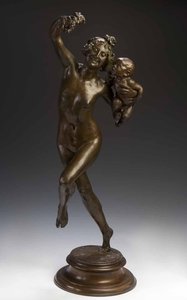
His sculptural language was characterized by a sense of lithe, energetic motion. Whether working in bronze or marble, he had an uncanny knack for capturing the fleeting moment—the tension of a muscle, the grace of a nymph, or the solemnity of a hero. His most iconic works, such as Diana and Bacchante and Infant Faun, exemplify this mastery of the human form in motion. These pieces were not merely static figures but were imbued with a sense of breath and vitality that seemed to defy the very bronze from which they were cast.

Legacy of a Master: Public Monuments and Artistic Innovation

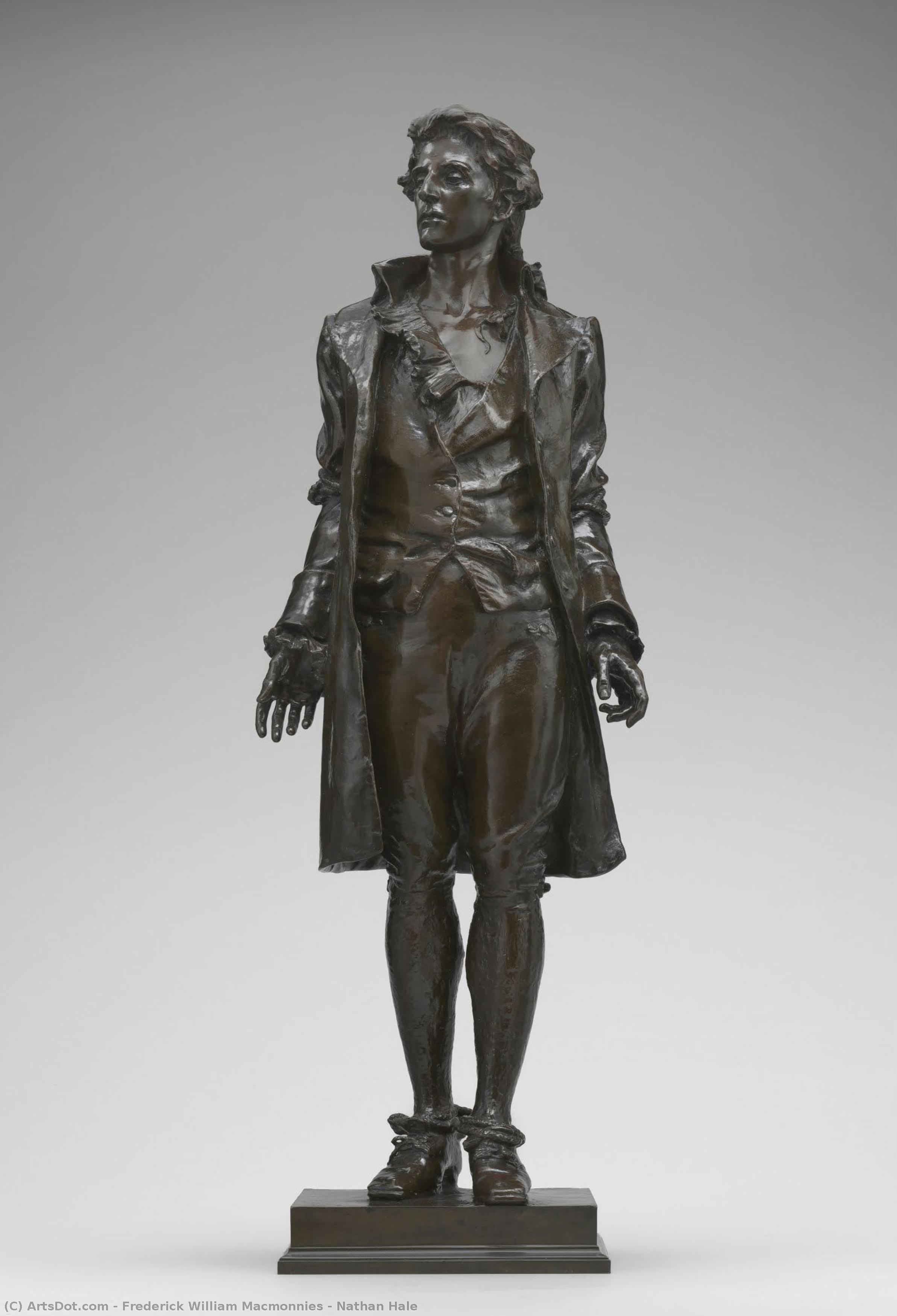
Beyond the ethereal beauty of his mythological figures, MacMonnies left an indelible mark on the urban landscape through his monumental public commissions. Perhaps his most enduring contribution to American civic identity is the Nathan Hale statue. Erected in New York City in 1893, this powerful depiction of the American spy stands as a testament to his ability to imbue historical portraiture with profound dignity and patriotic fervor. He was also a pioneer in the democratization of art; recognizing the growing middle class, he was among the first sculptors to copyright his designs and work with foundries to produce reduced-size reproductions, ensuring that fine art could reside in the homes of many, not just the elite.

The historical significance of Frederick William MacMonnies lies in his role as a bridge between the old world and the new. He took the classical traditions of Europe and infused them with an American vigor and accessibility. His life, spanning from the streets of Brooklyn to the grand ateliers of Paris, mirrored the growth of American art itself—moving from provincial beginnings toward a confident, global presence. Even today, his works continue to command attention in museums such as the Metropolitan Museum of Art and the Smithsonian, serving as enduring reminders of an era when sculpture sought to capture the very essence of the human spirit through the marriage of tradition and innovation.