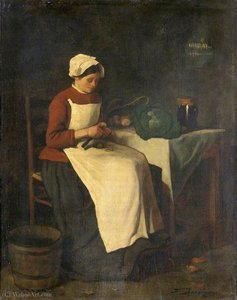
François Bonvin portree

68 kulubumatamatumat François Bonvin maalist, millist on vaid üks

Uuendatud november 2026 · järjestatud meie populaarsusindeksi järgi (otsingud, külastused ja tellimused igale teosele) · 70 teost François Bonvin meie kataloogis

Lühidalt

Woman Ironing (1858) on François Bonvin maalide kõige silmapaistvam teos; originaal kuulub museumi Philadelphia Museum of Art, Philadelphia. Pärast seda suunatakse pilk Sophie Unternährer at her easel (1848) ja Woman Playing Games (1853) suunas. Meie kataloogis olevatest François Bonvin 70 teosest on need 68 kõige kuulsumat, millist igaüks on esitatud koos aasta, muuseumi ja põhjusega, miks teos on püsiv.

1817 – 1887, Pariis Realism Enamama teoseid: Burrell Collection

François Bonvin top 10 maalist galeriist vaatenurgast

1
Woman Ironing (1858) autor François Bonvin

Woman Ironing

1858 · Oil · Philadelphia Museum of Art, Philadelphia

A single woman leans into her labor. The scene is tight, a quiet corner of a room where the air feels heavy with the scent of heated fabric. She is bent over her task, her body forming a soft curve against the stark, bright white of the linens. The light does not flood the room; it strikes only what is necessary. It catches the ridge of her shoulder, the pale…

2
Sophie Unternährer at her easel (1848) autor François Bonvin

Sophie Unternährer at her easel

1848 · Oil

The studio is swallowed by shadow, leaving only a single, concentrated pool of light to illuminate the scene. Within this luminous circle, Sophie Unternährer leans toward her canvas, her entire being pulled into the act of making. She is a figure of intense focus, caught in a private stillness that feels almost sacred. The light, spilling from the upper left, catches the heavy, creamy folds of her voluminous white dress,…

3
Woman Playing Games (1853) autor François Bonvin

Woman Playing Games

1853 · Oil On Panel · Centraal Museum, Utrehti

The oil painting titled Woman Playing Games captures a singular, quiet moment of domesticity. Created by the French artist François Bonvin, the work belongs to the genre art tradition. It focuses on the private, unadorned rhythms of daily life, finding weight in the stillness of a single figure.

5
The Embroideress (La Brodeuse) (1857) autor François Bonvin

The Embroideress (La Brodeuse)

1857 · Oil · Museum Gouda, Gouda

The Embroideress (La Brodeuse) is a realist oil painting from 1857 that captures a solitary woman immersed in the quiet task of embroidery. The composition is centered on the seated figure, creating an atmosphere of domestic devotion and stillness. The scene is characterized by a dark, muted color palette of deep blacks and browns, which serves to highlight the stark white of the woman's collar and the warm, reddish-orange hue…

6
Drawing Water (1858) autor François Bonvin

Drawing Water

1858 · Oil On Canvas · Walters Art Museum, Baltimore

In "Drawing Water" by François Bonvin, a quiet moment of domestic labor unfolds within a vertically oriented space. The scene captures a solitary woman engaged in her daily chore, positioned slightly to the right of center. She leans toward a water dispenser, her form defined by the steady rhythm of her task. In the immediate foreground, a bucket sits waiting, grounding the viewer in this intimate, private sphere. The perspective…

7
Ave Maria : interior of the  Aramont convent (1870) autor François Bonvin

Ave Maria : interior of the Aramont convent

1870 · Oil On Canvas · Musée d'Orsay, Pariis

The scene unfolds within the quietude of Ave Maria : interior of the Aramont convent, a work that captures a moment of stillness through the eyes of François Bonvin. This painting emerges from the year 1870, offering a glimpse into a world of devotion and architectural weight. The atmosphere feels heavy with the presence of the past, as if the very air within the convent holds its breath.

8
Woman in White (1865) autor François Bonvin

Woman in White

1865 · Oil On Canvas · Musée des Beaux-Arts, Reims

In Woman in White, François Bonvin captures a moment of quietude through a vertically oriented composition. The subject is positioned slightly off-center, a profile of a woman seen from the side. She gazes downward, her eyes cast toward an unseen point below. This posture creates a sense of stillness against a dark, indistinct background that offers no distraction from her form. The space around her feels heavy and silent.

10
Interior of a Tavern (1867) autor François Bonvin

Interior of a Tavern

1867 · Oil On Canvas · Walters Art Museum, Baltimore

In Interior of a Tavern by François Bonvin, we find ourselves within a quiet, somber moment of 19th-century life. The scene is anchored by a woman in a red bodice and white apron, who occupies the center of the composition. To her left, a man sits quietly at a wooden table, while to her right, a standing man wearing a red vest and a dark hat directs his gaze toward…

François Bonvin kuulsad maalid, numbrid 11 kuni 68

11Young Woman with a Mandolin, Portrait of Louison Köhler (1873) autor François BonvinYoung Woman with a Mandolin, Portrait of Louison Köhler1873 · Cleveland Museum of Art 12The Scrubber (1887) autor François BonvinThe Scrubber1887 · Musée des Beaux-Arts 13La Servante indiscrete (1871) autor François BonvinLa Servante indiscrete1871 · Art Gallery of Hamilton 14Still Life with Oyster (1860) autor François BonvinStill Life with Oyster1860 · Yale University Art Gallery 15Still Life with Asparagus (1867) autor François BonvinStill Life with Asparagus1867 · Kröller-Müller Museum 16Attributes of Music (1863) autor François BonvinAttributes of Music1863 · Cleveland Museum of Art 17Still Life (1858) autor François BonvinStill Life1858 · Museum of Fine Arts 18Landscape with Barn (1869) autor François BonvinLandscape with Barn1869 · Museum Gouda 19Still Life with Oysters (1865) autor François BonvinStill Life with Oysters1865 · National Gallery of Ireland 20Still life with cherries. (1865) autor François BonvinStill life with cherries.1865 · Museum of John Paul II Collection 21The Candlestick (Still Life with Candle) (1878) autor François BonvinThe Candlestick (Still Life with Candle)1878 · Museum Gouda 22Still Life with Grapes (1877) autor François BonvinStill Life with Grapes1877 · Museum Gouda 23Still Life with Clogs (1875) autor François BonvinStill Life with Clogs1875 · Museum Gouda 24Port-Marly (1872) autor François BonvinPort-Marly1872 · Musée d'Orsay 25The Trio (1880) autor François BonvinThe Trio1880 · Centraal Museum 26Still Life with Vegetables (1880) autor François BonvinStill Life with Vegetables1880 · Museum Gouda 27Still Life With Brass Kettle (1883) autor François BonvinStill Life With Brass Kettle1883 · Museum Boijmans Van Beuningen 28Still life, two glazed earthenware pots. (1887) autor François BonvinStill life, two glazed earthenware pots.1887 · Musée des Beaux-Arts de Rouen 29Femme lisant autor François BonvinFemme lisantMusée Fabre 30'Miss' autor François Bonvin'Miss'Burrell Collection 31The Butcher autor François BonvinThe Butcher 32A woman ironing autor François BonvinA woman ironingNational Museum Cardiff 33Two countrywomen autor François BonvinTwo countrywomenBowes Museum 34The winder autor François BonvinThe winder 35The Blacksmiths, Memory of Treport autor François BonvinThe Blacksmiths, Memory of Treport 36Still life, François Bonvin, 1871 (1871) autor François BonvinStill life, François Bonvin, 18711871 · Rijksmuseum 37Stilleven met vier vruchten, glas en aardewerk, François Bonvin, 1827 - 1887 (1887) autor François BonvinStilleven met vier vruchten, glas en aardewerk, François Bonvin, 1827 - 18871887 · Rijksmuseum 38Still Life autor François BonvinStill LifeMusée des Beaux-Arts 39Still life autor François BonvinStill lifeYork Art Gallery 40Still Life with Jar of Cherries autor François BonvinStill Life with Jar of Cherries 41Woman at a Spinet autor François BonvinWoman at a SpinetBurrell Collection 42The crow autor François BonvinThe crowBurrell Collection 43Interior of a Tavern autor François BonvinInterior of a Tavern 44Grandmamma's breakfast autor François BonvinGrandmamma's breakfastBowes Museum 45Still Life with a Copper Pot autor François BonvinStill Life with a Copper PotBurrell Collection 46The violin autor François BonvinThe violinBurrell Collection 47The meadow autor François BonvinThe meadowNational Gallery 48The young housewife autor François BonvinThe young housewifeNational Museum Cardiff 49The Letter of Recommendation autor François BonvinThe Letter of Recommendation 50Housemaid At The Wasserholen autor François BonvinHousemaid At The WasserholenMusée d'Orsay 51Oysters autor François BonvinOystersBurrell Collection 52Interior autor François BonvinInteriorFitzwilliam Museum 53Charity autor François BonvinCharity 54Still Life with Game autor François BonvinStill Life with GameBurrell Collection 55Still Life with Oysters, a Wine Bottle and a Glass of Wine autor François BonvinStill Life with Oysters, a Wine Bottle and a Glass of WineBurrell Collection 56Peasant knitting autor François BonvinPeasant knitting 57Still Life with Book, Papers and Inkwell autor François BonvinStill Life with Book, Papers and InkwellNational Gallery 58Still Life with Apples and a Silver Goblet autor François BonvinStill Life with Apples and a Silver GobletKelvingrove Art Gallery and Museum 59Interior with an Old Woman Kneeling autor François BonvinInterior with an Old Woman Kneeling 60The Attributes of Painting autor François BonvinThe Attributes of PaintingBarber Institute of Fine Arts 61Nature morte autor François BonvinNature morteBerwick Museum and Art Gallery 62Still Life with a Tobacco Pot and a Pipe autor François BonvinStill Life with a Tobacco Pot and a PipeBurrell Collection 63Still Life with a Jug, Cheese, Onions, Fish and a Knife autor François BonvinStill Life with a Jug, Cheese, Onions, Fish and a KnifeBurrell Collection 64Still Life with a Glass, Pears and a Knife autor François BonvinStill Life with a Glass, Pears and a KnifeBurrell Collection 65Still Life with Asparagus autor François BonvinStill Life with AsparagusScottish National Gallery 66Still Life with a Book and an Ink Well autor François BonvinStill Life with a Book and an Ink WellBurrell Collection 67Still Life with Vegetables and Cooking Utensils autor François BonvinStill Life with Vegetables and Cooking UtensilsBurrell Collection 68Self portrait autor François BonvinSelf portraitBowes Museum

Teemad, mis püüdisid François Bonvin pilma

Neli teemat, mis esinevad neis originaalkindel kõige sagedamini, ning iga teema parim näide.

Muuseumid, kus on säilitatud François Bonvin originaalteosed

Kümne 8 muuseumi kollektsioonid, mis sisaldavad kõige rohkem sellel lehel esitatud teoseid.

Muuseumid Linn François Bonvin teosid Selle nimekirja maalid
Burrell Collection, GlasgowBurrell Collection Glasgow 13 'Miss', Woman at a Spinet, The crow
Museum Gouda, GoudaMuseum Gouda Gouda 6 The Embroideress (La Brodeuse), Landscape with Barn, The Candlestick (Still Life with Candle)
Musée d'Orsay, PariisMusée d'Orsay Pariis 3 Ave Maria : interior of the Aramont convent, Port-Marly, Housemaid At The Wasserholen
Bowes Museum, Barnard CastleBowes Museum Barnard Castle 3 Two countrywomen, Grandmamma's breakfast, Self portrait
Centraal Museum, UtrehtiCentraal Museum Utrehti 2 Woman Playing Games, The Trio
Walters Art Museum, BaltimoreWalters Art Museum Baltimore 2 Drawing Water, Interior of a Tavern
Musée des Beaux-Arts, ReimsMusée des Beaux-Arts Reims 2 Woman in White, The Scrubber
Cleveland Museum of Art, ClevelandCleveland Museum of Art Cleveland 2 Young Woman with a Mandolin, Portrait of Louison Köhler, Attributes of Music

François Bonvin aastakatega: iga aastakannaga üks unikaalne originaal

Teosed aastakate kaupa

Vali vuosakülg, et näha selle ajastu definieerivat originaalteost.

François Bonvin maalid: küsimused galeriile

Mis on François Bonvin kõige kuulsam teos?Paljasta vastus

Woman Ironing (1858), Philadelphia Museum of Art, Philadelphia. Järgnevad Sophie Unternährer at her easel (1848) ja Woman Playing Games (1853).

Mis vanuses luunud François Bonvin teos Woman Ironing?Paljasta vastus

41 aastat vanus: teos Woman Ironing on pärinev aastast 1858 ning François Bonvin sündis aastal 1817.

Millised on François Bonvin kümneks kuulsumat maalatist?Paljasta vastus

Woman Ironing, Sophie Unternährer at her easel, Woman Playing Games, The Guitar Player, The Embroideress (La Brodeuse), Drawing Water, Ave Maria : interior of the Aramont convent, Woman in White, Portrait of a Seated Woman ja Interior of a Tavern. Ülemine reiting näitab iga teose puhul aastat ja muuseumi.

Kui palju teoseid kunstniku François Bonvin kohta on teada?Paljasta vastus

Meie kataloogist leiate 70 teost kunstnikult François Bonvin, mis on pärinevad ajastust 1848 kuni 1887.

Kust saab näha kõige kuulsamaid François Bonvin originaalteoseid?Paljasta vastus

Peamiselt Burrell Collection (Glasgow), Museum Gouda (Gouda) ja Musée d'Orsay (Pariis) muuseumites. Ülalpool olevate muuseumite tabelis on nendest kõik loetletud.

Mille perioodi jooksul lõi François Bonvin oma tuntumad maalid?Paljasta vastus

Ajal 1870s: 9 68 sellel lehel olevat teost on sellel perioodil loodud, მათart közül Ave Maria : interior of the Aramont convent.

Milline kuuls François Bonvin maal on kõige varasem ja milline kõige hiljema?Paljasta vastus

Sellel lehel on kõige vanem teos Sophie Unternährer at her easel (1848) ja kõige värskeim The Scrubber (1887).

Millist teemasid François Bonvin eelistas?Paljasta vastus

Woman (12), Life (12) ja Table (5), kogu selle lehekülje 68 teose kohta.

Mida François Bonvin kõige rohkem kasutas oma maalide nimiseks?Paljasta vastus

Oil On Canvas, 10 teoseks 68 töödelt sellel lehel.

Millisse toomangu kuulub François Bonvin teos?Paljasta vastus

Realism ja Contemporary realism, seda lähtudes selle lehe originaalteostest.

Mida François Bonvin originaalte ma näen Burrell Collection muuseumis?Paljasta vastus

'Miss', Woman at a Spinet ja The crow: Burrell Collection, Glasgow säilitab 13 selle lehel olevat teost.

François Bonvin: kunstniku portree

The Quiet Observer: The Life and Legacy of François Bonvin

In the bustling, transformative landscape of nineteenth-century Paris, where the shadows of the Industrial Revolution began to lengthen over the city's cobblestone streets, there existed a painter who found profound beauty in the most unassuming corners of existence. François Bonvin (1817–1887) was not a chronicler of grand historical battles or mythological epodes; instead, he was a master of the intimate, a realist whose brush captured the silent dignity of the everyday. His life, marked by early hardship and a resilient spirit, mirrored the very subjects he painted—unadorned, honest, and deeply human.
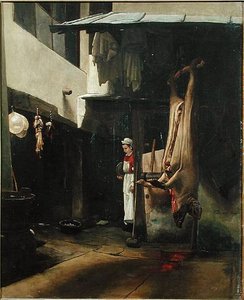
Born into humble circumstances as the son of a police officer and a seamstress, Bonvin’s childhood was far from the romanticized version of Parisian life often depicted in literature. The loss of his mother to tuberculosis when he was only four years old left him vulnerable to a world of scarcity and neglect. Raised in a crowded household with numerous siblings and facing the harsh realities of an undernourished upbringing, these early struggles instilled in him a profound empathy for the marginalized. It was this sensitivity that would later define his artistic vision, allowing him to see the poetic weight in a simple basket of fruit or the quiet labor of a domestic worker.

A Journey Through Light and Shadow

Bonvin’s path to artistry was as much a product of grit as it was of talent. While his formal education began at the École de dessin, supported by the generosity of a family friend, much of his true development occurred through solitary devotion and self-study. His time apprenticed to a printer provided him with a disciplined eye for detail, but it was his frequent pilgrimages to the Louvre that truly sculpted his soul. There, amidst the masterpieces of the past, he found his spiritual ancestors. He became deeply enamored with the Dutch Old Masters, particularly the dramatic chiaroscuro of Rembrandt and the spirited brushwork of Frans Hals.

This fascination with Northern European traditions allowed Bonvin to develop a technique that was uniquely his own—a blend of French precision and Dutch tonal depth. He mastered the art of capturing light as it falls upon varied textures: the cold sheen of a metal cup, the soft fuzz of a ripening strawberry, or the heavy, organic weight of an oyster shell. His work often features a muted, earthy palette that avoids the garishness of contemporary trends, opting instead for a nuanced gradation of tones that creates a sense of palpable atmosphere and stillness.

The Art of the Everyday

The significance of Bonvin’s oeuvre lies in its ability to elevate the mundane to the monumental. His paintings often function as windows into the private, domestic spheres of nineteenth-century France. Whether depicting a still life with four fruits or the poignant scene of A Woman Ironing, there is an unmistakable sense of presence and respect for the subject matter. He did not seek to embellish reality but to honor it.

His contributions to the Realist movement can be summarized through several key artistic hallmarks:

  • Mastery of Texture: An exquisite ability to render the tactile qualities of food, ceramics, and cloth.
  • Chiaroscuro Influence: The use of dramatic light and shadow to create depth and emotional resonance.
  • Empathetic Realism: A focus on the dignity of ordinary life and the beauty found in domesticity.
  • Tonal Nuance: A sophisticated approach to color that favors subtle, atmospheric transitions over bold pigments.

Though he may not have achieved the widespread fame of his contemporaries like Courbet, François Bonvin remains a vital figure for those who seek the soul within the ordinary. His legacy is found in every stroke that celebrates the quiet, the overlooked, and the enduringly beautiful aspects of our shared human experience.