Early Life and Artistic Awakening
Romain de Tirtoff, universally recognized as Erté, was born into a world of aristocratic tradition in Saint Petersburg, Russia, on November 23, 1892. His lineage traced back centuries to Tatar khans—a heritage that instilled within him an innate appreciation for grandeur and meticulous craftsmanship. His father, Admiral Nikolai Tirtoff, served with distinction in the Imperial Russian Navy, shaping young Romain’s understanding of discipline and ambition. Yet, amidst these expectations for naval service, a profound inner yearning emerged – a passion for artistic expression that would irrevocably alter his trajectory. Legend recounts that at just five years old, Romain sketched an evening gown for his mother, a feat that astonished seamstresses and foreshadowed his extraordinary talent for design.
Despite the societal pressures to follow in his father’s footsteps, Erté felt an irresistible pull towards creative pursuits. This internal conflict fueled his decision to adopt the pseudonym “Erté”—a clever adaptation of his initials—to shield his family from potential disapproval as he pursued a career diverging from conventional norms. In 1910, at eighteen, he bravely abandoned Russia for Paris, France’s artistic epicenter, embarking on a transformative journey that would solidify his place in visual culture history.
Parisian Flourishing and the Birth of an Art Deco Icon
Arriving in Paris with little more than his innate talent and unwavering determination, Erté swiftly immersed himself in the vibrant artistic milieu. Initially employed as a draughtsman, he quickly surpassed mere technical proficiency, cultivating a vision that transcended simple execution. A pivotal encounter occurred when he presented his portfolio to Paul Poiret—the celebrated “King of Fashion”—who immediately recognized Erté’s exceptional gift. This collaboration proved instrumental, providing him with invaluable experience in costume and accessory design and propelling him into the heart of Parisian haute couture.
However, it was his association with
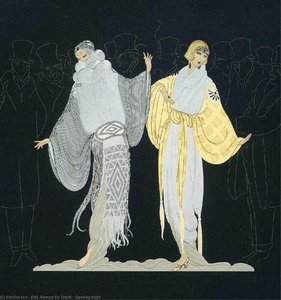
Harper's Bazaar that truly cemented Erté’s reputation as an Art Deco luminary. From 1915 to 1936, he graced over 240 covers with breathtaking illustrations—a remarkable feat of creativity and consistency. These weren’t merely fashion plates; they were exquisite works of art imbued with elongated figures draped in opulent costumes against stylized backgrounds. Erté didn't simply depict fashion; he
defined it, capturing the spirit of an era characterized by glamour, sophistication, and modernity. His distinctive style—marked by bold lines, geometric shapes, and luxurious aesthetics—became synonymous with Art Deco’s visual language.
Beyond Fashion: Theater, Hollywood, and Artistic Evolution
Erté's artistic prowess extended far beyond the realm of fashion illustration. He possessed a remarkable versatility, designing costumes and sets for numerous theatrical productions – including lavish spectacles at the Folies-Bergère and Ziegfeld Follies – demonstrating his mastery of dramatic design. His creations weren’t merely garments; they were transformative visions that breathed life into characters and amplified the emotional impact of each performance. This foray into theater allowed him to explore his creativity on a grand scale, experimenting with color, texture, and form in ways that further refined his artistic vision.
In 1925, Erté ventured westward, accepting a contract with Metro-Goldwyn-Mayer Studios in Hollywood—a pivotal moment that broadened his creative horizons. While his time in the film industry was relatively brief, it exposed him to a new audience and fostered experimentation with cinematic storytelling. He continued to exhibit his work, holding his first solo exhibition at the Madison Hotel in New York City that same year – marking a significant milestone that brought his art to a wider public sphere.
Throughout this period, Erté’s artistic style underwent subtle yet profound transformations. Initially influenced by Art Nouveau's flowing lines and organic forms, he increasingly embraced the principles of Art Deco—reflecting the evolving artistic landscape of the era. His figures became more streamlined, his compositions more geometric, and his color palettes more vibrant – all hallmarks of Erté’s signature visual language.
Legacy and Enduring Influence
Erté's influence transcends mere art history; he is universally regarded as a pioneer of Art Deco—shaping its aesthetic identity and inspiring generations of artists and designers. His designs have permeated fashion trends, interior design aesthetics, and graphic arts throughout the 20th century and continue to resonate with contemporary creatives. Erté received numerous accolades, including the Chevalier du Mérite Artistique et Culturel from the French government – recognizing his invaluable contribution to the arts. He passed away peacefully in Paris on April 21, 1990, at the age of 97—leaving behind a legacy that continues to inspire awe and admiration. His work remains a testament to artistic vision, elegance, and Art Deco’s timeless beauty.
## Notable Works
- Costume Design: A quintessential example of Erté's Art Deco aesthetic, showcasing geometric forms and luxurious fabrics.
- Seasons' Winter: A captivating winter scene that exemplifies his elegant style and masterful compositional skill.
- Asian Princess: An exotic illustration brimming with intricate details and rich colors – demonstrating Erté’s distinctive flair.
- Alphabet Suite: Considered one of Erté’s most important achievements, showcasing his design prowess and compositional precision.