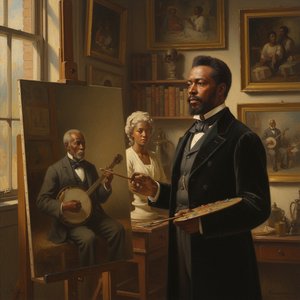
Elias V. Coe: A Quiet Observer of Victorian America
In the tapestry of nineteenth-century American art, there exist voices that do not shout with the grandiosity of academic masters but instead whisper with a profound, intimate truth. Elias V. Coe (circa 1794 – 1843) was such a voice. Born in New Jersey, Coe emerged as a prolific yet unassuming chronicler of rural life during the Victorian era. While the prestigious art academies of his time were preoccupied with rigid anatomical precision and complex mythological allegories, Coe turned his gaze toward the everyday. His work serves as a poignant window into the soul of a developing nation, capturing the essence of ordinary individuals through a lens of heartfelt sincerity and unpretentious beauty.
Coe’s artistic evolution was marked by a deeply personal journey of self-discovery. Eschewing formal institutional training, he developed his craft through meticulous observation and a spirited experimentation with oil paints on canvas. This self-taught path allowed him to bypass the stifling conventions of contemporary realism, leading him toward what scholars now celebrate as naive art. His technique was never about the pursuit of technical perfection for its own sake; rather, it was an intentional rejection of academic stiffness in favor of expressive brushwork and tonal gradations that prioritized emotional resonance. In his hands, a portrait became less a photographic record and more a spiritual tribute to the subject.
The Intimacy of the Naive Portrait
The heart of Coe’s oeuvre lies in his portraits, which often focused on the members of rural communities, particularly women, whom he depicted with a palpable warmth and tenderness. These works were rarely intended for the high-society galleries of New York or Philadelphia; instead, they functioned as personal keepsakes, imbued with the quiet dignity of those he knew within his social orbit. His ability to capture the subtle nuances of a gaze or the gentle contour of a face allowed him to communicate a sense of character that transcends the lack of formal perspective.
A definitive masterpiece that illustrates this approach is ‘Henry W. Houston’ (1837). In this oil on canvas, Coe demonstrates his mastery of the emotive power of color and light. Rather than focusing on the intricate textures of fine lace or the exactness of fabric weaves, he utilizes color to illuminate the subject's features, emphasizing the skin's contours and creating an aura of quiet strength. The composition draws the viewer into a direct encounter with Houston, where the focus remains steadfastly on the subject's presence rather than decorative embellishment. This deliberate simplicity is what gives his work its enduring, timeless quality.
Legacy and Historical Significance
Though Elias V. Coe remained largely unrecognized by the mainstream art establishment during his short lifetime, his historical significance has blossomed in the modern era. As the art world began to re-evaluate the merits of folk and primitive art, Coe’s work was rediscovered as a vital antidote to the ornate and often artificial conventions of the Victorian period. His paintings offer a raw, honest perspective on American identity during a formative century.
Today, Coe is remembered not merely as a provincial painter, but as an artist who found extraordinary depth within the ordinary. His contributions to the American artistic landscape include:
- The Elevation of Naive Art: Proving that emotional truth can be achieved through simplicity and direct experience rather than formal academic rigor.
- Cultural Documentation: Providing a visual record of the values, faces, and quiet dignity of 19th-century American rural life.
- A Unique Aesthetic Vision: Developing a signature style characterized by expressive brushwork that prioritizes feeling over meticulous detail.
Through his canvases, Coe continues to invite us to slow down and find the profound beauty in the simple, reminding us that the most enduring art often comes from the most sincere observations.