


1


Uuendatud november 2026 · järjestatud meie populaarsusindeksi järgi (otsingud, külastused ja tellimused igale teosele) · 24 teost Edward Calvert meie kataloogis
Lühidalt
Kõigist Edward Calvert jäetud originaalteostest on kõige kuulsam Nude Study (1830). Järgnevad sellest Classical Landscape with a Goatherd (1827) ja In the Aegean Sea (1844). Meie kataloogist löytyb 24 teost kunstnikult Edward Calvert; galeriist on säilitatud 24 maailmas kõige imetlustunud teost, millest iga on esitatud koos kuupäeva, museumi ja oma luguga.


 Nymphs and ShepherdsLeeds Art Gallery
12
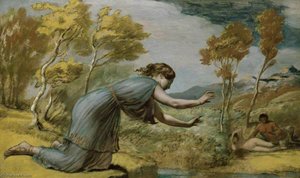 Psyche at the StreamThe Ashmolean Museum of Art And Archaeology
13
 Mars and VenusThe Ashmolean Museum of Art And Archaeology
14
 Pan Playing His Pipes (Pastoral Subject)
15
 Hesperides, 'Dance around the Golden Tree'Fitzwilliam College
16
 PsycheThe Ashmolean Museum of Art And Archaeology
17
 The Return HomeFitzwilliam College
18
 The Garden of CultureThe Ashmolean Museum of Art And Archaeology
19
 A Pastoral Idyll, 'The Other Shore'Fitzwilliam College
20
 Votive Offerings, Classical SceneBristol Museum - Art Gallery
21
 A Woodland Glade
22
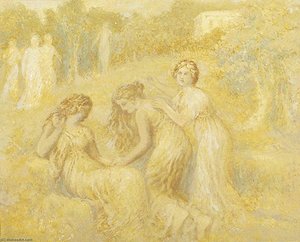 Dwellers in Elysian FieldsLeeds Art Gallery
23
 The Grove of Artemis1850 · Birmingham Museum and Art Gallery
24
 Oak Trees in SummerThe Ashmolean Museum of Art And Archaeology
Kümne 5 muuseumi kollektsioonid, mis sisaldavad kõige rohkem sellel lehel esitatud teoseid.
| Muuseumid | Linn | Edward Calvert teosid | Selle nimekirja maalid |
|---|---|---|---|
 The Ashmolean Museum of Art And Archaeology |
Oxford | 9 | Classical Landscape with a Goatherd, In the Aegean Sea, Sleeping Nymph |
 Birmingham Museum and Art Gallery |
Birmingham | 3 | Ulysses and the Sirens, Pan and Pithys, The Grove of Artemis |
 Fitzwilliam College |
Cambridge | 3 | Hesperides, 'Dance around the Golden Tree', The Return Home, A Pastoral Idyll, 'The Other Shore' |
 Leeds Art Gallery |
Leeds | 2 | Nymphs and Shepherds, Dwellers in Elysian Fields |
 Bristol Museum - Art Gallery |
Bristol | 1 | Votive Offerings, Classical Scene |
Vali vuosakülg, et näha selle ajastu definieerivat originaalteost.
Nude Study (1830). Järgnevad Classical Landscape with a Goatherd (1827) ja In the Aegean Sea (1844).
31 aastat vanus: teos Nude Study on pärinev aastast 1830 ning Edward Calvert sündis aastal 1799.
Nude Study, Classical Landscape with a Goatherd, In the Aegean Sea, Ulysses and the Sirens, Pan and Pithys, A Dryad, Alexander Monro 'Secundus' (1733–1817), Elemental Life, Sleeping Nymph ja Mythological Scene. Ülemine reiting näitab iga teose puhul aastat ja muuseumi.
Meie kataloogist leiate 24 teost kunstnikult Edward Calvert, mis on pärinevad ajastust 1827 kuni 1866.
Peamiselt The Ashmolean Museum of Art And Archaeology (Oxford), Birmingham Museum and Art Gallery (Birmingham) ja Fitzwilliam College (Cambridge) muuseumites. Ülalpool olevate muuseumite tabelis on nendest kõik loetletud.
Ajal 1850s: 3 24 sellel lehel olevat teost on sellel perioodil loodud, მათart közül Ulysses and the Sirens.
Sellel lehel on kõige vanem teos Classical Landscape with a Goatherd (1827) ja kõige värskeim A Dryad (1866).
Classical Landscape with a Goatherd, In the Aegean Sea ja Sleeping Nymph: The Ashmolean Museum of Art And Archaeology, Oxford säilitab 9 selle lehel olevat teost.
In the tapestry of nineteenth-century British art, few threads are as intricately woven with mysticism and precision as those left by Edward Calvert. Born in 1799 in the coastal beauty of Appledore, Devon, Calvert was an artist whose soul seemed to reside at the intersection of the tangible world and the ethereal realm. While many of his contemporaries sought to capture the mere surface of reality, Calvert embarked on a lifelong quest to etch the very essence of the sublime onto paper and canvas. His journey, which took him from the naval life of his youth to the prestigious halls of the Royal Academy Schools in 1824, was defined by an unwavering devotion to the spiritual and the symbolic.
Calvert’s artistic identity was profoundly shaped by his immersion in the vibrant, almost mystical, atmosphere of the Shoreham Circle. This group, centered around the influential Samuel Palmer, breathed the radical air of William Blake. For Calvert, Blake was more than a predecessor; he was a philosophical North Star. The influence of Blake’s exploration of myth, subconscious imagery, and spiritual symbolism became the bedrock of Calvert's compositions. Through his mastery of engraving, Calvert translated these complex, visionary ideas into delicate, tangible forms, most notably in works like ‘The Chamber Idyll’ (1831), where the boundaries between dream and reality begin to blur.
The true brilliance of Calvert lies in his technical virtuosity, particularly within the demanding medium of miniature wood engravings. He possessed an almost supernatural ability to manipulate light and shadow, using fine lines to create a sense of atmosphere that felt both ancient and immediate. His work often oscillates between the pastoral and the classical, finding profound beauty in the quietude of the English landscape and the structured elegance of Greek motifs. Whether he was rendering the textured bark of ‘Oak Trees in Summer’ or the serene, mythological stillness of ‘The Grove of Artemis’, his hand remained remarkably precise yet deeply emotive.
His technique allowed for a unique duality: a meticulous attention to detail that satisfied the eye, paired with an impressionistic sensitivity that captured fleeting moments of tranquility. In his oil paintings, one can observe a burgeoning use of bold lines and vibrant colors that hint at a connection to the Symbolist movement, emphasizing psychological depth over mere topographical accuracy. This ability to imbue even the smallest woodcut with a sense of "quiet grandeur" ensured that his work resonated far beyond the borders of simple illustration.
Though Calvert may not have achieved the widespread, flamboyant fame of some of his more boisterous Victorian peers, his historical significance remains undiminished among scholars of the Romantic and Visionary traditions. He was a master of the intimate, an artist who found the infinite within the miniature. His legacy is carried forward not only through his surviving prints and paintings but also through the lineage of talent he inspired; his son, Samuel Calvert, would go on to become a distinguished engraver in his own right, continuing the family's devotion to the craft.
Today, the works of Edward Calvert serve as a window into a period of intense artistic experimentation, where the boundaries of printmaking were pushed to accommodate the weight of human imagination. To look upon a Calvert engraving is to participate in a silent dialogue with the past—a moment of contemplation that honors the enduring power of beauty, nature, and the unseen spirit.