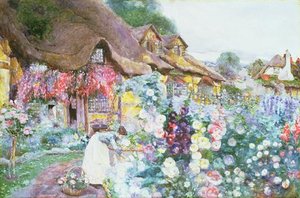
David Woodlock: A Painter of Tranquility and Detail
David Woodlock (1842 – 1929) emerged as a prominent figure in British
landscape painting during the Victorian era, renowned for his meticulous depictions of
rural England and portraits imbued with quiet dignity. Born in Dublin, Ireland, Woodlock’s artistic journey began amidst the burgeoning Romantic movement, absorbing its fascination with nature's sublime beauty and emotional resonance. He honed his skills under the tutelage of
John Ruskin, a celebrated critic and artist whose unwavering advocacy for honest representation and moral seriousness profoundly shaped Woodlock’s aesthetic sensibilities.
- Early Life & Training: Woodlock’s formative years were marked by exposure to Irish artistic traditions, fostering an appreciation for tonal landscapes and expressive brushwork. Ruskin's influence instilled a belief in capturing the essence of subjects with uncompromising accuracy and conveying profound emotion through subtle nuances of color and light.
- Style & Technique: Woodlock distinguished himself as a master watercolorist—a medium he embraced wholeheartedly—characterized by its luminous quality and ability to convey atmospheric conditions with remarkable fidelity. His canvases often presented idyllic cottages nestled amongst rolling hills, bathed in soft sunlight, reflecting the Romantic ideal of pastoral harmony.
- Notable Works: Among his most celebrated paintings are “Old Cottage At Sutton Courtney” and “Feeding The Chickens,” both quintessential examples of his distinctive style. These works exemplify Woodlock’s dedication to capturing fleeting moments of rural life with painstaking detail, prioritizing tonal gradation and subtle shading to create a palpable sense of realism.
- Influences: Ruskin's unwavering commitment to artistic integrity served as a cornerstone of Woodlock’s creative vision. Furthermore, he drew inspiration from the Pre-Raphaelites, particularly their emphasis on idealized beauty and symbolic storytelling—though Woodlock eschewed overtly fantastical elements in favor of grounded observation.
- Legacy & Significance: David Woodlock's contribution to British landscape painting remains significant. His paintings continue to captivate viewers with their serene atmosphere and masterful execution, embodying the Romantic spirit’s pursuit of sublime beauty and moral contemplation. He stands as a testament to the enduring power of watercolor and the artist’s ability to transform ordinary scenes into evocative representations of human experience.
Exploring Woodlock's Artistic Vision: Sutton Courtney Landscapes
Woodlock’s fascination with Sutton Courtney, Berkshire—a picturesque estate owned by Sir Richard Vernon—fueled several stunning
watercolor commissions. These landscapes aren’t merely topographical renderings; they are imbued with a palpable sense of tranquility and infused with Ruskinian principles. Consider “Old Cottage At Sutton Courtney,” where Woodlock meticulously captures the dappled sunlight filtering through the branches of ancient oaks, illuminating the weathered stone walls of a humble dwelling. The artist's masterful use of tonal gradation—a technique championed by
Ruskin—creates an illusion of depth and texture, transporting the viewer into the heart of
rural England.
The Watercolor Medium: Light & Atmosphere
Woodlock’s preference for
watercolor stemmed from its inherent ability to convey atmospheric conditions with unparalleled subtlety. Unlike
oil paint, which relies on layering pigments to build up color intensity,
watercolor allows artists to achieve luminous effects by manipulating washes of pigment diluted in water—a technique that perfectly suited Woodlock's desire to capture the fleeting beauty of nature. His canvases shimmer with reflected light and diffused hues, mirroring the Romantic preoccupation with capturing the sublime experience of encountering grandeur within the commonplace.
A Portrait Painter’s Quiet Dignity
Beyond his landscapes, Woodlock produced portraits that distinguished themselves by their understated elegance and psychological insight. He eschewed flamboyant poses and theatrical expressions, prioritizing a dignified stillness that conveyed inner character with remarkable sensitivity. Like
Ruskin, Woodlock believed in portraying subjects truthfully—not merely physically accurate but emotionally resonant—capturing the essence of human experience through subtle gestures and expressive eyes.