

1


Uuendatud november 2026 · järjestatud meie populaarsusindeksi järgi (otsingud, külastused ja tellimused igale teosele) · 6 teost Alan Cotton meie kataloogis
Lühidalt
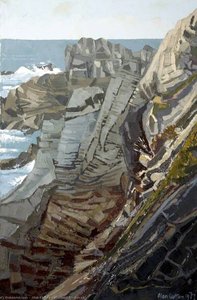
Galleriist vaadatuna on Alan Cotton kõige kuulsam teos Golden Harvest Landscape, near Gordes, Provence, France (1989), mille originaal ripub Forde House-is, Newton Abbot. County Donegal, Ireland, Slieve League in Evening Light (2007) ja Hartland IV, Devon täidavad kolmikut, mille iga silm tunnistab. Kunstnii Alan Cotton 6 teose põhjal esitleb galeriis allpool 6 kõige kuulsumat, kus iga originaal on märgitud aastaga, muuseumiga ja kirjeldatud, mis teeb selle unikaalseks.


Kümne 3 muuseumi kollektsioonid, mis sisaldavad kõige rohkem sellel lehel esitatud teoseid.
| Muuseum | Linn | Alan Cotton teosed | Selle nimekirja maalid |
|---|---|---|---|
 University of Exeter Museum |
Exeter | 4 | County Donegal, Ireland, Slieve League in Evening Light, Hartland IV, Devon, Summer Bank, Otter River, Devon |
 Forde House |
Newton Abbot | 1 | Golden Harvest Landscape, near Gordes, Provence, France |
 University of Surrey |
Guildford | 1 | Passageway through the Troodos, Northern Cyprus |
19 aastat Alan Cotton kunstitöid, aastatest 1989 aastani 2007: galeriis on esitatud iga aasta kõige kuulsamad originaalteosed järjekorras.
Vali aasta, et näha originaale.
Golden Harvest Landscape, near Gordes, Provence, France (1989), Forde House, Newton Abbot. Järgnevad County Donegal, Ireland, Slieve League in Evening Light (2007) ja Hartland IV, Devon.
Meie kataloogist leiate 6 teost kunstnikult Alan Cotton, mis on pärinevad ajastust 1989 kuni 2007.
Peamiselt University of Exeter Museum (Exeter), Forde House (Newton Abbot) ja University of Surrey (Guildford) muuseumites. Ülalpool olevate muuseumite tabelis on nendest kõik loetletud.
Sellel lehel on kõige vanem teos Golden Harvest Landscape, near Gordes, Provence, France (1989) ja kõige värskeim County Donegal, Ireland, Slieve League in Evening Light (2007).
County Donegal, Ireland, Slieve League in Evening Light, Hartland IV, Devon ja Summer Bank, Otter River, Devon: University of Exeter Museum, Exeter säilitab 4 selle lehel olevat teost.
Alan Cotton’s connection to the act of painting began with a makeshift necessity. Growing up in Redditch, Worcestershire, he started his practice as a small child using brushes fashioned from his mother’s hair. This early, tactile engagement with the medium suggests a fundamental drive to create order through sight, a motivation that would later define his approach to the landscape. He attended the local Grammar and Art Schools in Redditch, establishing a formal foundation before moving into specialized technical training.
His formal education followed a rigorous path through the Midlands and the South West. He studied at Ruskin Hall, Bourneville School of Art, before progressing to the Birmingham College of Art. This period of study provided the technical grounding necessary for his later shifts in style. He eventually completed his training at the Universities of Birmingham and Exeter, where he also earned a Masters Degree in Education. This academic background provided a structured intellectual framework to complement his practical development as a painter.
Cotton’s work is defined by a commitment to Tonalism, prioritizing atmospheric landscapes over mere visual imitation. He rejects the fleeting sensations of Impressionism in favor of subtle tonal variations that capture the essence of a specific place. His paintings explore themes of solitude and contemplation, using the natural world to establish a sense of order. This approach relies on a precise understanding of how light and shadow interact to define a landscape's mood.
The physical application of his medium is as significant as his color theory. Cotton utilizes an impasto technique with oils to build assertively textured surfaces. A decisive shift occurred early in his career when he began experimenting with a palette knife; he has hardly used a paintbrush since. This method allows him to achieve high colour keys that maintain a purity of pigment, preventing the muddying often found in heavy oil application. The resulting surfaces are not merely depictions of terrain but are tactile records of light and geological form.
Cotton’s move to Devon in the late 1960s fundamentally anchored his practice. He did not merely settle in the region; he became an integral part of its artistic infrastructure. His focus shifted toward the River Otter and the surrounding valley, where the specific light and topography of the area dictated his compositional concerns. This period saw him move beyond simple observation into a deep, sustained engagement with the Devon landscape.
His influence extended into the academic and institutional fabric of the South West. He held the position of Senior Lecturer in Painting and Art History at Rolle College Exmouth, shaping the technical approach of his students. His leadership was further cemented through his role as a founder member and president of the South West Academy of Fine and Applied Arts. This was not a period of mere residence, but one of active institutional building. His contributions to the region's cultural life were formally recognized in 2006 when the University of Exeter awarded him an Honorary Doctorate.
Cotton’s standing in the British art establishment is marked by high-profile official engagements and academic respect. In 2005, he served as Tour Artist to His Royal Highness, The Prince of Wales, accompanying him on official visits to Sri Lanka, Australia, New Zealand, and Fiji. This role placed his landscape observations in direct proximity to royal diplomacy. His influence extends into the academic sphere, where he has been appointed Hon. Professor of Arts at the University of Bath.
The recognition of his contribution to the arts reached a formal peak in 2021, when he was awarded an MBE for Services to the Arts in the South by Queen Elizabeth. This honor follows a trajectory of institutional validation, including a nomination as an icon by the Duke of Edinburgh Awards Committee in 2009. These accolades reflect a career that has moved from the private studio to the center of national cultural recognition.
Cotton’s presence in institutional collections confirms the lasting relevance of his approach to landscape. His work is held in numerous prestigious private and public collections both in the U.K. and internationally. The University of Exeter holds a significant portion of his output, with four of his works currently in their collection. These holdings demonstrate a consistent demand for his specific interpretation of light and terrain across different decades.
Specific compositions highlight his ability to translate geological and atmospheric conditions into oil. His 1989 work, Golden Harvest Landscape, near Gordes, Provence, France, captures the light of the French countryside. In contrast, his later output includes County Donegal, Ireland, Slieve League in Evening Light, dated about 2007. His depictions of the Devon coastline, such as Hartland IV, remain central to his reputation, focusing on the interaction between land and sea.
Cotton’s presence in institutional collections confirms the lasting relevance of his landscape studies. The University of Exeter maintains a significant holding of his work, securing several pieces within its permanent collection. This academic presence is mirrored by the University of Surrey in Guildford, which holds one of his paintings. These locations provide a structured way to observe his handling of light and texture within a formal setting.
Beyond these academic institutions, his work is held in Forde House, Newton Abbot. This placement ensures his depictions of the Devon landscape remain accessible within the region that shaped his mature style. His reach extends further than these specific sites, as his paintings are found in numerous prestigious private and public collections throughout the United Kingdom and internationally. This widespread distribution reflects a demand for his specific approach to tonalism and the physical application of oil paint.