

Introduction
To step into the world of graphite is to witness the raw, unadorned heartbeat of human creativity. Before the opulence of oil pigments or the vibrant complexity of tempera, there was the humble pencil—a tool of profound intimacy and stark precision. There is a unique vulnerability in a monochrome landscape; without the distraction of color, the eye is forced to confront the true essence of form, the delicate interplay of light and shadow, and the rhythmic texture of a single, sweeping stroke. It is an art of subtraction, where greatness is found not in what is added, but in what is masterfully revealed through the careful application of grey, silver, and deep, velvety black.
Throughout history, the graphite medium has served as the silent architect of the art world. From the preparatory sketches that breathed life into Renaissance frescoes to the finished, breathtakingly detailed portraits that captured the very soul of the Enlightenment, pencil work has bridged the gap between fleeting thought and permanent legacy. These works were often the first glimpses into an artist's private studio—the spontaneous, unmasked moments where genius meets paper. Culturally, these masterpieces represent a democratization of beauty, proving that profound emotional depth does not require expensive minerals or rare pigments, but merely a steady hand and a keen eye for the nuances of the natural world.
Today, these legendary works remain as vital as ever. In an era dominated by the hyper-saturated imagery of digital screens, the monochromatic depth of a graphite masterpiece offers a sanctuary of focus. They remind us that true atmosphere is born from contrast and that a subtle gradient can evoke more emotion than a thousand colors. As we journey through this curated selection, we will explore ten pivotal works that redefined the boundaries of the medium—pieces that transformed simple carbon and clay into eternal monuments of human expression. Prepare to see the world not in color, but in its most fundamental, breathtakingly beautiful light and shadow.
Salisbury cathedral - John Constable
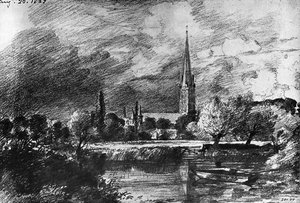 Salisbury cathedral - John Constable
In Salisbury Cathedral , the graphite lines of John Constable are not merely drawn; they are choreographed . This is not a simple sketch of a monument, but a dance frozen in time , where the weight of English Gothic architecture meets the ephemeral movement of the natural world. Through meticulous hatching and delicate cross-hatching, Constable captures the soaring spire—the tallest in England—as it pierces an expansive, overcast sky.
The composition achieves a profound equilibrium, balancing the geometric grandeur of the cathedral with the organic textures of riverbanks and weeping trees. The monochrome palette strips away distraction, forcing the eye to find rhythm in the interplay of light and shadow. It is a masterclass in making architectural chaos feel like absolute harmony. For the discerning collector, bringing this piece into a home allows your walls to breathe rhythm , offering a window into the Romantic era’s sublime tranquility. Whether you are seeking a focal point for a contemporary study or a classic library, this masterpiece serves as a silent, powerful testament to human endeavor and nature's enduring peace.
Girl Kneeling in Front of a Cradle - vincent willem van gogh
 Girl Kneeling in Front of a Cradle - vincent willem van gogh
In the quiet, monochromatic depths of "Girl Kneeling in Front of a Cradle," we are invited into a private sanctuary of domestic devotion. Created in 1883, this exquisite graphite work by Vincent van Gogh captures a fleeting moment of profound tenderness that transcends the simple boundaries of a sketch. While the world celebrates his explosive, sun-drenched oils, this early masterpiece earns its place among the legendary pencil works through its raw, emotional vitality and masterful use of hatching to create texture and soul.
Van Gogh utilizes rhythmic, expressive linework to breathe life into the wooden cradle and soft fabrics, finding extraordinary beauty in the humble rituals of care. This piece is a testament to how graphite can convey deep psychological weight through mere shadow and stroke. At OriginalUniqueArt.com , we believe such profound moments should not be confined to museum archives. You can bring this sense of grounded, soulful warmth into your own home or office with a hand-painted oil reproduction , meticulously crafted by our artists to preserve every visible brushstroke and emotional nuance of Van Gogh's original vision.
Studies of a horse - Leonardo da Vinci
 Studies of a horse - Leonardo da Vinci
To gaze upon Studies of a Horse by Leonardo da Vinci is to witness the rhythmic geometry of nature itself. The composition is a masterclass in structural harmony, where the organic curves of equine musculature are balanced against precise, vertical proportional marks and faint gridlines. These intersecting lines create a mathematical equilibrium, transforming a scientific inquiry into a dance of shapes that feels both grounded and ethereal. This delicate interplay of dark grey-brown graphite strokes against the aged, warm paper captures a sense of timeless perfection that has secured its place among the top 10 legendary graphite pencil masterpieces .
There is a profound, quiet prestige in Leonardo’s ability to find order within anatomical complexity. The work’s internal balance—the way weight and tension are distributed across the page—mirrors the principles of modern minimalist design, offering a sophisticated anchor for contemporary, clean aesthetics. For those seeking to bring a touch of Renaissance intellect into a modern home, this study provides a soulful connection to the era of discovery, where every shadow and sinew tells a story of eternal motion.
Houses by the Sea - Claude Monet
 Houses by the Sea - Claude Monet
What story does the salt-misted coastline of Houses by the Sea tell? In this 1864 graphite study, Claude Monet captures more than mere architecture; he captures the very breath of the Atlantic. Created during his formative years, this piece stands as a cornerstone in our selection of the Top 10 Legendary Graphite Pencil Masterpieces because it marks the precise moment the artist began to abandon academic rigidity for the ephemeral beauty of light and atmosphere.
Through masterful hatching and cross-hatching, Monet uses varying pencil densities to sculpt shadows and suggest the textured grasses of a coastal path. There is no photographic precision here, only the pursuit of a fleeting sensory experience. For the modern collector, bringing such a work into a home offers a curated escape—a window into a serene, monochromatic world where the interplay of light and shade provides a timeless, sophisticated focal point. Whether you are drawn to its historical significance or its ability to evoke a sense of coastal tranquility, this drawing remains an essential study in the power of simple graphite to convey profound depth.
Standing pair of Lovers, Seen from the Side - Gustav Klimt
 Standing pair of Lovers, Seen from the Side - Gustav Klimt
In the quiet, evocative lines of Gustav Klimt’s “Standing Pair of Lovers, Seen from the Side,” we are invited into a private sanctuary of affection. Created around 1908, this masterful graphite work transcends mere sketchwork to become a profound exploration of human connection. Its inclusion in our selection of legendary graphite masterpieces is earned through its ability to strip away the distractions of color, focusing entirely on the tender geometry of two souls in embrace. Through meticulous hatching and subtle traces of gold, Klimt captures a palpable sense of weight and texture, turning simple pencil strokes into an ethereal glow.
This piece serves as a quintessential specimen of Art Nouveau , where organic motifs and swirling patterns symbolize the interconnected nature of life. At OriginalUniqueArt.com, we believe such profound intimacy should not be confined to museum archives. Imagine this delicate interplay of light and shadow as a living part of your personal sanctuary. By bringing a high-quality oil reproduction of this masterpiece into your home, you transform a simple wall into a sophisticated statement of emotional depth and historical prestige.
Woman with Hat, Coat and Pleated Dress - vincent willem van gogh
 Woman with Hat, Coat and Pleated Dress - vincent willem van gogh
Before the world fell in love with his swirling celestial skies, Vincent van Gogh mastered the profound intimacy of monochrome. "Woman with Hat, Coat and Pleated Dress" stands as a cornerstone of our list because it captures the raw, psychological depth achievable through mere graphite. In this 1882 study, Van Gogh eschews the bravado of color to focus on the rhythmic soul of line. Through energetic hatching and cross-hatching , he breathes life into the heavy drape of a coat and the delicate pleats of a dress, transforming a fleeting Parisian moment into an eternal meditation on solitude.
This masterpiece ranks among the greatest graphite works for its ability to convey movement and emotion through texture alone. It invites us to find beauty in the understated and strength in the shadows. For the modern collector, bringing this sense of quiet, academic excellence into a home offers a sophisticated anchor—a timeless conversation between historical mastery and contemporary elegance. Whether displayed as a singular focal point or part of a curated gallery wall, its monochromatic grace provides a soulful depth that transcends eras.
El Vagabundo - Pablo Picasso
 El Vagabundo - Pablo Picasso
In the quiet, textured depths of Pablo Picasso’s "El Vagabundo," you encounter more than a mere sketch; you meet a profound meditation on the human condition. Created between 1907 and 1908, this monochrome masterpiece does not simply depict a wanderer; its lines are choreographed to evoke the very essence of solitude. The graphite strokes aren't merely drawn; they are a dance of shadow and light, where varying pressures create a palpable sense of the man's weathered skin and heavy clothing.
The composition is a study in architectural strength, placing a solitary figure against the distant, sharp silhouette of a church steeple—a tension between the transient individual and the permanent structures of faith. This work is a dance frozen in time , making the chaos of existence feel like harmony through remarkable restraint. For those seeking to bring this same intellectual depth to their own environment, our museum-quality oil reproductions capture every expressive hatch mark and tonal nuance. Imagine your walls breathing with the rhythm of Picasso’s early genius, transforming a modern space into a gallery of historical significance.
Untitled (95) - Pablo Picasso
 Untitled (95) - Pablo Picasso
In the somber shadows of 1936, as the Spanish Civil War began to fracture Europe, Pablo Picasso captured a moment of profound psychological tension in Untitled (95) . This graphite and charcoal study is far more than a sketch; it is a visceral, fragmented echo of human suffering. Through his signature Cubist vocabulary, Picasso presents three nude female figures intertwined in a tightly compressed tableau. The lack of spatial depth creates a palpable sense of claustrophobia, serving as a visual metaphor for the confinement of wartime upheaval.
The technical execution is masterfully austere, utilizing muted shades of blue-gray and white to create an ethereal, ghostly atmosphere. Picasso’s use of meticulous hatching and bold, angular lines builds volume while simultaneously distorting anatomy, capturing the raw energy of a breaking psyche. Owning a piece of this magnitude isn’t merely a purchase; it is an inheritance of a lineage of taste. At OriginalUniqueArt.com, we allow you to bring this legacy into your own home through museum-quality, hand-painted oil reproductions that preserve the very soul and texture of Picasso's legendary pencil strokes.
Fisherman with Sou'wester, head - vincent willem van gogh
 Fisherman with Sou'wester, head - vincent willem van gogh
Before the world knew him for the swirling celestial skies of The Starry Night , Vincent van Gogh was deeply immersed in the gritty, tactile reality of the working class. In 1883, while navigating his formative years, he produced “Fisherman with Sou'wester, head,” a work that captures a raw, unvarnished moment of human existence through nothing more than graphite and paper. This piece is far more than a mere sketch; it is a masterclass in the technical genius of hatching and cross-hatching. By layering dense, expressive pencil strokes, Van Gogh achieved a sculptural depth, rendering the weathered texture of the fisherman’s skin and the heavy, salt-drenched fabric of his maritime gear with startling realism.
The subject's downward gaze and slightly parted lips evoke a profound sense of weary contemplation, inviting the viewer into a silent dialogue with the hardships of sea life. This intense focus on character and texture serves as a precursor to his later, more emotive masterpieces. Such a powerful display of concentration and atmospheric depth makes this drawing an ideal inspiration for a modern study or home office, where the quiet strength of Van Gogh’s precision can foster an environment of deep thought and creative discipline.
Study of Jewish Bride - Rembrandt van Rijn
 Study of Jewish Bride - Rembrandt van Rijn
To encounter Rembrandt van Rijn’s Study of Jewish Bride is to witness a profound moment of Baroque intimacy captured through the raw, tactile power of graphite and pencil. Created around 1635, this work transcends mere sketching; it is a psychological masterclass where light and shadow—the legendary chiaroscuro —sculpt a face of breathtaking vulnerability. The artist’s hand moves with an urgent precision, using tonal gradations to define the soft contours of the subject's gaze, which confronts the viewer with an unwavering, soulful intensity.
This study serves as a spiritual precursor to his monumental oil canvases, acting as a window into Rembrandt’s meticulous process of capturing human emotion. Owning a piece inspired by such a masterpiece isn’t merely a purchase; it is an inheritance of the Dutch Golden Age. At OriginalUniqueArt.com, we allow you to bring this lineage of taste into your own home. Through our professional hand-painted oil reproductions, the dramatic interplay of light and the textured depth of the master's vision are reimagined on canvas, ensuring that this legendary legacy becomes a permanent part of your personal gallery.
Conclusion
As the light fades on our journey through these graphite marvels, we are left with more than just a memory of fine lines and delicate shadows; we carry with us the profound realization that the simplest of tools—a mere piece of carbon and paper—can capture the infinite complexity of the human soul. These masterpieces are not merely static relics preserved behind museum glass, frozen in a distant era; they are living presences, breathing with an enduring vitality that continues to shape our perceptions of beauty, depth, and truth. Each stroke of the pencil serves as a silent, rhythmic heartbeat, connecting us across centuries to the hands of masters who dared to find light within the darkness.
To live with such works is to invite a daily dialogue with greatness. When these textures and tones are brought into our own homes, they transform mere walls into windows of inspiration, offering a sanctuary of grace amidst the noise of modern life. They serve as gentle reminders that even in the most understated medium, there exists an inexhaustible capacity for wonder. We invite you to continue this exploration and find a piece of this timeless legacy to call your own by browsing our full collection . May these shadows and highlights inspire your own space with the same quiet, transformative power that has moved hearts for generations.


