Early Life & Parisian Training: Shaping Beckwith’s Artistic Foundation
--- title: Biographical Note | A Finding Aid to the James Carroll Beckwith papers, 1871-circa 1991, bulk 1875-1917 | Digitized Collection | Archives of American Art, Smithsonian Institution url: https://www.aaa.si.edu/collections/james-carroll-beckwi...
James Carroll Beckwith, born in Hannibal, Missouri in 1852, emerged from a landscape steeped in the burgeoning American spirit of exploration and self-discovery. Though his formative years unfolded in Chicago—a city rapidly rebuilding after the devastating Great Fire of 1871—it was not the raw energy of the Midwest that would ultimately define his artistic trajectory, but rather the refined traditions he encountered during an extended sojourn to Paris. Beckwith’s family background, with distant ties to fur trader James Murray Yale, hints at a lineage connected to the very landscapes that would later captivate his brush. His initial studies at the Chicago Academy of Design under Walter Shirlaw provided a foundational grounding, abruptly interrupted by the fire. This upheaval proved fortuitous, propelling him eastward to New York and ultimately across the Atlantic.
In Paris, from 1873 to 1878, Beckwith immersed himself in the heart of the art world. He enrolled at the prestigious École des Beaux-Arts, but it was his tutelage under Carolus-Duran that proved most transformative. Duran’s emphasis on meticulous draftsmanship and a sophisticated understanding of light resonated deeply with the young American artist. Sharing studio space with John Singer Sargent further enriched Beckwith's experience, fostering a collaborative environment where technical skill and artistic ambition flourished. This period wasn’t merely about acquiring technique; it was an absorption into a culture that valued elegance, historical awareness, and a nuanced approach to representation—qualities that would become hallmarks of his mature style.
The Naturalist Style & Luminist Influences in Beckwith's Landscapes
Luminism is a style of American landscape painting from the 1850s to 1870s, characterized by effects of light in a landscape, through the use of aerial perspective and the concealing of visible brushstrokes. Luminist landscapes emphasize tranquility,...
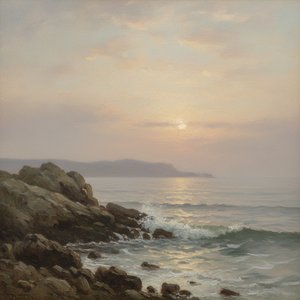
Upon returning to the United States in 1878, Beckwith quickly established himself as a prominent figure within the American art scene. His work is often categorized as Naturalist, reflecting a commitment to depicting scenes with remarkable accuracy and detail. However, to label him solely as a naturalist overlooks the subtle yet profound influence of Luminism—a style that prioritized atmospheric effects and the evocative power of light. While not strictly adhering to all tenets of Luminism, Beckwith’s landscapes share its emphasis on tranquility, calm waters, and soft, hazy skies. Consider his ‘Arcade of the Grand Trianon, Versailles’; it isn't a precise topographical rendering but rather an impressionistic evocation of light filtering through the elegant architecture, capturing a serene moment suspended in time.
Beckwith’s approach differed from the more dramatic compositions favored by some Hudson River School painters. He eschewed grand vistas and instead focused on intimate scenes—quiet corners of gardens, reflective waterways, and sun-dappled forests. This preference for subtlety allowed him to explore the nuances of light and atmosphere with exceptional skill. He masterfully employed aerial perspective, creating a sense of depth and distance that drew the viewer into his landscapes. The concealing of visible brushstrokes further enhanced this effect, lending his paintings an ethereal quality—a luminous stillness that invites contemplation.
Portraits and Murals: Expanding Beyond the Landscape Genre
 Margharite
Explore 'Margharite' by James Carroll Beckwith – a captivating Impressionistic portrait of a young woman. Discover its Parisian-influenced style & luminous technique.
While Beckwith’s landscapes secured his initial reputation, he was a remarkably versatile artist who excelled in portraiture and mural painting. His talent as a draftsman made him particularly sought after for portraits, where he captured not only physical likeness but also the character and personality of his sitters. Among his notable subjects were William Merritt Chase, Theodore Roosevelt, and Thomas Allibone Janvier—individuals who represented the intellectual and social elite of American society. These portraits are characterized by a refined elegance and attention to detail, reflecting his Parisian training.
Beckwith’s foray into mural painting further demonstrated his artistic range. He contributed to several significant projects, including work at the World Columbian Exposition in Chicago in 1893. These murals required a different skillset—a broader approach to composition and a mastery of large-scale execution. However, Beckwith seamlessly transitioned between these diverse mediums, consistently maintaining a high level of technical skill and artistic integrity. His ability to adapt his style while remaining true to his core aesthetic principles solidified his position as a respected figure in American art.
Spiritual Undercurrents & Transcendentalism in Beckwith’s Work
Beneath the surface realism of Beckwith's paintings lies a subtle yet pervasive spiritual undercurrent. While not overtly religious, his landscapes often evoke a sense of awe and reverence for nature—a quality that aligns with the principles of Transcendentalism. The quiet intimacy of his scenes, the emphasis on light and atmosphere, and the absence of human activity all contribute to this feeling of contemplative serenity. His paintings aren’t simply depictions of places; they are invitations to connect with something larger than oneself.
The influence of Transcendentalist thinkers like Ralph Waldo Emerson and Henry David Thoreau—who championed the inherent goodness of nature and the importance of individual intuition—can be detected in Beckwith's work. His landscapes suggest a belief that nature holds profound spiritual truths, accessible through quiet observation and contemplation. This subtle spirituality resonated with audiences seeking solace and meaning in a rapidly changing world. The luminous quality of his paintings can be interpreted as a metaphor for the divine presence within nature—a sense of transcendence experienced through artistic representation.
Beckwith’s Legacy & Place within American Art History
 James Carroll Beckwith
Discover James Carroll Beckwith (1852-1917), an American naturalist painter renowned for his detailed portraits, landscapes & murals influenced by Parisian training. Explore his legacy!
James Carroll Beckwith, though perhaps not as widely recognized today as some of his contemporaries, occupies an important place in American art history. His mastery of the Naturalist style, combined with his subtle embrace of Luminist principles, created a unique artistic voice that resonated with audiences during the late 19th and early 20th centuries. He was elected to the National Academy of Design in 1894—a testament to his peers’ recognition of his talent and skill.
Beckwith's legacy extends beyond his paintings themselves. As a professor at the Art Students League of New York, he mentored generations of aspiring artists, imparting his knowledge of technique and aesthetic principles. His papers, including sketchbooks and diaries held by the National Academy of Design, offer valuable insights into his artistic process and intellectual life. Today, Beckwith’s work is increasingly appreciated for its quiet beauty, technical skill, and subtle spiritual depth—a testament to the enduring power of a truly accomplished artist.
Collecting Beckwith Today: A Guide for Enthusiasts
For collectors seeking to acquire works by James Carroll Beckwith, opportunities exist across various price points. While major portraits command higher values, smaller landscapes and studies are often more accessible. Auction records indicate that prices range considerably depending on size, subject matter, and provenance. It’s important to research thoroughly and consult with reputable art dealers or appraisers before making a purchase.
When evaluating a Beckwith painting, pay close attention to the quality of light and atmosphere— hallmarks of his style. Look for subtle brushwork and a sense of depth created through aerial perspective. Authenticity is crucial; verifying provenance and seeking expert opinions are essential steps in ensuring a sound investment. OriginalUniqueArt.com offers high-quality reproductions of Beckwith’s most celebrated works, allowing enthusiasts to experience his artistry firsthand. Whether you're a seasoned collector or simply appreciate the beauty of American Luminism, James Carroll Beckwith’s paintings offer a captivating glimpse into a bygone era—a testament to the enduring power of art to inspire and uplift.