Lülita trükkitoodetele
 Loe lähemalt







































 Kunstiteoste või reproduktsioonide puhul, mille üks külg on üle 105 cm (umbikmolt 41 tolli), saadetakse raam kirjal asendis, la Dismantlitud komplektina. See meetod tagab ohutuse kohaletoimetamisel ja väldib transpordil tekkivaid kahjustusi.


A Symphony of Light and Leisure
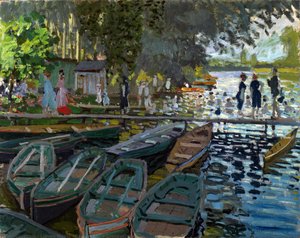
Claude Monet’s The Beach at Trouville, NG London is far more than a mere depiction of a seaside scene; it is a profound embodiment of the Impressionist philosophy, capturing the fleeting beauty of light and atmosphere. Created in 1870 during an idyllic summer sojourn with his wife Camille and son Jean at Trouville-sur-Seine, this oil on canvas invites viewers into a world where time seems to suspend itself. The painting orchestrates a delicate tableau of leisure and tranquility, where the sandy shore becomes a stage for quiet human moments. Several figures populate the coast—two women are seated beneath an umbrella, one delicately holding a parasol to shield herself from the sun’s glare, while another stands nearby, observing the scene with quiet contemplation. Scattered amongst them are other individuals enjoying the coastal air, adding a sense of depth and gentle dynamism to the composition.
The atmosphere is anchored by a boat visible in the background, a subtle reminder of Trouville's role as a burgeoning seaside resort during the late Victorian era. A lone chair rests on the beach, an evocative element that invites the observer to imagine themselves immersed in this serene environment. Through these elements, Monet captures not just a location, and not just a moment, but the very essence of a summer afternoon spent by the sea.
The Mastery of Impressionist Technique
In this work, Monet’s Impressionist style is instantly recognizable through its emphasis on luminous color palettes and loose, expressive brushstrokes. This was a deliberate rejection of the rigid academic conventions that favored meticulous detail and heavy shading. Instead, Monet abandons traditional techniques, opting for broken color to convey the shimmering effects of sunlight filtering through the air. The soft hues of ochre, lemon yellow, and pale blues coalesce into a harmonious blend that evokes feelings of warmth and serenity.
This approach was profoundly influenced by his mentor, Eugène Boudin, whose encouragement to paint en plein air—directly from nature—revolutionized the artist's practice. By working outdoors, Monet was able to translate the vibration of light onto the canvas, making the air itself feel palpable. For collectors and interior designers, this technique offers a unique sensory experience; the painting does not merely sit upon a wall but breathes with the light of the room, providing a sense of movement and organic beauty that can transform any space.
An Enduring Legacy for the Modern Collector
As a pivotal contribution to the Impressionist movement, The Beach at Trouville, NG London stands as a testament to Monet's ability to find the extraordinary within the ordinary. The painting captures the very breath of a moment, much like a memory that refuses to fade. Its emotional impact lies in its ability to evoke nostalgia and peace, making it an ideal centerpiece for those seeking to infuse their surroundings with a sense of historical elegance and natural tranquility.
Whether viewed as a window into the late 19th-century coastal life or as a masterclass in color theory, this artwork remains a profound inspiration. For those looking to acquire a high-quality reproduction, this piece offers an opportunity to possess a fragment of art history—a piece that celebrates the simple, sun-drenched joy of existence and the eternal dance of light upon the shore.
Korduvad küsimused
Millist emotsiooni edastab Impressionism suunaga teos "The Beach at Trouville, NG London"?
Impressionism suunangu raames on teos "The Beach at Trouville, NG London" üles seabetud Rahu ja vaikus toonil.
Mis vanuses loos Claude Monet teose "The Beach at Trouville, NG London"?
Kui teos "The Beach at Trouville, NG London" loodi aastal 1870, oli Claude Monet (sündinud aastal 1840) 30 aastane.
Kas ma saan teost „The Beach at Trouville, NG London“, autor Claude Monet enne tellimist eelvaatata?
Teose „The Beach at Trouville, NG London“, autor Claude Monet eelvaade on saadaval teose Eelvaade lehel.
 Eelvaade
 Saada
Saada Jaga
Jaga
 Teave teose kohta
 Juhend

 Laadi alla
 Sarnased teosed
 Röntgenuuring
 Slaidietendus
 KÜSIMUSED JA VASTUSID
 Statistika