Utagawa Kuniyoshi portree

Utagawa Kuniyoshi maalid: 100 kuulsumat teost galeriin läbi

Uuendatud november 2026 · järjestatud meie populaarsusindeksi järgi (otsingud, külastused ja tellimused igale teosele) · 329 teost Utagawa Kuniyoshi meie kataloogis

Lühidalt

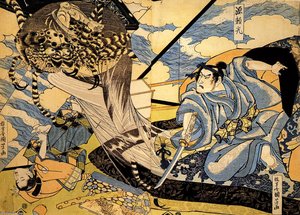
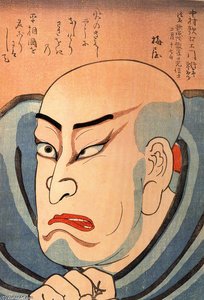
Galleriile on Utagawa Kuniyoshi kõige kuulsam teos Musashi on the back of a whale. Shikamatsu Kanroku Yukishige (1847) ja Hatakeyama sitting next to a Go board (1845) täidavad kolmikut, mille iga silm tunnistab. Kunstnii Utagawa Kuniyoshi 329 teose põhjal esitleb galeriis allpool 100 kõige kuulsumat, kus iga originaal on märgitud aastaga, muuseumiga ja kirjeldatud, mis teeb selle unikaalseks.

1798 – 1861, Tokio Ukiyo-e Enamama teoseid: Keio University Library

Galeria 10 parimat Utagawa Kuniyoshi maali

1
Musashi on the back of a whale autor Utagawa Kuniyoshi

Musashi on the back of a whale

Woodblock Print

This arresting image, a masterful execution of Ukiyo-e by the legendary artist Utagawa Kuniyoshi, transports us to 19th century Japan. Kuniyoshi, born Yoshisaburō in 1798 and tragically passing in 1861, was a pivotal figure at the close of the *ukiyo-e* movement – a vibrant artistic tradition that captured the essence of everyday life during the Edo period. This particular scene, depicting Musashi, the famed swordsman, astride a colossal whale, is…

2
Shikamatsu Kanroku Yukishige (1847) autor Utagawa Kuniyoshi

Shikamatsu Kanroku Yukishige

1847 · Woodblock Print

Utagawa Kuniyoshi’s “Shikamatsu Kanroku Yukishige” (circa 1847) is more than a depiction of a samurai; it’s a potent distillation of Japanese heroism, loyalty, and the fleeting beauty of a moment captured in woodblock form. This iconic image, part of Kuniyoshi's celebrated series “Stories of the True Loyalty of the Faithful Samurai,” transports us to a pivotal scene from the classic tale of Suikoden – a story of betrayal, redemption, and…

3
Hatakeyama sitting next to a Go board (1845) autor Utagawa Kuniyoshi

Hatakeyama sitting next to a Go board

1845 · Acrylic On Canvas

Utagawa Kuniyoshi’s “Hatakeyama Sitting Next to a Go Board” is more than just a depiction of a solitary figure; it's a window into the heart of 19th-century Japan. Painted in 1845, during a period of immense social and artistic change, this ukiyo-e masterpiece captures a quiet moment of contemplation – a scene imbued with layers of meaning reflecting the values and aesthetics of the Edo period. Kuniyoshi, one of the…

4
Yukukawa Sanpei Munenori (1848) autor Utagawa Kuniyoshi

Yukukawa Sanpei Munenori

1848 · Acrylic

This exceptional ukiyo-e print, created in 1848 by the master artist Utagawa Kuniyoshi, offers a captivating glimpse into the world of Edo-period Japan. Depicting Yukukawa Sanpei Munenori, a figure likely rooted in historical or legendary lore, the artwork is far more than a simple portrait; it’s a dynamic tableau brimming with action, symbolism, and the raw energy of a warrior's spirit. Kuniyoshi’s skill lies not just in his technical prowess…

5
The Twenty-four Paragons of Filial Piety in China , Script by Tanekazu : Min Ziqian (Bin Shiken) (1852) autor Utagawa Kuniyoshi

The Twenty-four Paragons of Filial Piety in China , Script by Tanekazu : Min Ziqian (Bin Shiken)

1852 · Woodblock Print · Keio University Library, Tokio

Utagawa Kuniyoshi’s “The Twenty-Four Paragons of Filial Piety,” created circa 1848/50, stands as a pinnacle achievement of *ukiyo-e*, the Japanese woodblock print tradition that flourished during the Edo period. More than just a visually arresting spectacle—a sprawling landscape dominated by towering mountains rendered in subtle shades of azure—this monumental print delves into profound philosophical concepts rooted in Buddhism and Confucianism, offering a timeless meditation on reverence for ancestors and the…

6
Ôtaka Gengo Tadao (1848) autor Utagawa Kuniyoshi

Ôtaka Gengo Tadao

1848 · Woodblock Print

Within the vibrant tapestry of Ukiyo-e prints, few images capture the raw power and stoic determination of a warrior quite like Utagawa Kuniyoshi's "Otaka Gengo Tadao," created in 1848. This remarkable woodblock print isn’t merely a depiction of a samurai; it’s a window into the heart of Edo-period Japan, brimming with tales of loyalty, honor, and the enduring spirit of martial prowess. Kuniyoshi, one of the last masters of this…

7
Oki no Jiro Hiroari killing a monstrous tengu autor Utagawa Kuniyoshi

Oki no Jiro Hiroari killing a monstrous tengu

Woodblock Print

In the vibrant world of Ukiyo-e, few scenes command the eye with as much visceral intensity as Utagawa Kuniyoshi’s masterpiece, Oki no Jiro Hiroari killing a monstrous tengu. This dynamic mythological painting serves as a window into a moment of profound struggle, where the boundaries between the human and the supernatural blur amidst a backdrop of dark, foreboding shadows. The composition is anchored by the figure of Oki no Jiro…

8
Battle of Uji River. Uji kawa kassen no zu autor Utagawa Kuniyoshi

Battle of Uji River. Uji kawa kassen no zu

Acrylic On Canvas · Hammer Museum, Los Angeles

Utagawa Kuniyoshi’s “Battle of Uji River,” painted between 1848 and 1850, stands as a quintessential example of *nishiki-e*, or polychrome woodblock printing, capturing the fervor and grandeur of samurai warfare against a backdrop of breathtaking natural beauty. This monumental print transcends mere depiction; it’s an immersive experience designed to evoke emotion and convey profound themes of courage, resilience, and the ephemeral nature of glory.

Utagawa Kuniyoshi maalid, järjestus 11 kuni 100

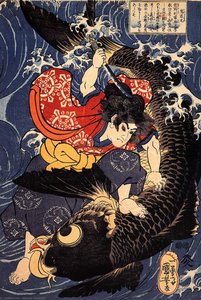
11The Twenty-four Paragons of Filial Piety in China , Script by Tanekazu : Ding Lan (Tei Ran) (1852) autor Utagawa KuniyoshiThe Twenty-four Paragons of Filial Piety in China , Script by Tanekazu : Ding Lan (Tei Ran)1852 · Keio University Library 12Thirty-six Famous Battles (1848) autor Utagawa KuniyoshiThirty-six Famous Battles1848 13Kiura Okaemon Sadayuki (1848) autor Utagawa KuniyoshiKiura Okaemon Sadayuki1848 14The Heavenly Weaver and the Heardsman (1842) autor Utagawa KuniyoshiThe Heavenly Weaver and the Heardsman1842 · Bristol Museum - Art Gallery 15Yata Gorôemon Suketake (1848) autor Utagawa KuniyoshiYata Gorôemon Suketake1848 16Oniwakamaru and the Giant Carp Fighting Underwater (1835) autor Utagawa KuniyoshiOniwakamaru and the Giant Carp Fighting Underwater1835 17A Votive Tablet with Masks of Kabuki Actors at Face Value autor Utagawa KuniyoshiA Votive Tablet with Masks of Kabuki Actors at Face ValueFukuoka City Museum 18The actor (12) autor Utagawa KuniyoshiThe actor (12) 19The Sixth Month (Right) (1849) autor Utagawa KuniyoshiThe Sixth Month (Right)1849 · British Museum 20Bon-bon Uta,Children autor Utagawa KuniyoshiBon-bon Uta,ChildrenFukuoka City Museum 21Scene from the play “The Life of Onoe Kikugorō III”\n\nScene from the play “The Life of Onoe Kikugorō III” (1847) autor Utagawa KuniyoshiScene from the play “The Life of Onoe Kikugorō III”\n\nScene from the play “The Life of Onoe Kikugorō III”1847 · The Art Museum RIGA BOURSE 22Minamoto Yorimitsu also known as Raiko autor Utagawa KuniyoshiMinamoto Yorimitsu also known as Raiko 23Mount Fuji from the Sumida River embankment (1842) autor Utagawa KuniyoshiMount Fuji from the Sumida River embankment1842 24A record of origins of the great country of Japan autor Utagawa KuniyoshiA record of origins of the great country of Japan 25The actor (16) autor Utagawa KuniyoshiThe actor (16) 26Seaweed Gatherers at Omari (1833) autor Utagawa KuniyoshiSeaweed Gatherers at Omari1833 27The ghost of Taira Tomomori autor Utagawa KuniyoshiThe ghost of Taira Tomomori 28Thaishun with elephants autor Utagawa KuniyoshiThaishun with elephants 29Raiko tormented by the earth spider autor Utagawa KuniyoshiRaiko tormented by the earth spider 30Benkei holdin a halberd autor Utagawa KuniyoshiBenkei holdin a halberd 31A samurai overwhelming a giant serpent autor Utagawa KuniyoshiA samurai overwhelming a giant serpent 32The Famous Unrivalled Hidari Jingoro autor Utagawa KuniyoshiThe Famous Unrivalled Hidari Jingoro 33Samurai and the conquered autor Utagawa KuniyoshiSamurai and the conquered 34Kamigashihime stabbing a giant spider autor Utagawa KuniyoshiKamigashihime stabbing a giant spider 35Vesper bell at Todaiji autor Utagawa KuniyoshiVesper bell at Todaiji 36Oniwakamaru about to kill the giant carp autor Utagawa KuniyoshiOniwakamaru about to kill the giant carp 37Uneme is exorcising the monstrous serpent from the lake autor Utagawa KuniyoshiUneme is exorcising the monstrous serpent from the lake 38Shoki and Demon, Edo period (1850) autor Utagawa KuniyoshiShoki and Demon, Edo period1850 · Arthur M. Sackler Gallery 39Nichiren going into exile on the island of Sado autor Utagawa KuniyoshiNichiren going into exile on the island of Sado 40Uchiwakamaru fighting Benkei on Gojo bridge autor Utagawa KuniyoshiUchiwakamaru fighting Benkei on Gojo bridge 41The young Benkei holding a pole autor Utagawa KuniyoshiThe young Benkei holding a pole 42New edition of the life of a hundred generals autor Utagawa KuniyoshiNew edition of the life of a hundred generals 43Sharks autor Utagawa KuniyoshiSharks 44Koga Saburo, suspendeding a basket, watching a dragon autor Utagawa KuniyoshiKoga Saburo, suspendeding a basket, watching a dragon 45Kamei Rokuro and the Black Bear in the Snow (1849) autor Utagawa KuniyoshiKamei Rokuro and the Black Bear in the Snow1849 46Hattara Sonja with his white tiger autor Utagawa KuniyoshiHattara Sonja with his white tiger 47Ishi-jo, wife of Oboshi Yoshio, one of the loyal ronin (1848) autor Utagawa KuniyoshiIshi-jo, wife of Oboshi Yoshio, one of the loyal ronin1848 48Untitled (D2X8SB) (801) autor Utagawa KuniyoshiUntitled (D2X8SB)801 · Metropolitan Museum of Art 49Yoshida Sadaemon Kanesada (1848) autor Utagawa KuniyoshiYoshida Sadaemon Kanesada1848 50Hara Gôemon Mototoki (1848) autor Utagawa KuniyoshiHara Gôemon Mototoki1848 51Woodcut (1852) autor Utagawa KuniyoshiWoodcut1852 · Museum of Far Eastern Antiquities 52Woodcut (1852) autor Utagawa KuniyoshiWoodcut1852 · Museum of Far Eastern Antiquities 53Island Enoshima. The Fuji can be seen far away autor Utagawa KuniyoshiIsland Enoshima. The Fuji can be seen far away 54Hayano Kanpei Tsuneyo (1848) autor Utagawa KuniyoshiHayano Kanpei Tsuneyo1848 · Cleveland Museum of Art 55In the Waves at Kakuda enroute to Sado Island, Edo period (1835) autor Utagawa KuniyoshiIn the Waves at Kakuda enroute to Sado Island, Edo period1835 · Arthur M. Sackler Gallery 56Woman selling decorative bowls autor Utagawa KuniyoshiWoman selling decorative bowls 57A fierce depiction of Uesugi Kenshin seated (1844) autor Utagawa KuniyoshiA fierce depiction of Uesugi Kenshin seated1844 58The Twenty-four Paragons of Filial Piety in China, Script by Tanekazu : Emperor Wen of Han (Kan no Buntei) (1852) autor Utagawa KuniyoshiThe Twenty-four Paragons of Filial Piety in China, Script by Tanekazu : Emperor Wen of Han (Kan no Buntei)1852 · Keio University Library 59The Twenty-four Paragons of Filial Piety in China , Script by Tanekazu : Cai Shun (Sai Jun) (1852) autor Utagawa KuniyoshiThe Twenty-four Paragons of Filial Piety in China , Script by Tanekazu : Cai Shun (Sai Jun)1852 · Keio University Library 60Isoai Jûroemon Masahisa (1848) autor Utagawa KuniyoshiIsoai Jûroemon Masahisa1848 61Tokuda Sadaemon Yukitaka (1848) autor Utagawa KuniyoshiTokuda Sadaemon Yukitaka1848 62Tamakatzura Tamatori attacked by the octopus autor Utagawa KuniyoshiTamakatzura Tamatori attacked by the octopus 63Bijin with a dog in the snow (1845) autor Utagawa KuniyoshiBijin with a dog in the snow1845 64From Suikoden of Japanese Heroes autor Utagawa KuniyoshiFrom Suikoden of Japanese Heroes 65Hatakeyama Shigetada autor Utagawa KuniyoshiHatakeyama Shigetada 66The sailor Tokuso and the sea monster autor Utagawa KuniyoshiThe sailor Tokuso and the sea monster 67Tokiwa Gozen in the snow autor Utagawa KuniyoshiTokiwa Gozen in the snow 68Mongaku doing penace at the Nachi waterfall autor Utagawa KuniyoshiMongaku doing penace at the Nachi waterfall 69Eight Hundred Heroes of Our Country autor Utagawa KuniyoshiEight Hundred Heroes of Our Country 70The suicide of morozumi Masakiyo autor Utagawa KuniyoshiThe suicide of morozumi Masakiyo 71Tametomo rescued from the sea monster by tengu autor Utagawa KuniyoshiTametomo rescued from the sea monster by tengu 72Miyamoto Musashi killing a giant autor Utagawa KuniyoshiMiyamoto Musashi killing a giant 73The Twenty-four Paragons of Filial Piety in China , Script by Tanekazu : Tanzi (Enshi) (1852) autor Utagawa KuniyoshiThe Twenty-four Paragons of Filial Piety in China , Script by Tanekazu : Tanzi (Enshi)1852 · Keio University Library 74The Twenty-four Paragons of Filial Piety in China , Script by Tanekazu : Jiang Shi (Kyo Shi) (1852) autor Utagawa KuniyoshiThe Twenty-four Paragons of Filial Piety in China , Script by Tanekazu : Jiang Shi (Kyo Shi)1852 · Keio University Library 75Hawk autor Utagawa KuniyoshiHawk 76Tengu autor Utagawa KuniyoshiTengu 77Otsu-e Paintings Coming Alive Triptych (1847) autor Utagawa KuniyoshiOtsu-e Paintings Coming Alive Triptych1847 78Lady-in-Waiting at Edo Castle (1854) autor Utagawa KuniyoshiLady-in-Waiting at Edo Castle1854 79Bando Shuka I as the courtesan Shiraito of Hashimoto-ya (1852) autor Utagawa KuniyoshiBando Shuka I as the courtesan Shiraito of Hashimoto-ya1852 · Art Gallery of New South Wales 80Self-portrait of the Shunga album autor Utagawa KuniyoshiSelf-portrait of the Shunga album 81Saitogo Kunitake, Japanese actor (1816) autor Utagawa KuniyoshiSaitogo Kunitake, Japanese actor1816 82Kuroda Ukinaga, Japanese actor (1816) autor Utagawa KuniyoshiKuroda Ukinaga, Japanese actor1816 83Sosan returning to his mother (1840) autor Utagawa KuniyoshiSosan returning to his mother1840 84Strings for night firing autor Utagawa KuniyoshiStrings for night firing 85Woman catching firefly by a stream autor Utagawa KuniyoshiWoman catching firefly by a stream 86Nakamura Kansuke Tadatoki (1848) autor Utagawa KuniyoshiNakamura Kansuke Tadatoki1848 87Yazama Shinroku Mitsukaze (1848) autor Utagawa KuniyoshiYazama Shinroku Mitsukaze1848 88Oribe Yasubei Taketsune (1848) autor Utagawa KuniyoshiOribe Yasubei Taketsune1848 89Katsuta Shin'emon Taketaka (1848) autor Utagawa KuniyoshiKatsuta Shin'emon Taketaka1848 90Senzaki Yagorô Noriyasu (1848) autor Utagawa KuniyoshiSenzaki Yagorô Noriyasu1848 91Ôboshi Rikiya Yoshikane (1848) autor Utagawa KuniyoshiÔboshi Rikiya Yoshikane1848 92Hayano Wasuke Tsunenari (1848) autor Utagawa KuniyoshiHayano Wasuke Tsunenari1848 93Writing a Label for Chrysanthemums (1844) autor Utagawa KuniyoshiWriting a Label for Chrysanthemums1844 94Shikamatsu Kanroku’s Manservant, Jinzaburô (1848) autor Utagawa KuniyoshiShikamatsu Kanroku’s Manservant, Jinzaburô1848 95Tokiwa-Gozen with her three children in the snow (1840) autor Utagawa KuniyoshiTokiwa-Gozen with her three children in the snow1840 96Neve, the moon is chilling (1845) autor Utagawa KuniyoshiNeve, the moon is chilling1845 97Shoriko kaei shooting a wild goose autor Utagawa KuniyoshiShoriko kaei shooting a wild goose 98One Hundred and Eight Heroes from the Chinese Tale, The Water Margin- Zhang Shun, alias White Stripe... autor Utagawa KuniyoshiOne Hundred and Eight Heroes from the Chinese Tale, The Water Margin- Zhang Shun, alias White Stripe...Tokyo National Museum 99Head of a Courtesan autor Utagawa KuniyoshiHead of a CourtesanHarvard Art Museums 100Ishiyakushi autor Utagawa KuniyoshiIshiyakushi

Utagawa Kuniyoshi kuulsaimad maalid ajastult ajastule

Teemad, mis püüdisid Utagawa Kuniyoshi pilma

Neli teemat, mis esinevad neis originaalkindel kõige sagedamini, ning iga teema parim näide.

Muuseumid, kus on säilitatud Utagawa Kuniyoshi originaalteosed

Kümne 8 muuseumi kollektsioonid, mis sisaldavad kõige rohkem sellel lehel esitatud teoseid.

Muuseumid Linn Utagawa Kuniyoshi teosid Selle nimekirja maalid
Keio University Library, TokioKeio University Library Tokio 8 The Twenty-four Paragons of Filial Piety in China , Script by Tanekazu : Min Ziqian (Bin Shiken), The Twenty-four Paragons of Filial Piety in China , Script by Tanekazu : Guo Ju (Kaku Kyo), The Twenty-four Paragons of Filial Piety in China , Script by Tanekazu : Lu Ji (Riku Seki)
Fukuoka City Museum, FukuokaFukuoka City Museum Fukuoka 4 A Votive Tablet with Masks of Kabuki Actors at Face Value, Bon-bon Uta,Children
Arthur M. Sackler Gallery, Washington, D.C.Arthur M. Sackler Gallery Washington, D.C. 2 Shoki and Demon, Edo period, In the Waves at Kakuda enroute to Sado Island, Edo period
Museum of Far Eastern Antiquities, StockholmMuseum of Far Eastern Antiquities Stockholm 2 Woodcut, Woodcut
Hammer Museum, Los AngelesHammer Museum Los Angeles 2 Battle of Uji River. Uji kawa kassen no zu
Tokyo National Museum, TokioTokyo National Museum Tokio 2 One Hundred and Eight Heroes from the Chinese Tale, The Water Margin- Zhang Shun, alias White Stripe...
Bristol Museum - Art Gallery, BristolBristol Museum - Art Gallery Bristol 1 The Heavenly Weaver and the Heardsman
British Museum, LondonBritish Museum London 1 The Sixth Month (Right)

Utagawa Kuniyoshi, iga kümnendiga üks signatuurpilt

Teosed aastakate kaupa

Vali vuosakülg, et näha selle ajastu definieerivat originaalteost.

Utagawa Kuniyoshi maalid: galerii vastused

Milline Utagawa Kuniyoshi maal on kõige kuulsam?Paljasta vastus

Musashi on the back of a whale. Järgnevad Shikamatsu Kanroku Yukishige (1847) ja Hatakeyama sitting next to a Go board (1845).

Millised on Utagawa Kuniyoshi top 10 maali?Paljasta vastus

Musashi on the back of a whale, Shikamatsu Kanroku Yukishige, Hatakeyama sitting next to a Go board, Yukukawa Sanpei Munenori, The Twenty-four Paragons of Filial Piety in China , Script by Tanekazu : Min Ziqian (Bin Shiken), Ôtaka Gengo Tadao, Oki no Jiro Hiroari killing a monstrous tengu, Battle of Uji River. Uji kawa kassen no zu, The Twenty-four Paragons of Filial Piety in China , Script by Tanekazu : Guo Ju (Kaku Kyo) ja The Twenty-four Paragons of Filial Piety in China , Script by Tanekazu : Lu Ji (Riku Seki). Ülemine reiting näitab iga teose puhul aastat ja muuseumi.

Kui palju teoseid Utagawa Kuniyoshi lõi?Paljasta vastus

Meie kataloogist leiate 329 teost kunstnikult Utagawa Kuniyoshi, mis on pärinevad ajastust 1816 kuni 1854.

Kust leiad Utagawa Kuniyoshi kõige kuulsamad originaalteosed?Paljasta vastus

Peamiselt Keio University Library (Tokio), Fukuoka City Museum (Fukuoka) ja Arthur M. Sackler Gallery (Washington, D.C.) muuseumites. Ülalpool olevate muuseumite tabelis on nendest kõik loetletud.

Millal lõi Utagawa Kuniyoshi oma kuulsamad maalid?Paljasta vastus

Ajal 1840s: 33 100 sellel lehel olevat teost on sellel perioodil loodud, მათart közül Shikamatsu Kanroku Yukishige.

Millised on Utagawa Kuniyoshi varased ja hilised kuulsad teosed?Paljasta vastus

Sellel lehel on kõige vanem teos Saitogo Kunitake, Japanese actor (1816) ja kõige värskeim Lady-in-Waiting at Edo Castle (1854).

Millist teemat Utagawa Kuniyoshi kõige rohkem käsitledas?Paljasta vastus

Japanese art (15), Warrior (14) ja Samurai (14), kogu selle lehekülje 100 teose kohta.

Millises tehnikas töötas Utagawa Kuniyoshi kõige rohkem?Paljasta vastus

Woodblock Print, 56 teoseks 100 töödelt sellel lehel.

Millise suunaga on Utagawa Kuniyoshi seotud?Paljasta vastus

Ukiyo-e, seda lähtudes selle lehe originaalteostest.

Milliseid Utagawa Kuniyoshi originaalte Keio University Library kogumuses on?Paljasta vastus

The Twenty-four Paragons of Filial Piety in China , Script by Tanekazu : Min Ziqian (Bin Shiken), The Twenty-four Paragons of Filial Piety in China , Script by Tanekazu : Guo Ju (Kaku Kyo) ja The Twenty-four Paragons of Filial Piety in China , Script by Tanekazu : Lu Ji (Riku Seki): Keio University Library, Tokio säilitab 8 selle lehel olevat teost.

Utagawa Kuniyoshi: kunstnik

Ukiyo-e Viimane Suur Meister: Utagawa Kuniyoshi Elu ja Pärand

Utagawa Kuniyoshi, sündinud Yoshisaburōna 1. jaanuaril 1798. aastal Edo linnas (kaasaegne Tokyo), on kahtlemata *ukiyo-e* traditsiooni säravaim täht hilises perioodis – “ujuvate maailmade pildid”, mis kujutasid nii elavat ja värvilist Jaapani elu Edo ajastul. Tema tee ei alanud kunstiringkondades, vaid pigem isa siidivärvimisäris praktilistes tegevustes. See varajane kokkupuude värvide ja mustritega mõjutas tema hilisemat loomingut, andes sellele erilise elujõu. Juba poisipõlves oli Kuniyoshi lummatud *ukiyo-e* dramaatilisest maailmast, eriti sõdalaste ja käsitööliste kangelaslikest kujunditest, mis olid populaarsetes trükistes esindatud. Need varased muljed süütasid temas kirge, mis määras tema elutee. 1811. aastal astus ta Utagawa Toyokuni I stuudiosse, võttes nime Kuniyoshi ja alustades ranget õpipäeva, mis lihvis tema oskusi ning tutvustas teda Utagawa kooli konventsioonidega.

Alates Tagasihoidlikest Algustest Meistri Innovatsioonini

Kuniyoshi varajast karjääri iseloomustas suhteline tundmatus. Kuigi ta oli vilunud kehtivates stiilides, tal ei õnnestunud leida oma unikaalset häält Edo trükikunstnike rahvarohkel maastikul. Tema esimesed teosed peegeldasid suurel määral tema õpetaja loomingut, pakkudes vähe eristuvat oma kaasaeglastest. Kuid see uurimisperiood osutus otsustavaks. Ta katsetas erinevate žanrite ja tehnikatega, arendades järk-järgult iseloomuliku lähenemisviisi, mida iseloomustasid dünaamilised kompositsioonid, julged värvid ning üha täpsem narratiivse jutustamise oskus. Läbimurre saabus 1827. aastal *Sajast kaheksast kangelasest populaarsest Suikodenist* sarja avaldamisega, mis põhines Hiina romaanil *Shui Hu Zhuan*. See töö katapulteeris Kuniyoshi kuulsuse tippu, kinnitades tema staatust *musha-e* – sõdalaste trükiste meistrina. Sarja ei olnud pelgalt kangelaslike lugude illustratsioon; see oli Kuniyoshi kasvava ande näideteater dramaatilise kompositsiooni ja karakteriseerimise alal. Ta ei kujutanud lihtsalt sõdalasi, ta äratas nad ellu veenva emotsiooni ja keeruka detailiga.

Traditsiooni ja Lääne Mõju Sünergia

Mis teeb Kuniyoshi eriti silmapaistvaks, on tema valmisolek omaks võtta uuendusi, jäädes samal ajal sügavalt juurdunud Jaapani kunstitraditsioonidesse. Edo perioodi lõpul koges Jaapan kasvavat kontakti Läänega ning Kuniyoshi oli üks esimesi *ukiyo-e* artiste, kes integreeris oma töödesse Lääne perspektiivi ja varjutustehnikaid. See ei olnud pelgalt jäljendamine; ta oskuslikult integreeris need tehnikad sügavuse, realismi ja dramaatilise mõju suurendamiseks. Tema maastikud näitavad eriti meisterlikku atmosfääriefektide ja ruumiliste suhete valdamist, kutsudes sageli esile vaimustuse ja aukartuse tunde. Lisaks tehnikale laiendas Kuniyoshi *ukiyo-e* teemavaldkonda. Kuigi traditsioonilised teemad nagu kaunid naised ja Kabuki näitlejad jäid populaarseks, ta seikles uutele aladele, kujutades ajaloolisi stseene, mütoloogilisi olendeid ning isegi kaasaegse ühiskonna satiirilisi kommentaare. Tema triptüüh *Minamoto residentsis ilmub maaspidur monstrina* (1843) on selle julge lähenemisviisi parim näide, mis nutikalt varjab poliitilist kriitikat fantaasiarikka narratiivi sisse.

Visionääri Pärand

Kuniyoshi mõju järgnevatele kunstnike põlvedele on vaieldamatu. Ta jättis maha tohutu ja mitmekesise töökorpuse – hinnanguliselt üle 5000 kujunduse –, mis jätkab tänapäeval imetlust ja austust äratavat. Tema uuenduslik traditsioonilise Jaapani esteetika ja Lääne tehnikate ühendamine avas uusi kunstilisi võimalusi, samal ajal kui tema valmisolek väljakutseid esitada laienes *ukiyo-e* piire. Ta koolitas arvukalt õpilasi, sealhulgas Yoshitoshit, kes jätkasid tema pärandit Meiji perioodil.
  • Tähtis sari: *Sajast kaheksast kangelasest populaarsest Suikodenist*, sõdalaste trükikunstis oluline saavutus.
  • Meisterlikud kompositsioonid: Tema võime luua dünaamilisi, visuaalselt vapustavaid stseene on võrreldamatu.
  • Uuenduslikud tehnikad: Lääne perspektiivi ja varjutuse integreerimine revolutsioneeris *ukiyo-e* maastikumaali.
  • Laiendatud teemavaldkond: Ta laienes *ukiyo-e* piire, uurides uusi teemasid ja narratiive.
Kuniyoshi kunst ei ole pelgalt ilusate piltide kogum; see on põnev ajastu aken, tunnistus kunstilise uuenduse jõust ning Jaapani vaimu tähistamine. Ta jääb silmapaistvaks figuuriks Jaapani kunsti ajaloos, kelle töö jätkab publikut üle maailma kõnetades. Ta suri 14. aprillil 1861, jättes maha pärandi, mis kinnistas tema koha *ukiyo-e* viimaseks suureks meistriks.