


1


Uuendatud oktoober 2026 · järjestatud meie populaarsusindeksi järgi (otsingud, külastused ja tellimused igale teosele) · 45 teost John Theodore Heins meie kataloogis
Lühidalt
Kõigist John Theodore Heins jäetud originaalteostest on kõige kuulsam Robert Marsh (1679 1680–1771), Mayor of Norwich (1731) (1732). Järgnevad sellest John Ives Senior as a Boy (1718 1719–1793) (1728) ja Allegory of Trade (1743). Meie kataloogist löytyb 45 teost kunstnikult John Theodore Heins; galeriist on säilitatud 45 maailmas kõige imetlustunud teost, millest iga on esitatud koos kuupäeva, museumi ja oma luguga.


 Thomas Gainsborough (1709–1739)1731 · Gainsborough's House
12
 Robert Lambert (d.1734), Lady Margaret Preacher, Master, Vice Chancellor1727 · St John's College
13
 Samuel Bradford (1652–1731), Master (1716–1724), Bishop of Rochester (1723–1731)1729
14
 Edward Astley (1729–1802), Later Sir Edward Astley, 4th Bt Astley of Hill Morton, and His Sister Blanche, Later Mrs Edward Pratt, as Children, with a Parrot and a Bunch of Grapes1732
15
 John Gainsborough (1711–1772)1731 · Gainsborough's House
16
 The Death of Thomas Guy1737
17
 The Honourable Horatio Walpole (1678–1757)1740
18
 Thomas Guy Counting His Money1737
19
 William Wiggett (1693 1694–1768), Mayor of Norwich (1742)1743
20
 Thomas Emerson (d.1785), Sheriff of Norwich (1785)1741
21
 Christopher Amiraut1739 · Musée des Beaux-Arts Jules Chéret
22
 Benjamin Nuthall (d.1752), Mayor of Norwich (1721 1749)1738
23
 A Music Party at Melton Constable1734
24
 Portrait of a Man1744
25
 John, Lord Hobart (1694–1756), 1st Earl of Buckinghamshire1743
26
 Robert Walpole (1676–1745), Earl of Orford1743
27
 Thomas Vere (1680 1681–1766), Mayor of Norwich (1735)1736
28
 William Clarke (d.1752), Mayor of Norwich (1739)1740
29
 Thomas Harwood (b.1664 1665), Mayor of Norwich (1728)1737
30
 Lady Gooch, Wife of Sir Thomas Gooch, Bt, Bishop of Norwich and Master of Gonville and Caius College, Cambridge1741 · Fries Museum
31
 Portrait of an Unknown Lady1748 · Oxburgh Hall
32
 Simeon Waller, Mayor of Norwich (1745)1746
33
 Thomas Hurnard (1711 1712–1753), Mayor of Norwich (1752)1754
34
 The Reverend Thomas Roger Duquesne1750
35
 Sir Benjamin Wrench (1665–1747), MD1746
36
 Richard Walker (1679–1764), Vice Master and Horticulturist1751
37
 Thomas Harvey (1711–1772), Mayor of Norwich (1748)1749
38
 The Reverend Henry Hubbard (1708–1778), Registrary of the University (1758–1778)1750 · Old Schools
39
 Nockold Tompson (d.1777), Mayor of Norwich (1759), and Speaker of the Common Council (1744–1753)1756
40
 Matthew Goss (b.1680 1681)1756
41
 Sir Jacob Astley (1692–1760), 3rd Bt
42
 The Meeting of Abraham and MelchizedekNational Trust
43
 John Kirkpatrick (1686–1728)
44
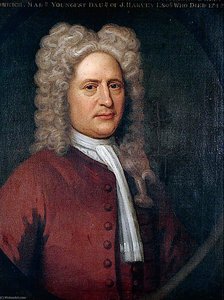
 John Harvey (1666–1742), Mayor of Norwich (1727)
45
 Portrait of Georg Friedrich Handel1750
Neli teemat, mis esinevad neis originaalkindel kõige sagedamini, ning iga teema parim näide.
Kümne 8 muuseumi kollektsioonid, mis sisaldavad kõige rohkem sellel lehel esitatud teoseid.
| Muuseumid | Linn | John Theodore Heins teosid | Selle nimekirja maalid |
|---|---|---|---|
 Gainsborough's House |
Sudbury | 2 | Thomas Gainsborough (1709–1739), John Gainsborough (1711–1772) |
 Yale Center for British Art |
New Haven | 1 | Allegory of Trade |
 Art Institute of Chicago |
Chicago | 1 | Family Group on a Terrace |
 Rahvuslik Mereväemuuseum |
London | 1 | Admiral Sir Robert Harland, circa 1715-1784 |
 RIBA Library Drawings And Archives Collections |
London | 1 | Matthew Brettingham the Elder (1699–1769) |
 St John's College |
Cambridge | 1 | Robert Lambert (d.1734), Lady Margaret Preacher, Master, Vice Chancellor |
 Musée des Beaux-Arts Jules Chéret |
Nice | 1 | Christopher Amiraut |
 Fries Museum |
Leeuwarden | 1 | Lady Gooch, Wife of Sir Thomas Gooch, Bt, Bishop of Norwich and Master of Gonville and Caius College, Cambridge |
Vali vuosakülg, et näha selle ajastu definieerivat originaalteost.

Robert Marsh (1679 1680–1771), Mayor of Norwich (1731) (1732). Järgnevad John Ives Senior as a Boy (1718 1719–1793) (1728) ja Allegory of Trade (1743).
35 aastat vanus: teos Robert Marsh (1679 1680–1771), Mayor of Norwich (1731) on pärinev aastast 1732 ning John Theodore Heins sündis aastal 1697.
Robert Marsh (1679 1680–1771), Mayor of Norwich (1731), John Ives Senior as a Boy (1718 1719–1793), Allegory of Trade, Family Group on a Terrace, Timothy Balderston (1682–1764), Mayor of Norwich (1736 1751), Admiral Sir Robert Harland, circa 1715-1784, Matthew Brettingham the Elder (1699–1769), Isabella Astley (1724–1741), Aged Eight, Self Portrait ja Francis Arnam (1673 1674–1741), Mayor of Norwich (1732). Ülemine reiting näitab iga teose puhul aastat ja muuseumi.
Meie kataloogist leiate 45 teost kunstnikult John Theodore Heins, mis on pärinevad ajastust 1726 kuni 1756.
Peamiselt Gainsborough's House (Sudbury), Yale Center for British Art (New Haven) ja Art Institute of Chicago (Chicago) muuseumites. Ülalpool olevate muuseumite tabelis on nendest kõik loetletud.
Ajal 1740s: 16 45 sellel lehel olevat teost on sellel perioodil loodud, მათart közül Allegory of Trade.
Sellel lehel on kõige vanem teos Self Portrait (1726) ja kõige värskeim Nockold Tompson (d.1777), Mayor of Norwich (1759), and Speaker of the Common Council (1744–1753) (1756).
Portraiture (5), 18th century (5) ja Dignified (4), kogu selle lehekülje 45 teose kohta.
Thomas Gainsborough (1709–1739) ja John Gainsborough (1711–1772): Gainsborough's House, Sudbury säilitab 2 selle lehel olevat teost.
In the vibrant tapestry of eighteenth-century British art, where the flamboyant grandeur of Joshua Reynolds and the fluid grace of Thomas Gainsborough often command the spotlight, there exists a more intimate, contemplative voice. This is the voice of John Theodore Heins Senior (1697–1756), a portraitist whose work serves as a window into the psychological depth and social dignity of the Enlightenment era. While his name may not resonate with the same thunderous fame as his more celebrated contemporaries, Heins Senior offered a unique brand of visual storytelling, characterized by a meticulous devotion to detail and an uncanny ability to capture the very essence of his subjects—ranging from the scholarly elite to the powerful mayors of Norwich.
Born in London, Heins’s early years were shaped by the rigorous traditions of the English school. His artistic journey was profoundly influenced by his apprenticeship under Jonathan Richardson Sr., a master renowned for integrating theatrical composition with innovative perspectives. From Richardson, Heins inherited more than just technical proficiency; he learned the art of characterization. This foundational training instilled in him a respect for realism and an understanding of how light and shadow could be used to sculpt not just physical form, but the very soul of the sitter. As his career progressed, Heins moved away from mere imitation, developing a signature style that favored a restrained palette and a subtle gradation of tones reminiscent of the Old Master traditions.
The true brilliance of Heins Senior lies in his technical command over the medium of oil painting. Unlike the looser, more impressionistic brushstrokes that would later define much of British portraiture, Heins employed a painstaking method of building up layers of paint. This laborious process allowed him to achieve a remarkable luminosity and a textural complexity that makes his canvases feel almost tactile. His subjects are often bathed in a diffused, soft light, creating an atmosphere of serene contemplation that invites the viewer to linger.
Central to his technique was the masterful use of chiaroscuro. By orchestrating the dramatic interplay between deep shadows and brilliant highlights, Heins could direct the viewer's eye toward the most expressive features of a face or the intricate textures of fine silk and lace. This precision is evident in several of his notable works:
The historical significance of John Theodore Heins Senior resides in his role as a chronicler of an era defined by intellectual growth and social stratification. His portraits were more than mere likenesses; they were carefully constructed symbols of identity, intellect, and authority. Through his work, we gain insight into the architectural symbolism and the sartorial elegance that defined the 18th-century British upper classes and scholarly circles.
Though he may have been overshadowed by the more theatrical movements of his time, Heins Senior’s contribution to the canon of British portraiture remains indispensable. His ability to marry the precision of a craftsman with the sensitivity of an artist allowed him to create works that possess a timeless, quiet dignity. Today, as art historians revisit his oeuvre, they find a painter who did not seek to overwhelm the viewer with spectacle, but rather to enchant them through the profound beauty of truth and meticulous observation.

