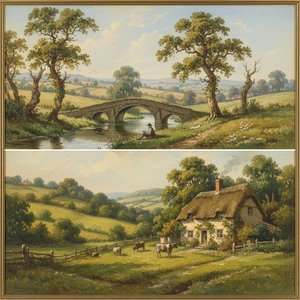
A Window into Harpenden’s Past: Exploring John Fulleylove's ‘Merton College & St Alban Hall’
Discovering Harpenden Town Hall isn’t merely visiting a museum; it’s stepping back centuries, immersing yourself in the story of Hertfordshire’s vibrant heritage. Situated at Leyton Road, St Albans, this unassuming building houses an extraordinary blend of local history and artistic contemplation – namely John Fulleylove's captivating oil painting, ‘Merton College & St Alban Hall.’ Part of St Albans Museums, it offers a free entry experience unlike any other, inviting visitors to delve into the town’s evolution from Roman settlements to its modern identity.
-
Collection Highlight:
Fulleylove's masterpiece exemplifies Impressionism’s focus on capturing fleeting moments and atmospheric conditions. Observe how he skillfully employs muted tones – predominantly blues and greens – to evoke the serene beauty of Merton College’s courtyard, bathed in soft sunlight.
-
Technique & Texture:
The artist’s brushstrokes are loose and textured, conveying a palpable sense of movement and depth. Notice the subtle layering of paint—a technique characteristic of Impressionism—that builds up to create an illusionistic representation of space.
-
Symbolic Resonance:
Beyond its aesthetic appeal, ‘Merton College & St Alban Hall’ speaks volumes about Harpenden's cultural significance. Merton College, founded in 1497, represents intellectual tradition and scholarly pursuits—values deeply rooted in the town’s history.
More Than Just Stone Walls: The Architectural Context of Harpenden Town Hall
While detailed architectural plans remain scarce in readily available documentation, Harpenden Town Hall stands as a testament to its time. Constructed during the Victorian era—specifically around 1875—the building reflects the prevailing architectural styles of the period, characterized by symmetrical facades and ornate detailing. Its presence dominates Leyton Road, serving as a focal point for community life and civic administration.
-
Historic Function:
Originally designed to house St Albans County Court and cells—a crucial element in upholding justice during the Victorian period—the Town Hall embodies the values of law and order. These preserved historic spaces offer visitors a tangible connection to Harpenden’s legal past.
-
Evolution Through Time:
Subsequent renovations have adapted the building for contemporary purposes, maintaining its grandeur while accommodating evolving needs. This careful preservation underscores Harpenden's commitment to safeguarding its heritage.
Exploring Beyond the Courtyard Walls: Connecting History and Art
Harpenden Town Hall distinguishes itself through a unique approach—combining historical displays with thoughtfully curated art installations. Alongside exhibits detailing Harpenden’s Roman past and local folklore, visitors can encounter contemporary artworks that stimulate dialogue and enrich their understanding of artistic expression.
-
Contemporary Perspectives:
The inclusion of pieces like Cornelis Springer's ‘The Town Hall on the Burchtstraat with the St Stevenskerk beyond,’ provides a contrasting viewpoint—a masterful depiction of architectural grandeur rendered in Impressionistic style.
-
Visual Dialogue:
These artworks complement the historical narrative, prompting reflection on how artistic representations evolve alongside societal changes.
A Legacy of Community and Artistic Appreciation
Ultimately, Harpenden Town Hall represents more than just a repository of artifacts; it’s a vibrant space where history intertwines with beauty. Its free admission policy ensures accessibility for all interested in exploring Hertfordshire's rich cultural heritage. Don’t miss the opportunity to experience this remarkable blend of tradition and innovation—a journey that promises to captivate visitors of every age.