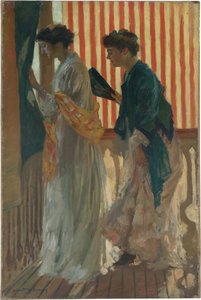
Retrato de Rupert Bunny

Pinturas de Rupert Bunny: Las 24 más famosas, bajo la mirada de una galería

Actualizado noviembre 2026 · clasificado según nuestro índice de popularidad (búsquedas, visitas y pedidos de cada obra) · 25 obras de Rupert Bunny en nuestro catálogo

En resumen

Para el ojo de la galería, la pintura más famosa de Rupert Bunny es Idylle marine (1891), cuya obra original se encuentra en el National Gallery of Victoria, Melbourne. Tritons (1890) y Angels Descending (1897) completan el trío que toda mirada reconoce. De las 25 obras de Rupert Bunny en nuestro catálogo, la galería presenta a continuación las 24 más famosas; cada una original, con su año, su museo y aquello que la hace única.

1864 – 1947, Melbourne Romantic symbolism Más obras: Art Gallery of New South Wales

Las 10 mejores pinturas de Rupert Bunny en la galería

1
Idylle marine (1891) de Rupert Bunny

Idylle marine

1891 · Acrílico sobre lienzo · National Gallery of Victoria, Melbourne

Una Sinfonía de Color y Mito: Explorando la Ídilo Marina de Rupert Bunny Rupert Charles Wulsten Bunny (1864–1947), pintor australiano, se erige como un testimonio del encanto del París de fin de siglo, una ciudad que cautivó a los artistas ávidos de belleza y estimulación intelectual. Nacido en St Kilda, Victoria, la trayectoria artística de Bunny comenzó con una formación fundamental bajo la tutela de Calderon y Laurens, dotándolo de…

2
Tritons (1890) de Rupert Bunny

Tritons

1890 · Oil On Canvas · Art Gallery of New South Wales, Sídney

In this work, titled Tritons, the artist Rupert Bunny explores the themes of classical mythology. Created about 1890, the painting captures a serene seascape where figures inhabit a shallow ocean setting. The subject matter draws from ancient lore, presenting a scene that feels both mythological and deeply atmospheric.

5
Mermaids dancing (1896) de Rupert Bunny

Mermaids dancing

1896 · Oil On Canvas · National Gallery of Victoria, Melbourne

The scene unfolds in 1896, a moment where the boundary between myth and reality dissolves into the salt spray. In Mermaids dancing, the artist Rupert Bunny brings legendary beings to life amidst the rhythmic pulse of the ocean. These mermaids move through a world of shifting tides, their presence a quiet celebration of leisure amidst the vastness of the sea. The composition captures a sense of movement that feels as…

6
Madame Melba (1902) de Rupert Bunny

Madame Melba

1902 · Oil On Canvas · National Gallery of Victoria, Melbourne

Rupert Bunny painted Madame Melba in 1902. The subject of this portrait is Madame Melba, an Australian operatic lyric coloratura soprano. She was the first Australian to achieve international recognition as a classical musician. The portrait captures the singer in a full-length pose, presenting her as a figure of significant stature.

7
Summer time (1907) de Rupert Bunny

Summer time

1907 · Oil On Canvas · Art Gallery of New South Wales, Sídney

We are looking at Summer time, an oil on canvas painted by Rupert Bunny in 1907. This work captures a specific moment of leisure, rendered with the precision and atmospheric quality characteristic of the artist's time in Paris. The composition centers on a group of women gathered in a sunlit setting, a recurring theme in Bunny's oeuvre that explores the intersection of light and domestic grace.

8
The Rape of Persephone (1913) de Rupert Bunny

The Rape of Persephone

1913 · Oil On Canvas · Galería Nacional de Australia, Canberra

The Rape of Persephone is a classical allegory rendered in oil on canvas. The work was executed by the Australian painter Rupert Bunny. It captures a moment of mythic upheaval, centering on the struggle between the figures of Hades and Persephone. The scene is a heavy, swirling collision of form and shadow.

9
Maenads (1917) de Rupert Bunny

Maenads

1917 · Oil On Canvas

In this 1917 oil painting, Maenads by Rupert Bunny, a group of figures breaks into a rhythmic, dynamic dance. The scene unfolds within a lush, impressionistic landscape where movement feels constant. Two female figures, likely the Maenads, appear caught in mid-motion, their limbs flowing through the air as they dance. They move with a sense of weightless energy against the greenery.

10
Amymone Rescued by Poseidon (1920) de Rupert Bunny

Amymone Rescued by Poseidon

1920 · Oil On Canvas

Amymone Rescued by Poseidon is a mythological work by the Australian painter Rupert Bunny. Created about 1920, the painting draws upon classical themes to present a scene of divine intervention. The subject matter focuses on the moment Poseidon intervenes to rescue Amymone.

Pinturas de Rupert Bunny, clasificadas de la 11 a la 24

Los temas que cautivaron la mirada de Rupert Bunny

Los cuatro temas que se repiten con más frecuencia en estas obras originales, cada uno con su mejor ejemplo.

Los museos que conservan los originales de Rupert Bunny

Los 4 museos que albergan la mayoría de las pinturas de esta página.

Museos Ciudad Obras de Rupert Bunny Pinturas de esta lista
Art Gallery of New South Wales, SídneyArt Gallery of New South Wales Sídney 8 Tritons, Summer time, Una mañana de verano
National Gallery of Victoria, MelbourneNational Gallery of Victoria Melbourne 7 Idylle marine, Mermaids dancing, Madame Melba
Galería Nacional de Australia, CanberraGalería Nacional de Australia Canberra 3 The Rape of Persephone, ¿Quién viene?, Pastoral
Galería de Arte de Australia del Sur, AdelaidaGalería de Arte de Australia del Sur Adelaida 2 Angels Descending, A summer morning

Rupert Bunny, una pintura emblemática por década

Obras por década

Elige una década para ver la obra original que la define.

Pinturas de Rupert Bunny: la galería responde

¿Cuál es la pintura más famosa de Rupert Bunny?Descubre la respuesta

Idylle marine (1891), National Gallery of Victoria, Melbourne. A Tritons (1890) y Angels Descending (1897) le siguen.

¿Qué edad tenía Rupert Bunny al completar Idylle marine?Descubre la respuesta

27 años: Idylle marine data de 1891, y Rupert Bunny nació en 1864.

¿Cuáles son las 10 pinturas principales de Rupert Bunny?Descubre la respuesta

Idylle marine, Tritons, Angels Descending, A summer morning, Mermaids dancing, Madame Melba, Summer time, The Rape of Persephone, Maenads y Amymone Rescued by Poseidon. La clasificación anterior indica el año y el museo de cada una.

¿Cuántas obras creó Rupert Bunny?Descubre la respuesta

Nuestro catálogo cuenta con 25 obras de Rupert Bunny, datadas desde 1890 hasta 1920.

¿Dónde se exhiben los originales más famosos de Rupert Bunny?Descubre la respuesta

Principalmente en Art Gallery of New South Wales (Sídney), National Gallery of Victoria (Melbourne) y Galería Nacional de Australia (Canberra). La tabla de museos arriba los enumera todos.

¿Cuándo creó Rupert Bunny sus pinturas más famosas?Descubre la respuesta

En 1900s: 7 de las 24 obras de esta página se realizaron entonces, Madame Melba de ellas.

¿Cuáles son las primeras y últimas obras famosas de Rupert Bunny?Descubre la respuesta

En esta página, la más antigua es Tritons (1890) y la más reciente Amymone Rescued by Poseidon (1920).

¿A qué temas volvió Rupert Bunny con más frecuencia?Descubre la respuesta

Water (6), Woman (6) y Drapery (4), en las 24 obras de esta página.

¿En qué técnica trabajó más Rupert Bunny?Descubre la respuesta

Oil On Canvas, para 12 de las 24 obras de esta página.

¿A qué movimiento se asocia Rupert Bunny?Descubre la respuesta

Romantic symbolism, a juzgar por los originales de esta página.

¿Qué obras originales de Rupert Bunny posee el Art Gallery of New South Wales?Descubre la respuesta

Tritons, Summer time y Una mañana de verano: el Art Gallery of New South Wales, Sídney posee 8 de las obras de esta página.

Rupert Bunny: el artista

Early Life and Training

Rupert Charles Wolston Bunny (1864 - 1947) was an Australian painter, born in St Kilda, Victoria. He received a traditional and academic education in the arts under Calderon and Laurens. This foundation would later serve him well in his successful career as an expatriate artist in fin-de-siècle Paris. His father, Brice Frederick Bunny, was a British Victorian county court judge, and his mother, Marie Hedwig Dorothea Wulsten, was German. He had an affluent upbringing and travelled extensively during his childhood, gaining fluency in English, French, and German—a skill that would prove invaluable for his artistic pursuits abroad. He enrolled at the University of Melbourne intending to study civil engineering but quickly abandoned this ambition to pursue painting, influenced by artists like McCubbin and Folingsby. His formative years were spent honing his craft under Campbell and Folingsby at the National Gallery School in Melbourne.

Achievements and Accolades

Bunny’s artistic talent was recognized early on; he garnered an honorable mention at the Salon of 1890 for “Tritons,” marking a significant milestone in his burgeoning career. This recognition propelled him to greater heights, culminating in a bronze medal at the Paris Exposition Universelle in 1900 for “Burial of St Catherine of Alexandria.” The French state’s acquisition of thirteen of his paintings—including those now housed in the Musée du Luxembourg and regional collections—testament to his enduring reputation. He was celebrated as a "sumptuous colourist and splendidly erudite painter of ideal themes," embodying the spirit of Aestheticism and drawing inspiration from classical mythology.

Artistic Style and Themes

Bunny’s distinctive style revolved around portraying groups of female figures immersed in tranquil scenes—relaxing, dreaming, or engaging in activities like dressing and undressing by expanses of water. This approach reflected his profound understanding of symbolism and aesthetic principles. His canvases captured the essence of beauty and contemplation, aligning him with luminaries such as Puvis de Chavannes and Ford Madox Brown. Notable works included “Endormies,” “Sea Idyll,” and “Pastoral”—each demonstrating a masterful blend of technique and imaginative vision.

Notable Works

Bunny’s oeuvre encompassed numerous masterpieces that continue to captivate audiences today. Among these stand out: "Endormies," displayed at the National Gallery of Victoria, Melbourne; "Sea Idyll," also residing in the National Gallery of Victoria; and “Pastoral,” housed in the National Gallery of Australia, Canberra. These paintings exemplify his artistic prowess and solidify his place as a pivotal figure in Australian art history. His works are readily available for viewing and purchase through platforms like OriginalUniqueArt.com, offering enthusiasts access to museum-quality reproductions.