


1


Actualizado noviembre 2026 · clasificado según nuestro índice de popularidad (búsquedas, visitas y pedidos de cada obra) · 35 obras de Pieter Wouwerman en nuestro catálogo
En resumen
De todos los originales que dejó Pieter Wouwerman, la más famosa es Forest with staffage figures (1642), que forma parte de la colección del Villa Vauban, Luxemburgo. Le siguen muy de cerca Dice-Playing Soldiers in Front of an Inn (1652) y Officer on Horseback (1660). Nuestro catálogo cuenta con 35 obras de Pieter Wouwerman; la galería ha conservado las 31 que el mundo más admira, cada una presentada con su fecha, su museo y su historia.


 View of Paris seen from the Place Dauphine1660 · Statens Museum for Kunst
12
 Frederik Hendrik at the surrender of Maastricht, 22 August 16321650 · Rijksmuseum
13
 Hunting party on horseback with servants and dogs1661 · Staatliche Kunsthalle Karlsruhe
14
 Beach Scene with Fisher Woman1668 · Gemäldegalerie Alte Meister
15
 View of Paris with the tower and porch of Nesle, in the backgroud the Pont Neuf and la Place Dauphine1664
16
 Landscape with a dapple grey horse1667 · Museum Boijmans Van Beuningen
17
 The storming of Coevorden, December 30, 16721672 · Rijksmuseum
18
 Horsemarket in Delft1670 · Het Prinsenhof
19
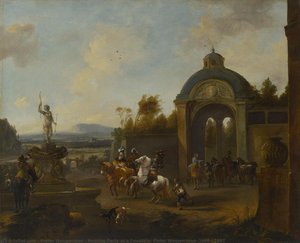 Hunting Party at a Fountain, Pieter Wouwerman, 1660 - 16821682 · Rijksmuseum
20
 Cavalry Skirmish with Foot SoldiersReal Museo de Bellas Artes de Amberes
21
 Departure for huntingMuseo Nacional de Varsovia
22
 The watering place
23
 Landscape with a genre sceneMuseo Nacional de Varsovia
24
 Setting Off On A Falcon Hunt
25
 The stableFitzwilliam Museum
26
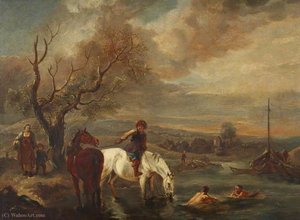 Country Scene with a Man on Horseback and Bathers
27
 Landscape with resting travellers
28
 Cavalry Men by a Suttler's Tent
29
 Dune landscape with figuresCleveland Museum of Art
30
 Encampment beside an Ale HouseFitzwilliam Museum
31
 La Caza de CiervosMuseo del Hermitage
Los cuatro temas que se repiten con más frecuencia en estas obras originales, cada uno con su mejor ejemplo.
Los 8 museos que albergan la mayoría de las pinturas de esta página.
| Museos | Ciudad | Obras de Pieter Wouwerman | Pinturas de esta lista |
|---|---|---|---|
 Museo Nacional de Varsovia |
Varsovia | 3 | Groom and horses, Departure for hunting, Landscape with a genre scene |
 Rijksmuseum |
Ámsterdam | 3 | Frederik Hendrik at the surrender of Maastricht, 22 August 1632, The storming of Coevorden, December 30, 1672, Hunting Party at a Fountain, Pieter Wouwerman, 1660 - 1682 |
 Staatliche Kunsthalle Karlsruhe |
Carlsruhe | 2 | The Collision, Hunting party on horseback with servants and dogs |
 Museo del Hermitage |
San Petersburgo | 2 | Horses in the Pasture, La Caza de Ciervos |
 Gemäldegalerie Alte Meister |
Kassel | 2 | Landscape with horsemen at a blacksmith, Beach Scene with Fisher Woman |
 Fitzwilliam Museum |
2 | The stable, Encampment beside an Ale House | |
 Villa Vauban |
Luxemburgo | 1 | Forest with staffage figures |
 Colecciones de Pintura del Estado Bávaro |
Múnich | 1 | Dice-Playing Soldiers in Front of an Inn |
Elige una década para ver la obra original que la define.

Forest with staffage figures (1642), Villa Vauban, Luxemburgo. A Dice-Playing Soldiers in Front of an Inn (1652) y Officer on Horseback (1660) le siguen.
19 años: Forest with staffage figures data de 1642, y Pieter Wouwerman nació en 1623.
Forest with staffage figures, Dice-Playing Soldiers in Front of an Inn, Officer on Horseback, The Combat, The Collision, Groom and horses, Army Camp, Horses in the Pasture, Landscape with horsemen at a blacksmith y Sandhills with Figure. La clasificación anterior indica el año y el museo de cada una.
Nuestro catálogo cuenta con 35 obras de Pieter Wouwerman, datadas desde 1642 hasta 1682.
Principalmente en Museo Nacional de Varsovia (Varsovia), Rijksmuseum (Ámsterdam) y Staatliche Kunsthalle Karlsruhe (Carlsruhe). La tabla de museos arriba los enumera todos.
En 1660s: 7 de las 31 obras de esta página se realizaron entonces, Officer on Horseback de ellas.
En esta página, la más antigua es Forest with staffage figures (1642) y la más reciente Hunting Party at a Fountain, Pieter Wouwerman, 1660 - 1682 (1682).
Groom and horses, Departure for hunting y Landscape with a genre scene: el Museo Nacional de Varsovia, Varsovia posee 3 de las obras de esta página.