Menú
Asesoría de arte gratuita

Paulus Constantijn La Fargue

1729 - 1782

Breves datos

  • Top 3 works:
    • The Hall of the Artistic Society "Kunst wordt door Arbeid verkregen" (Art is Acquired through Labor) in Leiden, Paulus Constantijn la Fargue, 1780
    • De Groenmarkt in Den Haag gezien naar het Westeinde
    • View of a town house garden in The Hague,
  • Copyright status: Public domain
  • Born: 1729, Países Bajos
  • Lifespan: 53 years
  • Nationality: Países Bajos
  • Ver más…

Test de arte

Cada pregunta tiene una única respuesta correcta.

Pregunta 1:
¿Cuál fue el enfoque artístico principal de Paulus Constantijn La Fargue?
Pregunta 2:
¿En qué sociedad miembro fueron La Fargue y Jacob Elias?
Pregunta 3:
¿Quién influyó en el estilo artístico de La Fargue?
Pregunta 4:
¿Qué desafío común enfrentó La Fargue y su familia durante su carrera?
Pregunta 5:
¿Por qué La Fargue es considerado significativo en cuanto a su obra?

Paulus Constantijn La Fargue: A Pioneer of Dutch Topographical Art

Paulus Constantijn la Fargue (1729-1782) stands as a pivotal figure in the history of Dutch art, particularly renowned for his meticulous depictions of cities and landscapes—a genre known as topographical art. Born in The Hague on January 5th, 1729, he descended from an artistic lineage that instilled within him a profound appreciation for visual representation and observation. His father, Jean Thomas la Fargue, was a respected notary and translator, fostering an environment where intellectual curiosity thrived alongside creative expression. This upbringing profoundly shaped his artistic sensibilities and propelled him toward a career dedicated to capturing the essence of his surroundings with remarkable accuracy and artistry.

Family Background and Artistic Influences

La Fargue’s family comprised several artists—Isaac Lodewijk, Jacob Elias, Karel, and Maria Margaretha—each contributing to the vibrant artistic tapestry of The Hague during the Enlightenment era. This familial connection undoubtedly instilled in him a deep understanding of artistic techniques and traditions. Notably, his father's profession cultivated a meticulous attention to detail – a characteristic that would later become central to la Fargue’s topographical style. Furthermore, he absorbed influences from prominent seventeenth-century painters like Jan van der Heyden, whose dynamic compositions and masterful use of perspective served as models for his own artistic endeavors. These formative experiences cemented his commitment to realism and established him within the broader context of Dutch Golden Age art.

Career Highlights: Mastering Topographical Art

La Fargue’s artistic career gained momentum in 1761 when he joined The Hague Painters Society, known as the confrerie pictura—a collective dedicated to advancing artistic excellence and fostering collaborative creativity. This association provided him with invaluable opportunities for professional development and exposure within the artistic community. By 1768, he was formally recognized as a member of the Royal Academy of Art in The Hague, marking a significant milestone in his artistic trajectory. During this period, he embarked on ambitious projects aimed at documenting Dutch urban landscapes—primarily Rotterdam and The Hague—with unparalleled detail. His sketches served as the foundation for larger paintings that captured not only architectural grandeur but also the everyday life of citizens within these bustling cities.

Notable Works and Artistic Style

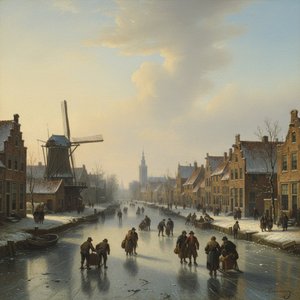
La Fargue’s artistic style was characterized by a remarkable blend of observation, precision, and expressive color palettes. Unlike many artists of his time who favored idealized representations, he prioritized faithful depictions of reality—a hallmark of topographical art. His paintings possessed a captivating vibrancy thanks to the skillful application of pigments that conveyed the atmosphere and nuances of each scene. Furthermore, he incorporated diminutive figures into his compositions—a technique reminiscent of van der Heyden—creating a sense of scale and dynamism that brought his landscapes to life. Among his most celebrated works are views of Rotterdam, The Hague, Delft, Leiden, Haarlem, and Amsterdam, showcasing his mastery of perspective and color theory. He also produced stunning depictions of events like the siege of Maastricht and portraits of prominent figures, demonstrating versatility within his artistic repertoire.

Legacy and Significance

Paulus Constantijn la Fargue’s contribution to Dutch art history transcends mere stylistic innovation; he embodies a commitment to documenting the visual world with unwavering accuracy—a pursuit that aligns perfectly with the intellectual currents of the eighteenth century. His meticulous sketches and paintings offer invaluable insights into the social, economic, and cultural landscape of Holland during his lifetime. As one of the foremost topographical artists of his era, la Fargue’s work continues to inspire admiration for its realism and artistic merit—a testament to his enduring legacy as a visionary artist who captured the spirit of his time. His dedication to detail and observation cemented his place among the most influential figures in Dutch art history.