Menú
Asesoría de arte gratuita

Nikos Hadjikyriakos-Ghika

1906 - 1994

Resumen biográfico

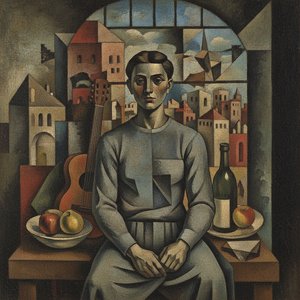
  • Corpus themes: cubist influences
  • Top-ranked work: Kifissia
  • Top 3 works:
    • Kifissia
    • The pleasures of rest
    • The first morning of the world, stage design for the dance-drama
  • Also known as: Nikos Ghika
  • Topics explored: birds
  • Works on APS: 12
  • Nationality: Ελλάδα
  • Museums on APS:
    • Museo Benaki de la Civilización Griega
    • Museo Benaki de la Civilización Griega
    • Museo Benaki de la Civilización Griega
    • Museo Benaki de la Civilización Griega
    • Museo Benaki de la Civilización Griega
  • Movements: cubism
  • Color intensity: equilibrado
  • Art period: Arte moderno
  • Ver más…
  • Typical colors:
    • tonos neutros
    • tonos tierra
  • Born: 1906, Αθήνα, Ελλάδα
  • Died: 1994
  • Room fit: salón principal
  • Lifespan: 88 years
  • Emotional tone: calma
  • Gift suitability: other-none
  • Copyright status: Under copyright
  • Best occasions: punto focal
  • Creative periods: mature period

Test de arte

Solo hay una respuesta correcta para cada pregunta.

Pregunta 1:
¿Dónde estudió Nikos Hadjikyriakos-Ghika simultáneamente francés y griego?
Pregunta 2:
¿En qué año fue elegido profesor de dibujo en la Escuela Superior Técnica de Atenas?
Pregunta 3:
¿A qué bienal internacional representó Grecia?
Pregunta 4:
¿Qué grupo artístico fundó Nikos Hadjikyriakos-Ghika junto con otros artistas destacados?
Pregunta 5:
¿En qué museo se encuentran obras importantes de Nikos Hadjikyriakos-Ghika?

Nikos Hadjikyriakos-Ghika: Pioneer of Greek Cubism

Nikos Hadjikyriakos-Ghika, a monumental figure in Greek art history, stands as a testament to artistic innovation and unwavering devotion to the landscape. Born in Athens on February 26, 1906, his lineage traced back to the valiant defenders of Greece during its independence struggle—a heritage that instilled within him an enduring appreciation for national identity and tradition. From early childhood, he demonstrated exceptional talent, nurtured by his family’s recognition of his artistic potential and guided by the influential mentorship of Parthenis, a celebrated Athenian painter who recognized Ghika's innate ability to capture the essence of Greek visual culture. Between 1922 and 1924, Ghika pursued his academic studies at Sorbonne University in Paris, immersing himself in French literature and aesthetics while simultaneously honing his artistic skills at Académie Ranson—a crucible for avant-garde movements where he encountered luminaries like Picasso, whose groundbreaking cubist explorations profoundly impacted Ghika’s stylistic trajectory. This formative period cemented his commitment to dismantling conventional perspectives and reconstructing reality through geometric forms and interlocking planes—a technique that would become synonymous with his distinctive artistic vision. Ghika's artistic journey commenced in 1923 with his debut exhibition at the Société des Artistes Indépendants, establishing him as a prominent voice within the Parisian art scene. The discerning eye of Picasso himself acknowledged Ghika’s originality and daring experimentation—a validation that propelled him forward on his path to international acclaim. Collaborations extended beyond artistic endeavors; he actively participated in theatrical productions alongside playwrights and directors, shaping stage designs and costumes that reflected his fascination with Greek mythology and folklore. His involvement with the “Armos” art group solidified his connection to fellow artists who shared a similar passion for exploring new aesthetic horizons. His dedication to preserving and celebrating Greek heritage culminated in his relocation to Hydra Island in 1937, where he transformed an ancestral home into a studio—a sanctuary for artistic creation that served as inspiration for countless paintings capturing the sublime beauty of the Aegean landscape. Ghika’s oeuvre encompasses a vast spectrum of styles—from monumental sculptures reflecting the grandeur of ancient Greece to intricate engravings imbued with symbolic depth—demonstrating his versatility and intellectual curiosity. He was elected Professor of Drawing at the National Technical University of Athens in 1941, shaping generations of aspiring artists and fostering a deep understanding of artistic principles. Throughout his illustrious career, Ghika garnered recognition from prestigious institutions worldwide, including the British Council, which organized his first retrospective exhibition in 1946—a landmark event showcasing 42 canvases that captivated audiences and critics alike. He represented Greece at the Venice Biennale in 1950, presenting a selection of works that reaffirmed his position as a leading figure in European art. His legacy continues to inspire artists and scholars today, securing his place among the titans of 20th-century Greek artistic expression. His artworks are housed in prominent museums across Europe and North America—a testament to their enduring beauty and intellectual significance: The National Gallery (Athens), Musée d’Art Moderne de la Ville de Paris, Tate Gallery London, Metropolitan Museum New York. His contribution to the art world transcends mere stylistic innovation; it embodies a profound engagement with Greek culture and history—a legacy that resonates powerfully through his timeless creations.