Retrato de John Wootton

Pinturas de John Wootton: Las 91 más famosas, bajo la mirada de una galería

Actualizado octubre 2026 · clasificado según nuestro índice de popularidad (búsquedas, visitas y pedidos de cada obra) · 91 obras de John Wootton en nuestro catálogo

En resumen

Para el ojo de la galería, la pintura más famosa de John Wootton es La muerte de la liebre (1735), cuya obra original se encuentra en el Yale Center for British Art, Nueva Haven. Retrato de un hombre a caballo (1720) y The Meet of a Hunt with Henry II Hoare (1705 - 1785) (1729) completan el trío que toda mirada reconoce. De las 91 obras de John Wootton en nuestro catálogo, la galería presenta a continuación las 91 más famosas; cada una original, con su año, su museo y aquello que la hace única.

1682 – 1764, Snitterfield Baroque Más obras: Yale Center for British Art

Las 10 mejores pinturas de John Wootton en la galería

1
La muerte de la liebre (1735) de John Wootton

La muerte de la liebre

1735 · Óleo sobre lienzo · Yale Center for British Art, Nueva Haven

En este óleo sobre lienzo, nos encontramos inmersos en la atmósfera silenciosa y densa de un paisaje tras la caza. La escena se desarrolla bajo la luz suave y difusa del atardecer, donde el cielo despliega azules pálidos y los tonos cálidos y cremosos de un sol poniente. Grandes y oscuros árboles enmarcan la composición a ambos lados, creando una viñeta natural que atrae la mirada hacia el drama central.…

2
Retrato de un hombre a caballo (1720) de John Wootton

Retrato de un hombre a caballo

1720 · Óleo sobre lienzo · Yale Center for British Art, Nueva Haven

En "Retrato de un hombre a caballo" de John Wootton, un caballero se encuentra montado sobre un caballo bayo oscuro. La composición es vertical y centrada, fijando la mirada del espectador directamente en el jinete. Viste un atuendo de equitación de carácter regio, con una presencia definida por un abrigo de un rojo saturado. Este color audaz atraviesa los matices apagados y tonos tierra del fondo. El sujeto se sitúa…

3
The Meet of a Hunt with Henry II Hoare (1705 - 1785) (1729) de John Wootton

The Meet of a Hunt with Henry II Hoare (1705 - 1785)

1729 · Oil On Canvas

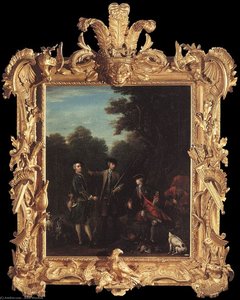
The composition centers on a group of horsemen and hounds assembled in a wide, rolling landscape. On the left, a tall stone obelisk rises vertically, providing a fixed point against the horizontal expanse of the countryside. The scene depicts a specific social gathering, identified by inscriptions as involving Henry Hoare and Benjamin Hoare. Henry Hoare is mounted on a horse, wearing a grey coat, while a groom leads a second…

4
The Hampton Court Chestnut Arabian (1726) de John Wootton

The Hampton Court Chestnut Arabian

1726 · Oil On Canvas · Royal Collection, Londres

The air feels heavy with the quiet dignity of the 18th century as a chestnut Arabian horse commands the center of the scene. Its sleek, muscular form catches the light from the upper left, casting soft shadows that define every curve of its powerful body. This is a portrait of poise and breeding. To the left, a man in classical attire holds the reins with a steady hand, his presence…

5
The Duke of Hamilton's Grey Racehorse, 'Victorious,' at Newmarket (1725) de John Wootton

The Duke of Hamilton's Grey Racehorse, 'Victorious,' at Newmarket

1725 · Oil On Canvas · Yale Center for British Art, Nueva Haven

We are looking at The Duke of Hamilton's Grey Racehorse, 'Victorious,' at Newmarket, a significant work by the English painter John Wootton. Created about 1725, this oil painting captures a grey racehorse positioned within a vast, open landscape. The subject is presented with a sense of quiet dignity, set against an expansive backdrop that emphasizes the scale of the environment.

6
Lamprey at Newmarket, with a Group of Figures Including Sir William Morgan and Girolamo Bardoletti (1723) de John Wootton

Lamprey at Newmarket, with a Group of Figures Including Sir William Morgan and Girolamo Bardoletti

1723 · Oil · Yale Center for British Art, Nueva Haven

In this oil painting from about 1723, the viewer enters a moment of high social ritual. Lamprey at Newmarket, with a Group of Figures Including Sir William Morgan and Girolamo Bardoletti presents a formal presentation of a grey horse to a gathering of gentlemen. The scene unfolds in an outdoor setting, where the quiet tension of the assembly meets the presence of the animal. The artist, John Wootton, captures a…

7
Two Stallions Fighting (1734) de John Wootton

Two Stallions Fighting

1734 · Oil

A white stallion and a black stallion collide in a moment of intense physical struggle. The composition relies on a sharp diagonal tension, driving the eye from the bright, muscular form of the white horse on the left toward the deep, dark tones of its opponent on the right. Arched necks and outstretched limbs create a sense of chaotic movement, framed by the intervention of handlers and the sharp line…

8
The Shooting Party: Frederick, Prince of Wales with John Spencer and Charles Douglas, 3rd Duke of Queensberry (1740) de John Wootton

The Shooting Party: Frederick, Prince of Wales with John Spencer and Charles Douglas, 3rd Duke of Queensberry

1740 · Oil On Canvas · Royal Collection, Londres

The Shooting Party: Frederick, Prince of Wales with John Spencer and Charles Douglas, 3rd Duke of Queensberry is an oil on canvas executed by the English painter John Wootton. Dated 1740, the work belongs to the genre of Georgian Sporting Art. It captures a specific moment of aristocratic leisure, centering on a group of prominent figures engaged in a hunting scene.

9
The Death of the Stag (1737) de John Wootton

The Death of the Stag

1737 · Oil On Canvas · Royal Collection, Londres

The scene unfolds across a wide, panoramic landscape under a vast sky of blue and white. In the foreground, the immediate focus is a fallen stag, its body positioned amidst a group of hunting dogs that scatter around the carcass. Some of these animals actively engage with the animal, their forms creating a sense of movement against the earth. Beyond this central action, the midground contains a group of hunters,…

10
The Return from the Chase (1737) de John Wootton

The Return from the Chase

1737 · Oil On Canvas · Royal Collection, Londres

An expansive 18th-century landscape captures a group of aristocratic figures and their horses returning from a hunt. The composition utilizes a wide format to emphasize the scale of the estate, leading the eye from a detailed foreground of riders and attendants toward a distant, imposing stone manor situated on a slight rise. To the right, a dense cluster of mature trees provides verticality, framing the scene and adding depth to…

Pinturas de John Wootton, clasificadas de la 11 a la 91

11The Siege of Tournay (1742) de John WoottonThe Siege of Tournay1742 · Royal Collection 12William Augustus, Duke of Cumberland (1721-65) at the Battle of Dettingen (1744) de John WoottonWilliam Augustus, Duke of Cumberland (1721-65) at the Battle of Dettingen1744 · Royal Collection 13Frederick, Prince of Wales (1707-1751) in the Hunting Field (1734) de John WoottonFrederick, Prince of Wales (1707-1751) in the Hunting Field1734 · Royal Collection 14A Fox Hunt (1735) de John WoottonA Fox Hunt1735 · Yale Center for British Art 15Lord Portmore Watching Racehorses at Exercise on Newmarket Heath (1735) de John WoottonLord Portmore Watching Racehorses at Exercise on Newmarket Heath1735 · Yale Center for British Art 16William Augustus, Duke of Cumberland (1721-1765) (1745) de John WoottonWilliam Augustus, Duke of Cumberland (1721-1765)1745 · Royal Collection 17Haycart Passing a Ruined Abbey (1745) de John WoottonHaycart Passing a Ruined Abbey1745 · Yale Center for British Art 18Preparándose para la caza (1745) de John WoottonPreparándose para la caza1745 · Yale Center for British Art 19Abadía de Rievaulx (1745) de John WoottonAbadía de Rievaulx1745 · Yale Center for British Art 20Paisaje clásico: Mañana (1740) de John WoottonPaisaje clásico: Mañana1740 · Yale Center for British Art 21Paisaje clásico (1725) de John WoottonPaisaje clásico1725 · Yale Center for British Art 22The Battle of Blenheim, 13 August (1704) de John WoottonThe Battle of Blenheim, 13 August (1704) 23Horse Race at Newmarket de John WoottonHorse Race at NewmarketPetworth House 24Battle Scene on Bridge (1706) de John WoottonBattle Scene on Bridge1706 · Antony House 25George I at Newmarket, 4 or 5 October, 1717 (1717) de John WoottonGeorge I at Newmarket, 4 or 5 October, 17171717 · Yale Center for British Art 26El Duque de Rutland (1715) de John WoottonEl Duque de Rutland1715 · Yale Center for British Art 27Sketch for ‘A prospect of Dover Castle’, Warmer Castle (1727) de John WoottonSketch for ‘A prospect of Dover Castle’, Warmer Castle1727 28Park Place, Henley (1742) de John WoottonPark Place, Henley1742 · Royal Collection 29A Distant View of Henley-on-Thames (1742) de John WoottonA Distant View of Henley-on-Thames1742 · Royal Collection 30The Siege of Lille (1742) de John WoottonThe Siege of Lille1742 · Royal Collection 31A Grey Spotted Hound (1738) de John WoottonA Grey Spotted Hound1738 · Yale Center for British Art 32Two of the Duchess of Marlborough's Dogs (1736) de John WoottonTwo of the Duchess of Marlborough's Dogs1736 33Classical Landscape (1754) de John WoottonClassical Landscape1754 · Yale Center for British Art 34Classical Landscape with Figures and Animals: Sunset (1754) de John WoottonClassical Landscape with Figures and Animals: Sunset1754 · Yale Center for British Art 35Releasing the Hound (1745) de John WoottonReleasing the Hound1745 · Yale Center for British Art 36Racing Scene at Newmarket (1750) de John WoottonRacing Scene at Newmarket1750 · Minneapolis Institute of Art 37La partida de caza (1740) de John WoottonLa partida de caza1740 · Royal Collection 38Perros de caza y una urraca (1740) de John WoottonPerros de caza y una urraca1740 · Museo del Hermitage 39Classical Landscape de John WoottonClassical LandscapeMuseo de Bellas Artes de Budapest 40Paisaje clásico: Atardecer (1740) de John WoottonPaisaje clásico: Atardecer1740 · Yale Center for British Art 41A Dark Bay Stallion, Possibly the Byerley Turk de John WoottonA Dark Bay Stallion, Possibly the Byerley Turk 42Bowater Vernon (1683–1735), with Hanbury Hall and Its Formal Garden de John WoottonBowater Vernon (1683–1735), with Hanbury Hall and Its Formal GardenHanbury Hall 43The Beauchamp-Proctor Family and Friends at Langley Park, Norfolk de John WoottonThe Beauchamp-Proctor Family and Friends at Langley Park, Norfolk 44The Bloody-Shouldered Arabian de John WoottonThe Bloody-Shouldered Arabian 45Viscount Weymouth's Hunt The Hon. John Spencer beside a Hunter held by a Young Boy de John WoottonViscount Weymouth's Hunt The Hon. John Spencer beside a Hunter held by a Young Boy 46Landscape with Angelica and Medoro de John WoottonLandscape with Angelica and Medoro 47The Duke of Rutland de John WoottonThe Duke of Rutland 48Classical Landscape with a Grecian Temple de John WoottonClassical Landscape with a Grecian Temple 49Before the hunt de John WoottonBefore the hunt 50Paisaje clásico con gitanos (1748) de John WoottonPaisaje clásico con gitanos1748 · Metropolitan Museum of Art 51Retrato de Coplestone Warre Bampfylde (1720-96) frente a Hestercombe House con su cazador c. 1740 de John WoottonRetrato de Coplestone Warre Bampfylde (1720-96) frente a Hestercombe House con su cazador c. 1740Hestercombe House - Jardines 52Rome from the Aventine Hill de John WoottonRome from the Aventine HillBirmingham Museum and Art Gallery 53Classical landscape de John WoottonClassical landscapeFitzwilliam Museum 54Stag hunt de John WoottonStag hunt 55Horses Exercising on Newmarket Heath de John WoottonHorses Exercising on Newmarket Heath 56'Lamprey' (A Racehorse) de John Wootton'Lamprey' (A Racehorse) 57A Race on the Round Course at Newmarket de John WoottonA Race on the Round Course at NewmarketFitzwilliam Museum 58Life-Size Horse with Huntsman Blowing a Horn de John WoottonLife-Size Horse with Huntsman Blowing a Horn 59Landscape with Cattle de John WoottonLandscape with Cattle 60Lady Mary Churchill at the Death of the Hare de John WoottonLady Mary Churchill at the Death of the Hare 61A View of Cassiobury Park de John WoottonA View of Cassiobury Park 62Coastal Scene with Shipping at Dawn de John WoottonCoastal Scene with Shipping at DawnHartwell House 63Muff, a Black and White Dog de John WoottonMuff, a Black and White Dog 64A Turkey in a Landscape de John WoottonA Turkey in a Landscape 65Drovers at a Harbour de John WoottonDrovers at a Harbour 66A Stag Hunt in Full Cry de John WoottonA Stag Hunt in Full CryWimpole Hall 67George II (1683–1760), on Horseback de John WoottonGeorge II (1683–1760), on HorsebackBlickling Hall 68View of the Severn Valley with Haymaking and Figures de John WoottonView of the Severn Valley with Haymaking and Figures 69Landscape of a River Valley at Sunset de John WoottonLandscape of a River Valley at SunsetHartwell House 70Landscape with Fishermen de John WoottonLandscape with Fishermen 71A Stag Hunt at Chirk de John WoottonA Stag Hunt at Chirk 72A Grey Horse and Jockey in Red Colours, before a Stable de John WoottonA Grey Horse and Jockey in Red Colours, before a StableClandon Park 73Lionel Sackville, 1st Duke of Dorset, Lord Warden of the Cinque Ports, Returning in Procession to Dover Castle de John WoottonLionel Sackville, 1st Duke of Dorset, Lord Warden of the Cinque Ports, Returning in Procession to Dover CastleKnole 74Italianate landscape de John WoottonItalianate landscape 75Equestrian Portrait of Sir Richard Hoare II (1709–1754), as Lord Mayor of London, at Temple Bar de John WoottonEquestrian Portrait of Sir Richard Hoare II (1709–1754), as Lord Mayor of London, at Temple Bar 76William tregonwell frampton de John WoottonWilliam tregonwell frampton 77Wooded Landscape and Coastal Town de John WoottonWooded Landscape and Coastal Town 78A Bay Racehorse and Attendants de John WoottonA Bay Racehorse and Attendants 79Sir Robert Walpole, 1st Earl of Orford, as a Ranger of Richmond Park de John WoottonSir Robert Walpole, 1st Earl of Orford, as a Ranger of Richmond Park 80George II at the Battle of Dettingen, with the Duke of Cumberland and Robert, 4th Earl of Holderness, 27 June (1743) de John WoottonGeorge II at the Battle of Dettingen, with the Duke of Cumberland and Robert, 4th Earl of Holderness, 27 June (1743) 81Henry Hoare II (1705–1785), on Horseback de John WoottonHenry Hoare II (1705–1785), on Horseback 82George Henry Lee, 3rd Earl of Litchfield, and his Uncle the Hon. Robert Lee, Subsequently 4th Earl of Litchfield, Shooting in 'True Blue' Frock Coats de John WoottonGeorge Henry Lee, 3rd Earl of Litchfield, and his Uncle the Hon. Robert Lee, Subsequently 4th Earl of Litchfield, Shooting in 'True Blue' Frock Coats 83A Classical Landscape with Animals de John WoottonA Classical Landscape with AnimalsUpton House 84Dancing Dogs 'Lusette', 'Madore', 'Rosette' and 'Moucheby' de John WoottonDancing Dogs 'Lusette', 'Madore', 'Rosette' and 'Moucheby'Wallington Hall 85Viscount Weymouth's Hunt A Groom holding a Saddled Grey Hunter with Hounds and Terriers de John WoottonViscount Weymouth's Hunt A Groom holding a Saddled Grey Hunter with Hounds and Terriers 86Viscount Weymouth's Hunt Two Hunt Servants on Hunters beside a Cottage de John WoottonViscount Weymouth's Hunt Two Hunt Servants on Hunters beside a Cottage 87Gilbert Coventry (c.1688–1719), 4th Earl of Coventry, with Two Huntsmen in a Landscape de John WoottonGilbert Coventry (c.1688–1719), 4th Earl of Coventry, with Two Huntsmen in a LandscapeAntony House 88A favorite poodle and monkey belonging to thomas osborn de John WoottonA favorite poodle and monkey belonging to thomas osborn 89Viscount Weymouth's Hunt Mr Jackson, the Hon. Henry Villiers and the Hon. Thomas Villiers, with Hunters and Hounds de John WoottonViscount Weymouth's Hunt Mr Jackson, the Hon. Henry Villiers and the Hon. Thomas Villiers, with Hunters and Hounds 90Viscount Weymouth's Hunt Thomas, 2nd Viscount Weymouth, with a Black Page and other Huntsmen at the Kill de John WoottonViscount Weymouth's Hunt Thomas, 2nd Viscount Weymouth, with a Black Page and other Huntsmen at the Kill 91A View of Henley-on-Thames (1742) de John WoottonA View of Henley-on-Thames1742 · Royal Collection

Pinturas famosas de John Wootton, época por época

Los temas que cautivaron la mirada de John Wootton

Los cuatro temas que se repiten con más frecuencia en estas obras originales, cada uno con su mejor ejemplo.

Los museos que conservan los originales de John Wootton

Los 8 museos que albergan la mayoría de las pinturas de esta página.

Museos Ciudad Obras de John Wootton Pinturas de esta lista
Yale Center for British Art, Nueva HavenYale Center for British Art Nueva Haven 18 La muerte de la liebre, Retrato de un hombre a caballo, The Duke of Hamilton's Grey Racehorse, 'Victorious,' at Newmarket
Royal Collection, LondresRoyal Collection Londres 13 The Hampton Court Chestnut Arabian, The Shooting Party: Frederick, Prince of Wales with John Spencer and Charles Douglas, 3rd Duke of Queensberry, The Death of the Stag
Antony HouseAntony House 2 Battle Scene on Bridge, Gilbert Coventry (c.1688–1719), 4th Earl of Coventry, with Two Huntsmen in a Landscape
Fitzwilliam MuseumFitzwilliam Museum 2 Classical landscape, A Race on the Round Course at Newmarket
Hartwell House, AylesburyHartwell House Aylesbury 2 Coastal Scene with Shipping at Dawn, Landscape of a River Valley at Sunset
Petworth House, PetworthPetworth House Petworth 1 Horse Race at Newmarket
Minneapolis Institute of Art, MinneapolisMinneapolis Institute of Art Minneapolis 1 Racing Scene at Newmarket
Museo del Hermitage, San PetersburgoMuseo del Hermitage San Petersburgo 1 Perros de caza y una urraca

John Wootton, una pintura emblemática por década

Obras por década

Elige una década para ver la obra original que la define.

Pinturas de John Wootton: la galería responde

¿Cuál es la pintura más famosa de John Wootton?Descubre la respuesta

La muerte de la liebre (1735), Yale Center for British Art, Nueva Haven. A Retrato de un hombre a caballo (1720) y The Meet of a Hunt with Henry II Hoare (1705 - 1785) (1729) le siguen.

¿Qué edad tenía John Wootton al completar La muerte de la liebre?Descubre la respuesta

53 años: La muerte de la liebre data de 1735, y John Wootton nació en 1682.

¿Cuáles son las 10 pinturas principales de John Wootton?Descubre la respuesta

La muerte de la liebre, Retrato de un hombre a caballo, The Meet of a Hunt with Henry II Hoare (1705 - 1785), The Hampton Court Chestnut Arabian, The Duke of Hamilton's Grey Racehorse, 'Victorious,' at Newmarket, Lamprey at Newmarket, with a Group of Figures Including Sir William Morgan and Girolamo Bardoletti, Two Stallions Fighting, The Shooting Party: Frederick, Prince of Wales with John Spencer and Charles Douglas, 3rd Duke of Queensberry, The Death of the Stag y The Return from the Chase. La clasificación anterior indica el año y el museo de cada una.

¿Cuántas obras creó John Wootton?Descubre la respuesta

Nuestro catálogo cuenta con 91 obras de John Wootton, datadas desde 1706 hasta 1754.

¿Dónde se exhiben los originales más famosos de John Wootton?Descubre la respuesta

Principalmente en Yale Center for British Art (Nueva Haven), Royal Collection (Londres) y Antony House. La tabla de museos arriba los enumera todos.

¿Cuándo creó John Wootton sus pinturas más famosas?Descubre la respuesta

En 1740s: 17 de las 91 obras de esta página se realizaron entonces, The Shooting Party: Frederick, Prince of Wales with John Spencer and Charles Douglas, 3rd Duke of Queensberry de ellas.

¿Cuáles son las primeras y últimas obras famosas de John Wootton?Descubre la respuesta

En esta página, la más antigua es Battle Scene on Bridge (1706) y la más reciente Classical Landscape (1754).

¿A qué temas volvió John Wootton con más frecuencia?Descubre la respuesta

Landscape (24), Horse (10) y Hunting (10), en las 91 obras de esta página.

¿En qué técnica trabajó más John Wootton?Descubre la respuesta

Oil On Canvas, para 13 de las 91 obras de esta página.

¿A qué movimiento se asocia John Wootton?Descubre la respuesta

Baroque, a juzgar por los originales de esta página.

¿Qué obras originales de John Wootton posee el Yale Center for British Art?Descubre la respuesta

La muerte de la liebre, Retrato de un hombre a caballo y The Duke of Hamilton's Grey Racehorse, 'Victorious,' at Newmarket: el Yale Center for British Art, Nueva Haven posee 18 de las obras de esta página.

John Wootton: el artista

John Wootton: Pionero del Arte Ecuestre y Paisajístico

  • Nacido: c. 1686, Snitterfield, Warwickshire, Reino Unido
  • Fallecido: 13 de noviembre de 1764, Londres, Inglaterra
  • Conocido Por: Pinturas de caballos, paisajes, escenas deportivas, ilustraciones

Primeros Años y Formación

  • John Wootton nació en Snitterfield, cerca de Stratford-upon-Avon, Warwickshire. Se cree que pudo haber servido como paje para la familia Beaufort desde temprana edad.
  • Probablemente recibió su formación artística inicial bajo Jan Wyck durante la década de 1690. Esta instrucción fundamental le proporcionó habilidades esenciales en dibujo y técnicas pictóricas.
  • Su obra datada más antigua conocida, "Bonny Black" (1711), demuestra una aptitud temprana para el retrato equino, mostrando una habilidad en desarrollo para capturar el parecido y el carácter de los caballos.

Carrera y Desarrollo Artístico

  • Wootton se estableció en Londres en 1706, ganando rápidamente reconocimiento por sus representaciones de caballos, particularmente aquellos asociados con la escena de carreras de Newmarket.
  • Se convirtió en una figura destacada dentro de los círculos artísticos de su tiempo, suscribiéndose a la primera Academia Inglesa de Pintura y Dibujo en 1711 y sirviendo más tarde como administrador del Virtuosi Club of St Lukes en 1717.
  • Su especialización en temas equinos le trajo un considerable éxito y patrocinio de miembros de alto rango de la sociedad británica, incluyendo a Jorge II y Federico, Príncipe de Gales.
  • Más allá de los retratos ecuestres, Wootton contribuyó significativamente a la pintura británica a través de su introducción del paisaje ideal. Influenciado por artistas como Gaspard Dughet (también conocido como Gaspar van Wittel), incorporó elementos clásicos en sus paisajes, ofreciendo una alternativa a los estilos predominantes holandeses y flamencos. Esta influencia se extendió a posteriores artistas británicos como Thomas Gainsborough.

Obras Principales y Estilo Artístico

  • Retratos Ecuestres: Wootton es recordado principalmente por sus detallados y expresivos retratos de caballos, capturando sus individualidades y características físicas con notable precisión. "Bonny Black" ejemplifica esta habilidad.
  • Escenas Deportivas: Sus pinturas a menudo representaban escenas de caza y actividades ecuestres, reflejando la popularidad de estos pasatiempos entre la aristocracia británica. Estas obras frecuentemente incluían piezas de conversación con jinetes y perros en entornos pintorescos.
  • Paisajes: Los paisajes de Wootton, aunque a veces eclipsados por sus pinturas de animales, demuestran una comprensión refinada de la perspectiva y la composición, incorporando elementos clásicos y efectos atmosféricos.
  • Estilo: Su estilo se caracteriza por el meticuloso detalle, el renderizado realista de los animales y una armoniosa combinación de pintura de paisajes y figuras. Combinó hábilmente la observación con la representación idealizada, creando obras que eran tanto estéticamente agradables como reflejo de la cultura deportiva de su tiempo.

Legado y Significado Histórico

  • Aunque posteriormente eclipsado en popularidad por George Stubbs, quien poseía una mayor maestría técnica en la anatomía animal, John Wootton sigue siendo una figura significativa en la historia del arte británico.
  • Es reconocido como un pionero del arte deportivo, estableciendo un género que sería desarrollado aún más por artistas posteriores.
  • Su introducción del estilo de paisaje ideal tuvo un impacto duradero en la pintura británica, influyendo en generaciones de artistas y contribuyendo al desarrollo de una estética distintivamente británica.
  • Las obras de Wootton se conservan en prestigiosas colecciones de todo el mundo, incluyendo la Tate Gallery (Londres), el Virginia Museum of Fine Arts (Richmond) y el Yale Center for British Art, asegurando que su legado continúe siendo apreciado por los entusiastas del arte hoy en día.