Retrato de John Gilbert

Las 100 pinturas más famosas de John Gilbert, una selección de la galería

Actualizado noviembre 2026 · clasificado según nuestro índice de popularidad (búsquedas, visitas y pedidos de cada obra) · 204 obras de John Gilbert en nuestro catálogo

En resumen

De todos los originales que dejó John Gilbert, la más famosa es Bello San Jorge (1881), que forma parte de la colección del Galería de la Casa del Gremio, Londres. Le siguen muy de cerca La fierecilla domada (1860) y Sir John Falstaff revisando su regimiento harapiento (1858). Nuestro catálogo cuenta con 204 obras de John Gilbert; la galería ha conservado las 100 que el mundo más admira, cada una presentada con su fecha, su museo y su historia.

1817 – 1897, Blackheath Romantic landscape painting Más obras: Galería de la Casa del Gremio

Las 10 mejores pinturas de John Gilbert: la elección de la galería

1
Bello San Jorge (1881) de John Gilbert

Bello San Jorge

1881 · Óleo sobre lienzo · Galería de la Casa del Gremio, Londres

El aire se siente pesado, impregnado con el aroma de la tierra húmeda y el matiz metálico del acero pulido. En este instante congelado, un caballero se erige como un pilar de fortaleza frente a un telón de fondo de colinas onduladas y un cielo nublado e inquieto. Sostiene su lanza en alto, con las manos aferradas al asta con una firmeza y una naturalidad experimentada que sugiere una pausa…

2
La fierecilla domada (1860) de John Gilbert

La fierecilla domada

1860 · Óleo sobre lienzo · Birmingham Museum and Art Gallery, Birmingham

es una escena dramática plasmada por el artista inglés John Gilbert. Esta obra captura un momento de fricción extraído de una comedia escrita por William Shakespeare entre 1590 y 1592. La imagen funciona como una ilustración para la publicación de Tales from Shakespeare de Charles Lamb, siendo esta versión específica de la obra lanzada por George Routledge.

3
Sir John Falstaff revisando su regimiento harapiento (1858) de John Gilbert

Sir John Falstaff revisando su regimiento harapiento

1858 · Óleo · Birmingham Museum and Art Gallery, Birmingham

En esta obra de 1858, nos vemos atraídos hacia una escena densa y teatral que se siente menos como una imagen estática y más como un momento capturado de una obra de teatro. La composición se centra en Sir John Falstaff, envuelto en pesadas túnicas rojas, mientras realiza una revisión meticulosa de su regimiento harapiento. A su alrededor, se congrega una multitud de personajes rústicos, cuya presencia crea una sensación…

4
Escena de El mercader de Venecia de Shakespeare (1864) de John Gilbert

Escena de El mercader de Venecia de Shakespeare

1864 · Acuarela · Birmingham Museum and Art Gallery, Birmingham

La "Escena de El mercader de Venecia de Shakespeare" de John Gilbert, una pintura de acuarela del siglo XIX, captura un momento dramático de la obra. Creada alrededor de 1864, la pieza refleja el profundo compromiso del artista con las narrativas literarias y la teatralidad de la época. Gilbert, una figura prominente en el arte británico, utilizó el medio de la acuarela para traducir la tensión dramática en un formato…

5
El regreso de los vencedores (1878) de John Gilbert

El regreso de los vencedores

1878 · Óleo sobre lienzo · Birmingham Museum and Art Gallery, Birmingham

El aire se espesa con el polvo de mil pies marchando en El regreso de los vencedores. Esta grandiosa escena, pintada en 1878, captura un momento de movimiento triunfal mientras un ejército victorioso recorre el paisaje. La escala de la obra sugiere una visión panorámica de la historia en movimiento, donde el peso de la victoria se encuentra con la energía caótica de una multitud que regresa. Cada figura contribuye…

6
Margarita de Anjou capturada tras la batalla de Tewkesbury (1875) de John Gilbert

Margarita de Anjou capturada tras la batalla de Tewkesbury

1875 · Óleo sobre lienzo · Galería de la Casa del Gremio, Londres

La pintura al óleo titulada Margarita de Anjou capturada tras la batalla de Tewkesbury fue ejecutada por el artista británico John Gilbert en 1875. Esta obra retrata un acontecimiento histórico específico centrado en las secuelas de la Batalla de Tewkesbury. La temática se enfoca en las consecuencias inmediatas del conflicto, capturando con precisión la brutalidad y el estado del campo de batalla tras el enfrentamiento.

7
Don Quijote y Sancho en el castillo del Duque (1883) de John Gilbert

Don Quijote y Sancho en el castillo del Duque

1883 · Óleo sobre lienzo

La escena se desarrolla en un patio de piedra, donde la pesada arquitectura de un castillo proporciona un telón de fondo rígido para un momento de profunda interacción humana. Dos figuras dominan la composición, su presencia física definida por un marcado contraste de estatura y temperamento. Una figura, revestida con el brillo metálico de la armadura, se eleva con un aire de idealismo sublime, con una postura que encarna la…

8
Paisaje con un campamento gitano (1888) de John Gilbert

Paisaje con un campamento gitano

1888 · Óleo sobre lienzo

Una empinada ladera desciende hacia un valle, donde la tierra se encuentra con un cielo turbulento. Bajo un dosel de nubes oscuras y pesadas, una pequeña hoguera parpadea, proyectando un resplandor cálido contra la penumbra que acecha. Varias figuras se agrupan cerca de las llamas, rodeadas por la presencia silenciosa de caballos, camellos y ovejas. El aire se siente denso, impregnado con el aroma del humo de leña y el…

9
Lancelot du Lac (1886) de John Gilbert

Lancelot du Lac

1886 · Óleo sobre lienzo · Galería de la Casa del Gremio, Londres

El río se agita con una densa espuma blanca, tragándose la luz bajo el peso de los caballos acorazados. Dos caballeros colisionan en el centro de la marejada, con sus espadas y escudos cortando la bruma. Un árbol se inclina precariamente sobre la orilla, con sus ramas cargadas por la amenaza de caer en el caos que se desarrolla debajo. En el primer plano, una mujer observa. Su rostro es…

10
Ego et Rex Meus (1888) de John Gilbert

Ego et Rex Meus

1888 · Óleo · Galería de la Casa del Gremio, Londres

In this 1888 oil painting, two men are positioned in a close, vertical composition against the architectural backdrop of a stone building. The figure on the left wears a crown and is draped in heavy red robes accented with gold. He is turned toward the second man, his posture suggesting he is in the middle of speaking. The second man, characterized by a beard, is dressed in similar red and…

La selección de John Gilbert continúa, de 11 a 100

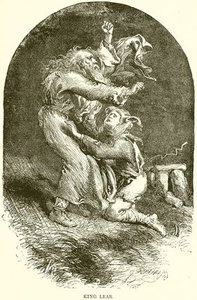
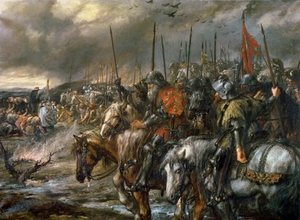
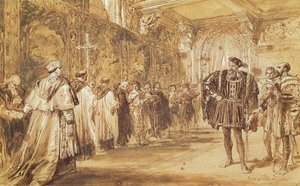
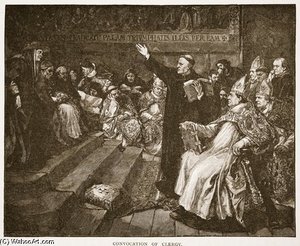
11The Ford (1891) de John GilbertThe Ford1891 · Galería de la Casa del Gremio 12Don Quixote and Sancho Panza (1840) de John GilbertDon Quixote and Sancho Panza1840 13Don Quixote Disputing with the Priest and the Barber (1844) de John GilbertDon Quixote Disputing with the Priest and the Barber1844 14Her Majesty the Queen Holding a Drawing Room at St James's Palace (1851) de John GilbertHer Majesty the Queen Holding a Drawing Room at St James's Palace1851 15'Henry VIII', Act I, Scene 1, Cardinal Wolsey and Buckingham (1861) de John Gilbert'Henry VIII', Act I, Scene 1, Cardinal Wolsey and Buckingham1861 · Colección de la Royal Shakespeare Company 16Keston Common, Kent (1856) de John GilbertKeston Common, Kent1856 17Study Of Trees (1874) de John GilbertStudy Of Trees1874 · Birmingham Museum and Art Gallery 18Old Cottages At Lewisham (1876) de John GilbertOld Cottages At Lewisham1876 · Birmingham Museum and Art Gallery 19Preparing For The Charge (1873) de John GilbertPreparing For The Charge1873 · Birmingham Museum and Art Gallery 20Landscape Sketch (1877) de John GilbertLandscape Sketch1877 · Birmingham Museums And Art Gallery 21Don Sancho Panza, Governor of Barataria (1875) de John GilbertDon Sancho Panza, Governor of Barataria1875 · Manchester Art Gallery 22The Baggage Wagon (1884) de John GilbertThe Baggage Wagon1884 · Birmingham Museum and Art Gallery 23A Windy Day (1885) de John GilbertA Windy Day1885 · Birmingham Museum and Art Gallery 24The Horse Pond at Tarring, Sussex (1882) de John GilbertThe Horse Pond at Tarring, Sussex1882 25The Morning of the Battle of Agincourt (1884) de John GilbertThe Morning of the Battle of Agincourt1884 · Galería de la Casa del Gremio 26Don Quixote's Niece and Housekeeper (1891) de John GilbertDon Quixote's Niece and Housekeeper1891 · Galería de la Casa del Gremio 27Stock exchange de John GilbertStock exchange 28The aberdeen cabinet de John GilbertThe aberdeen cabinet 29King John de John GilbertKing John 30King Henry's Forces At The Siege Of Harfleur, de John GilbertKing Henry's Forces At The Siege Of Harfleur, 31Richard Ii de John GilbertRichard Ii 32Henry Iv, Part I de John GilbertHenry Iv, Part I 33War - After The Battle de John GilbertWar - After The Battle 34Marmion's Defence to Douglas de John GilbertMarmion's Defence to Douglas 35Queen Elizabeth I Knighting Francis Drake de John GilbertQueen Elizabeth I Knighting Francis Drake 36Coriolanus, de John GilbertCoriolanus, 37As You Like It de John GilbertAs You Like It 38King Lear de John GilbertKing Lear 39King Lear de John GilbertKing Lear 40The Battle Of The Standard de John GilbertThe Battle Of The Standard 41Morning Of The Battle Of Agincourt de John GilbertMorning Of The Battle Of Agincourt 42Titus Andronicus de John GilbertTitus Andronicus 43The Heir Of Linne de John GilbertThe Heir Of Linne 44Guy Fawkes Before King James de John GilbertGuy Fawkes Before King James 45Much Ado About Nothing de John GilbertMuch Ado About Nothing 46King Henry Vi de John GilbertKing Henry Vi 47The Merchant Of Venice de John GilbertThe Merchant Of Venice 48The Merchant Of Venice de John GilbertThe Merchant Of Venice 49Battle of the Standard, de John GilbertBattle of the Standard, 50Henry Viii And Cardinal Thomas Wolsey de John GilbertHenry Viii And Cardinal Thomas Wolsey 51Cordelia de John GilbertCordelia 52Convocation Of Clergy de John GilbertConvocation Of Clergy 53What Shall He Have That Killed The Deer de John GilbertWhat Shall He Have That Killed The Deer 54Wolsey de John GilbertWolsey 55King Henry VI, Part I de John GilbertKing Henry VI, Part I 56Cardinal Wolsey On His Way To Westminster Hall, de John GilbertCardinal Wolsey On His Way To Westminster Hall, 57The Brave Lord Willoughby de John GilbertThe Brave Lord Willoughby 58Valentine And Ursine de John GilbertValentine And Ursine 59Under The Greenwood Tree de John GilbertUnder The Greenwood Tree 60Rembrandt in his Studio de John GilbertRembrandt in his Studio 61Fairies In A Bird's Nest de John GilbertFairies In A Bird's Nest 62A Girl with Fruit (1882) de John GilbertA Girl with Fruit1882 · Galería de la Casa del Gremio 63Landscape with Hunting Party (1893) de John GilbertLandscape with Hunting Party1893 · Galería de la Casa del Gremio 64King Henry's Fleet Sails For France, de John GilbertKing Henry's Fleet Sails For France, 65Malvolio de John GilbertMalvolio 66Measure For Measure, de John GilbertMeasure For Measure, 67The Tempest de John GilbertThe Tempest 68Julius Caesar de John GilbertJulius Caesar 69Henry Iv, Part Ii de John GilbertHenry Iv, Part Ii 70Henry Vi, Part I, de John GilbertHenry Vi, Part I, 71Come Away, Come Away, Death de John GilbertCome Away, Come Away, Death 72The Merchant Of Venice, de John GilbertThe Merchant Of Venice, 73The Two Gentlemen Of Verona de John GilbertThe Two Gentlemen Of Verona 74Romeo And Juliet, de John GilbertRomeo And Juliet, 75Othello de John GilbertOthello 76Henry Vi, Part Iii, de John GilbertHenry Vi, Part Iii, 77After The Battle Of Naseby de John GilbertAfter The Battle Of Naseby 78Twelfth Night de John GilbertTwelfth Night 79The Merry Wives Of Windsor de John GilbertThe Merry Wives Of Windsor 80Joan La Pucelle Abandoned de John GilbertJoan La Pucelle Abandoned 81Valentine And Ursine de John GilbertValentine And Ursine 82As You Like It de John GilbertAs You Like It 83The Yellow Dwarf, de John GilbertThe Yellow Dwarf, 84Investiture Of A Knight Of The Garter de John GilbertInvestiture Of A Knight Of The Garter 85Andrew Barton de John GilbertAndrew Barton 86Macbeth de John GilbertMacbeth 87Henry Viii de John GilbertHenry Viii 88Hamlet de John GilbertHamlet 89Tempest de John GilbertTempest 90Taming Of The Shrew de John GilbertTaming Of The Shrew 91Othello de John GilbertOthello 92A Midsummer Night's Dream de John GilbertA Midsummer Night's Dream 93King Richard Ii de John GilbertKing Richard Ii 94Henry V de John GilbertHenry VMuseo de Bellas Artes 95Timon Of Athens de John GilbertTimon Of Athens 96Joan Of Arc de John GilbertJoan Of Arc 97Apotheosis Of Shakespeare's Characters de John GilbertApotheosis Of Shakespeare's Characters 98Guy Fawkes Brought Before James I And His Council de John GilbertGuy Fawkes Brought Before James I And His Council 99Come Away Death de John GilbertCome Away Death 100The Merchant Of Venice de John GilbertThe Merchant Of Venice

Pinturas famosas de John Gilbert, época por época

Los temas que cautivaron la mirada de John Gilbert

Los cuatro temas que se repiten con más frecuencia en estas obras originales, cada uno con su mejor ejemplo.

Los museos que conservan los originales de John Gilbert

Los 6 museos que albergan la mayoría de las pinturas de esta página.

Museos Ciudad Obras de John Gilbert Pinturas de esta lista
Galería de la Casa del Gremio, LondresGalería de la Casa del Gremio Londres 9 Bello San Jorge, Margarita de Anjou capturada tras la batalla de Tewkesbury, Lancelot du Lac
Birmingham Museum and Art Gallery, BirminghamBirmingham Museum and Art Gallery Birmingham 9 La fierecilla domada, Sir John Falstaff revisando su regimiento harapiento, Escena de El mercader de Venecia de Shakespeare
Manchester Art Gallery, ManchesterManchester Art Gallery Manchester 2 Don Sancho Panza, Governor of Barataria
Colección de la Royal Shakespeare Company, AvonColección de la Royal Shakespeare Company Avon 1 'Henry VIII', Act I, Scene 1, Cardinal Wolsey and Buckingham
Birmingham Museums And Art Gallery, BirminghamBirmingham Museums And Art Gallery Birmingham 1 Landscape Sketch
Museo de Bellas Artes, BostonMuseo de Bellas Artes Boston 1 Henry V

John Gilbert década tras década: la obra original que define cada una

Obras por década

Elige una década para ver la obra original que la define.

Preguntas de coleccionistas sobre las pinturas de John Gilbert

¿Por qué obra es más famoso/a John Gilbert?Descubre la respuesta

Bello San Jorge (1881), Galería de la Casa del Gremio, Londres. A La fierecilla domada (1860) y Sir John Falstaff revisando su regimiento harapiento (1858) le siguen.

¿Qué edad tenía John Gilbert cuando se creó Bello San Jorge?Descubre la respuesta

64 años: Bello San Jorge data de 1881, y John Gilbert nació en 1817.

¿Cuáles son las diez pinturas más famosas de John Gilbert?Descubre la respuesta

Bello San Jorge, La fierecilla domada, Sir John Falstaff revisando su regimiento harapiento, Escena de El mercader de Venecia de Shakespeare, El regreso de los vencedores, Margarita de Anjou capturada tras la batalla de Tewkesbury, Don Quijote y Sancho en el castillo del Duque, Paisaje con un campamento gitano, Lancelot du Lac y Ego et Rex Meus. La clasificación anterior indica el año y el museo de cada una.

¿Cuántas pinturas dejó John Gilbert?Descubre la respuesta

Nuestro catálogo cuenta con 204 obras de John Gilbert, datadas desde 1840 hasta 1893.

¿En qué museos se exhiben las obras maestras de John Gilbert?Descubre la respuesta

Principalmente en Galería de la Casa del Gremio (Londres), Birmingham Museum and Art Gallery (Birmingham) y Manchester Art Gallery (Manchester). La tabla de museos arriba los enumera todos.

¿En qué años pintó John Gilbert sus obras más famosas?Descubre la respuesta

En 1880s: 10 de las 100 obras de esta página se realizaron entonces, Bello San Jorge de ellas.

¿Cuáles son las primeras y las últimas obras originales de John Gilbert?Descubre la respuesta

En esta página, la más antigua es Don Quixote and Sancho Panza (1840) y la más reciente Landscape with Hunting Party (1893).

¿Qué temas eligió John Gilbert con mayor frecuencia?Descubre la respuesta

Victorian era (8), Royalty (4) y Shakespeare (4), en las 100 obras de esta página.

¿Qué técnica utilizó más John Gilbert?Descubre la respuesta

Óleo sobre lienzo, para 7 de las 100 obras de esta página.

¿A qué movimiento artístico pertenece John Gilbert?Descubre la respuesta

Romantic landscape painting, a juzgar por los originales de esta página.

¿Qué obras de John Gilbert se exhiben en el Galería de la Casa del Gremio?Descubre la respuesta

Bello San Jorge, Margarita de Anjou capturada tras la batalla de Tewkesbury y Lancelot du Lac: el Galería de la Casa del Gremio, Londres posee 9 de las obras de esta página.

John Gilbert: vida y obra

Sir John Gilbert RA: The Sculptor of Victorian Imagination

John Gilbert (July 21, 1817 – October 5, 1897), born in Blackheath, Surrey, was a British artist whose prolific output cemented his reputation as “the Scott of painting,” an accolade reflecting his unparalleled skill in capturing the spirit and grandeur of literary classics. Unlike many artists of his era who pursued formal training, Gilbert honed his craft through self-discipline and meticulous observation—primarily copying prints—establishing himself as a master of watercolour, oils, and crucially, wood engraving. His artistic journey began with an apprenticeship at a firm of estate agents but quickly transitioned towards a passion for visual storytelling that would define his career.

Early Life and Artistic Beginnings

Gilbert’s formative years instilled in him a profound appreciation for detail and precision—qualities he would later translate into breathtaking illustrations. George Lance, his sole instructor, nurtured Gilbert's talent, encouraging him to experiment with various mediums and fostering an unwavering dedication to artistic excellence. Despite being denied admission to the Royal Academy Schools, Gilbert’s determination propelled him forward, mastering techniques that allowed him to produce works of remarkable beauty and complexity. His initial exposure to art came through printmaking, a practice he embraced wholeheartedly, recognizing its ability to convey emotion and narrative with striking effectiveness. This early fascination with visual representation would become the cornerstone of his artistic philosophy—a belief that art possessed the power to illuminate the human experience and elevate the soul.

The Illustrated London News and Shakespeare

Gilbert’s breakthrough arrived in 1856 when he accepted an invitation from William Mulready and Thomas Sheepshanks to contribute woodcuts for *The Illustrated London News*. This collaboration marked the beginning of a prolific partnership that would yield over 2000 engravings—a staggering achievement for the time—demonstrating Gilbert’s mastery of this demanding medium. However, his most enduring legacy resides in his monumental undertaking: the illustrated Shakespeare folio (1862–63). With nearly 750 drawings meticulously crafted to capture the essence of Shakespeare's plays, Gilbert achieved a feat considered impossible by many contemporaries and established himself as the foremost interpreter of Shakespeare’s dramatic vision. The sheer scale and ambition of this project underscored his belief in the transformative power of art—specifically its capacity to illuminate the human condition. He painstakingly researched Elizabethan theatrical conventions and meticulously recreated stage settings with astonishing accuracy, ensuring that each illustration faithfully conveyed the atmosphere and emotion of the original text.

Technique and Style

Gilbert’s artistic style was characterized by a masterful command of chiaroscuro, employing dramatic contrasts between light and shadow to heighten emotional impact and convey depth of feeling. He favored meticulous detail, painstakingly rendering textures and surfaces with remarkable accuracy—a hallmark of his oeuvre that distinguishes him from many other artists of the Victorian period. His paintings often depicted landscapes imbued with atmospheric grandeur, reflecting a fascination with Romantic ideals and an unwavering commitment to capturing sublime beauty. Furthermore, Gilbert’s artistic explorations extended beyond painting into sculpture, where he created evocative figures that embodied both strength and grace. He skillfully utilized marble and bronze to sculpt portraits and monumental sculptures—works that celebrated heroism and nobility—demonstrating his versatility as a visual artist.

Legacy and Recognition

Gilbert's influence on Victorian art and illustration is undeniable. He served as president of the Royal Watercolour Society from 1871, solidifying his position as a leading figure in British artistic circles. In recognition of his contributions to the visual arts, he was knighted in 1872—a testament to his enduring reputation for excellence and innovation—and subsequently elected into the Royal Academy in 1876—a symbol of his unwavering commitment to artistic integrity and scholarly pursuits. His work continues to inspire artists today, serving as an exemplar of artistic discipline, technical virtuosity, and imaginative storytelling. The Gilbert-Garret Competition for Sketching Clubs established in 1870 at St. Martins School of Art stands as a lasting tribute to his pioneering spirit and unwavering belief in the importance of artistic education. John Gilbert’s legacy extends beyond his artistic achievements; he is remembered as a champion of humanist values—a man who sought to elevate the human spirit through beauty and contemplation. He rests peacefully at Brockley and Ladywell Cemeteries, Surrey.