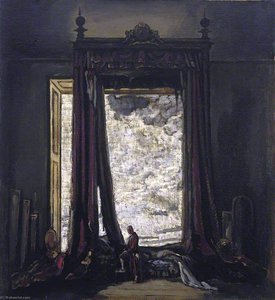
Retrato de James Pryde

Pinturas de James Pryde: Las 31 más famosas, bajo la mirada de una galería

Actualizado noviembre 2026 · clasificado según nuestro índice de popularidad (búsquedas, visitas y pedidos de cada obra) · 37 obras de James Pryde en nuestro catálogo

En resumen

Para la galería, la pintura más famosa de James Pryde es Ellen Terry como Nance Oldfield (1906). Un paisaje romántico (1908) y El suburbio (1916) completan el trío que toda mirada reconoce. De las 37 obras de James Pryde en nuestro catálogo, la galería presenta a continuación las 31 más famosas; cada una original, con su año, su museo y aquello que la hace única.

1866 – 1941, Edimburgo Escuela de glasgow Más obras: Galería Nacional de Arte Moderno de Escocia

Las 10 mejores pinturas de James Pryde en la galería

1
Ellen Terry como Nance Oldfield (1906) de James Pryde

Ellen Terry como Nance Oldfield

1906 · Óleo sobre tabla

El escenario es un vacío de tonos oscuros, un silencio denso capturado en óleo y barniz. Dentro de esta penumbra, emerge una figura solitaria, atrapada en un momento de movimiento repentino y envolvente. Es Nance Oldfield, con su cuerpo inclinado con una urgencia teatral que desafía la quietud del lienzo. Un brazo se extiende hacia la oscuridad, en un gesto de anhelo o quizás un mandato dirigido a un público…

2
Un paisaje romántico (1908) de James Pryde

Un paisaje romántico

1908 · Acrílico sobre lienzo · Galería de Arte de Leeds, Leeds

“Un paisaje romántico”, pintado en 1908 por James Ferrier Pryde, no es simplemente la representación de una escena pintoresca; es una invitación cuidadosamente construida hacia el corazón de una era pasada. Este óleo, con unas dimensiones de 119 x 104 cm, captura a un grupo de figuras resguardadas en un bosque exuberante, cuya presencia se entrelaza sutilmente con la grandeza y el misterio de la naturaleza. La composición dirige la…

3
El suburbio (1916) de James Pryde

El suburbio

1916 · Acrílico sobre lienzo · El Museo Ashmolean de Arte y Arqueología, Oxford

“El suburbio”, pintada en 1916 por James Ferrier Pryde, no es simplemente una representación de un rincón olvidado de Edimburgo; es una profunda meditación sobre la pobreza, la injusticia social y las sombras acechantes de la modernidad. Nacido en medio del fermento artístico de la Escuela de Arte de Glasgow, Pryde desarrolló un estilo distintivo —una mezcla magistral de realismo atmosférico y un simbolismo sutil— que resonó profundamente con las…

Pinturas de James Pryde, clasificadas de la 11 a la 31

Los temas que cautivaron la mirada de James Pryde

Los cuatro temas que se repiten con más frecuencia en estas obras originales, cada uno con su mejor ejemplo.

Los museos que conservan los originales de James Pryde

Los 8 museos que albergan la mayoría de las pinturas de esta página.

Museos Ciudad Obras de James Pryde Pinturas de esta lista
Galería Nacional de Arte Moderno de Escocia, EdimburgoGalería Nacional de Arte Moderno de Escocia Edimburgo 2 Lumber A Silhouette, An Ancient Harbour
Galería de Arte de Leeds, LeedsGalería de Arte de Leeds Leeds 1 Un paisaje romántico
El Museo Ashmolean de Arte y Arqueología, OxfordEl Museo Ashmolean de Arte y Arqueología Oxford 1 El suburbio
Colección de Arte del Gobierno, LondresColección de Arte del Gobierno Londres 1 El Monumento
National Trust, CambridgeNational Trust Cambridge 1 Alegoría: El monolito de la 'Victoria'
Museo y Galería de Arte de Leicester, LeicesterMuseo y Galería de Arte de Leicester Leicester 1 The Monument
La Colección Fleming, LondresLa Colección Fleming Londres 1 The Unknown Corner
Museo & Arte Swindon, SwindonMuseo & Arte Swindon Swindon 1 Sin título

James Pryde, una pintura emblemática por década

Obras por década

Elige una década para ver la obra original que la define.

Pinturas de James Pryde: la galería responde

¿Cuál es la pintura más famosa de James Pryde?Descubre la respuesta

Ellen Terry como Nance Oldfield (1906). A continuación, Un paisaje romántico (1908) y El suburbio (1916).

¿Qué edad tenía James Pryde al completar Ellen Terry como Nance Oldfield?Descubre la respuesta

40 años: Ellen Terry como Nance Oldfield data de 1906, y James Pryde nació en 1866.

¿Cuáles son las 10 pinturas principales de James Pryde?Descubre la respuesta

Ellen Terry como Nance Oldfield, Un paisaje romántico, El suburbio, Moll Cutpurse (The Roaring Girl), John Price, John Price, Cartouche, The Deserted Garden, The Birdcage y The Black Pillar. La clasificación anterior indica el año y el museo de cada una.

¿Cuántas obras creó James Pryde?Descubre la respuesta

Nuestro catálogo cuenta con 37 obras de James Pryde, datadas desde 1902 hasta 1940.

¿Dónde se exhiben los originales más famosos de James Pryde?Descubre la respuesta

Principalmente en Galería Nacional de Arte Moderno de Escocia (Edimburgo), Galería de Arte de Leeds (Leeds) y El Museo Ashmolean de Arte y Arqueología (Oxford). La tabla de museos arriba los enumera todos.

¿Cuándo creó James Pryde sus pinturas más famosas?Descubre la respuesta

En 1900s: 9 de las 31 obras de esta página se realizaron entonces, Ellen Terry como Nance Oldfield de ellas.

¿Cuáles son las primeras y últimas obras famosas de James Pryde?Descubre la respuesta

En esta página, la más antigua es Moll Cutpurse (The Roaring Girl) (1902) y la más reciente The Untouchables (1940).

¿A qué temas volvió James Pryde con más frecuencia?Descubre la respuesta

Figuras (2), Arquitectura (2) y Victorian era (2), en las 31 obras de esta página.

¿En qué técnica trabajó más James Pryde?Descubre la respuesta

Acrílico sobre lienzo, para 5 de las 31 obras de esta página.

¿A qué movimiento se asocia James Pryde?Descubre la respuesta

Escuela de glasgow y Paisaje romántico, a juzgar por los originales de esta página.

¿Qué obras originales de James Pryde posee el Galería Nacional de Arte Moderno de Escocia?Descubre la respuesta

Lumber A Silhouette y An Ancient Harbour: el Galería Nacional de Arte Moderno de Escocia, Edimburgo posee 2 de las obras de esta página.

James Pryde: el artista

James Ferrier Pryde (1866–1941): A Painter of Atmospheric Visions

James Ferrier Pryde (1866-1941) stands as a pivotal figure in the history of British art, particularly renowned for his groundbreaking collaboration with William Nicholson as “The Beggarstaffs” and his distinctive approach to architectural painting. Born in Edinburgh on December 4, 1866, into a family steeped in artistic heritage—his lineage tracing back to Robert Scott Lauder and James Eckford Lauder—Pryde’s formative years instilled within him an appreciation for creativity and intellectual stimulation. His father, David Pryde, served as headmaster of Edinburgh Ladies’ College, fostering a household valuing education and artistic pursuits. From a young age, Pryde demonstrated an innate talent for drawing and painting, nurtured by the encouragement of influential educators who recognized his potential.

Early Artistic Training and Influences

Pryde’s formal artistic training commenced at the Royal Scottish Academy between 1885 and 1888, where he honed his skills under the tutelage of masters like James Guthrie and Edward Arthur Walton. These formative years exposed him to the prevailing stylistic currents of Glasgow School, shaping his initial artistic explorations and establishing a foundation for his subsequent endeavors. Beyond formal instruction, Pryde absorbed inspiration from diverse sources—including Whistler’s ethereal landscapes and Piranesi’s monumental architectural etchings—whose aesthetic sensibilities profoundly impacted his visual vocabulary. The influence of Bouguereau's meticulous realism served as another crucial element in developing Pryde’s artistic technique.

The Beggarstaffs: Revolutionizing Poster Design

Pryde’s most celebrated partnership began in 1893 with William Nicholson, resulting in the formation of “The Beggarstaffs.” This alliance swiftly transformed the landscape of poster design, ushering in a new era characterized by bold compositions, striking imagery, and theatrical grandeur. Prior to The Beggarstaffs, posters were often cluttered and illustrative; Pryde and Nicholson deliberately stripped away superfluous ornamentation, prioritizing clarity and visual impact. Their designs transcended mere advertising—they functioned as artistic statements, elevating poster art from utilitarian necessity to a respected form of creative expression. Rejecting established conventions, they crafted works that captivated audiences with their arresting beauty and intellectual depth. The Beggarstaffs’ innovative approach extended beyond typography and illustration; they embraced dramatic lighting effects and compositional arrangements reminiscent of theatrical staging—a deliberate strategy aimed at maximizing visual impact and conveying emotion.

Architectural Paintings: Exploring Mood and Scale

Pryde’s artistic passion centered around architectural paintings, where he pursued a singular vision—capturing not just the physical structure of buildings but also their emotional resonance and psychological significance. Unlike conventional depictions that prioritized accuracy, Pryde sought to evoke atmosphere and convey feeling through expansive brushwork and masterful use of light. His canvases frequently featured monumental structures dwarfing human figures, emphasizing our vulnerability against the grandeur of history and time—a motif directly influenced by Piranesi’s etchings. Pryde eschewed precise representation, prioritizing instead a subjective interpretation of space and emotion. He meticulously crafted scenes that felt like glimpses into dreamlike realms—hauntingly beautiful and subtly unsettling—reflecting his profound engagement with the psychological dimensions of art.

Recognition and Legacy

Throughout his career, Pryde garnered acclaim from fellow artists and critics alike. His association with the International Society of Sculptors, Painters and Gravers solidified his position within the artistic community, while collaborations with luminaries like Edward Gordon Craig affirmed his talent as a painter—despite acknowledging limitations in theatrical performance. Pryde’s involvement in Edinburgh artistic circles ensured that he remained connected to the cultural landscape of his time. His paintings were exhibited at the Baillie Gallery in 1911 and the Leicester Galleries in 1933, securing his place within British art history. James Ferrier Pryde passed away peacefully on February 24, 1941, leaving behind a legacy as one of Britain’s foremost practitioners of atmospheric painting and a pioneer of graphic design—a testament to his enduring influence on the visual arts.