


1


Actualizado noviembre 2026 · clasificado según nuestro índice de popularidad (búsquedas, visitas y pedidos de cada obra) · 28 obras de Henri Evenepoel en nuestro catálogo
En resumen
Man in Red (1894) es la pintura de Henri Evenepoel que más llama la atención; la obra original pertenece al Musées Royaux Des Beaux, Bruselas. Después, la mirada se dirige a My Ill Grandfather (1892) y Charles Milcendeau (1899). De las 28 obras de Henri Evenepoel en nuestro catálogo, estas 26 son las más famosas; cada una es un original único presentado con su año, su museo y la razón de su trascendencia.


Este retrato, titulado Charles Milcendeau, fue pintado por Henri Evenepoel en 1899. La obra captura a un individuo específico, Charles Edmond Théodore Soullans, quien es conocido para nosotros a través de esta pieza como Charles Milcendeau. La pintura ofrece un encuentro directo con el sujeto, presentado de una manera que se siente tanto personal como serena.


 Count Aymer de la Chevalerie1896 · Real Museo de Bellas Artes de Amberes
12
 The running girl1895 · Real Museo de Bellas Artes de Amberes
13
 Wrestling Barrack at a Fair1898 · Real Museo de Bellas Artes de Amberes
14
 The Poulterer1897 · Real Museo de Bellas Artes de Amberes
15
 The Box1896 · Real Museo de Bellas Artes de Amberes
16
 Portrait of Edward Tuck, Vice-Consul of the United States in Paris1899 · Museo de Bellas Artes de Gante (MSK)
17
 Sunday at the Bois de Boulogne1899 · Real Museo de Bellas Artes de Amberes
18
 Sunday in the Bois de Boulogne1891
19
 Orange Market at Blida1898 · Museos Reales de Bellas Artes de Bélgica
20
 Sunday Fair at Les Invalides1897 · Real Museo de Bellas Artes de Amberes
21
 Mendiant. Algerie1897
22
 Veterans' Festival1898 · Musées Royaux des Beaux-Arts
23
 Henriette in a Large Hat1899 · Musées Royaux Des Beaux
24
 La chambre de l'artiste
25
 Charles in a Striped Jersey1898
26
 The Spaniard in Paris1899 · Museo de Bellas Artes de Gante (MSK)
Los 8 museos que albergan la mayoría de las pinturas de esta página.
| Museos | Ciudad | Obras de Henri Evenepoel | Pinturas de esta lista |
|---|---|---|---|
 Real Museo de Bellas Artes de Amberes |
Amberes | 10 | My Ill Grandfather, Louise in Mourning, Returning from Work at Sunset |
 Museo de Bellas Artes de Gante (MSK) |
Gante | 4 | Portrait of Hélène Roulet, the Wife of the Artist Adolphe Crespin, The Clown, Portrait of Edward Tuck, Vice-Consul of the United States in Paris |
 Musées Royaux Des Beaux |
Bruselas | 2 | Man in Red, Henriette in a Large Hat |
 Museos Reales de Bellas Artes de Bélgica |
Bruselas | 2 | Pictures - Portrait of Louis Charles Crespin, Orange Market at Blida |
 Musée d'Orsay |
París | 1 | Charles Milcendeau |
 Städel Museum |
Frankfurt | 1 | In the Café d'Harcourt in Paris |
 Museum of Fine Arts |
Houston | 1 | At the Moulin Rouge |
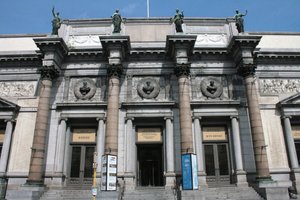 Musées Royaux des Beaux-Arts |
Bruselas | 1 | Veterans' Festival |
Las obras originales fechadas de Henri Evenepoel que se muestran aquí abarcan aproximadamente diez años, de 1891 a 1899: la mirada las recorre año tras año.
Selecciona un año para ver sus originales.

Más de 1896
Este retrato, titulado Charles Milcendeau, fue pintado por Henri Evenepoel en 1899. La obra captura a un individuo específico, Charles Edmond Théodore Soullans, quien es conocido para nosotros a través de esta pieza como Charles Milcendeau. La pintura ofrece un encuentro directo con el sujeto, presentado de una manera que se siente tanto personal como serena.
Más de 1899
Man in Red (1894), Musées Royaux Des Beaux, Bruselas. A My Ill Grandfather (1892) y Charles Milcendeau (1899) le siguen.
22 años: Man in Red data de 1894, y Henri Evenepoel nació en 1872.
Man in Red, My Ill Grandfather, Charles Milcendeau, In the Café d'Harcourt in Paris, Pictures - Portrait of Louis Charles Crespin, At the Moulin Rouge, Portrait of Hélène Roulet, the Wife of the Artist Adolphe Crespin, The Clown, Louise in Mourning y Returning from Work at Sunset. La clasificación anterior indica el año y el museo de cada una.
Nuestro catálogo cuenta con 28 obras de Henri Evenepoel, datadas desde 1891 hasta 1899.
Principalmente en Real Museo de Bellas Artes de Amberes (Amberes), Museo de Bellas Artes de Gante (MSK) (Gante) y Musées Royaux Des Beaux (Bruselas). La tabla de museos arriba los enumera todos.
En 1897: 5 de las 26 obras de esta página se realizaron entonces, In the Café d'Harcourt in Paris de ellas.
En esta página, la más antigua es Sunday in the Bois de Boulogne (1891) y la más reciente Charles Milcendeau (1899).
My Ill Grandfather, Louise in Mourning y Returning from Work at Sunset: el Real Museo de Bellas Artes de Amberes, Amberes posee 10 de las obras de esta página.


