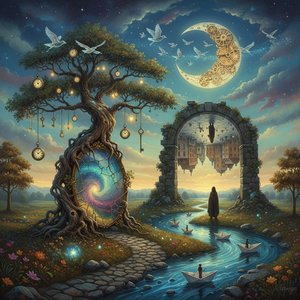
The Renaissance Spirit in Modern Shadows
Gregory Gillespie was an artist who lived between worlds, bridging the gap between the meticulous rigor of the Italian Renaissance and the unsettling dreamscapes of contemporary surrealism. Born in Roselle Park, New Jersey, his journey took him from the foundational studies at Cooper Union to the vibrant artistic community of the San Francisco Art Institute. However, it was his transformative period in Italy, fueled by prestigious Fulbright-Hays grants, that truly forged his visual language. Immersed in the works of masters like Masccio, Mantegna, and Carlo Crivelli, Gillespie absorbed a sense of compositional gravity and symbolic depth that would haunt his canvases for decades. His time in Florence and Rome allowed him to cultivate an atmosphere of profound melancholy, where landscapes were never merely scenery but vessels for contemplation and quiet drama.The Alchemy of Image and Layer
Gillespie’s methodology was a fascinating study in transformation, often blurring the line between found reality and painted fiction. In his most evocative early works, he employed a unique collage technique, meticulously cutting images from newspapers and magazines to layer beneath or atop his painted surfaces. This process allowed him to breathe new life into the mundane, turning a simple newsprint fragment into a ghostly inhabitant of a surreal landscape. His ability to blend Flemish realism with elements of the unexpected created a tension that invited viewers to question the boundaries of their own perception. As he returned to the United States in 1970 and settled in Massachusetts, his focus shifted toward working directly from life. This evolution brought about a period of exquisite still lifes and self-portraits that maintained his signature attention to detail while embracing a newfound expressive freedom.A Legacy of Enchanted Realism
The significance of Gillespie’s contribution to American art lies in his ability to sustain the flame of magic realism in a modern era. His career was marked by prestigious recognitions, including his election as an Associate of the National Academy of Design in 1971 and later as a full Academician in 1994. Through exhibitions in the Whitney Biennials and a major retrospective at the Hirshhorn Museum, he established himself as a master of the enigmatic. His oeuvre remains a testament to the power of meticulous craft and the enduring allure of the mysterious, leaving behind a collection of works characterized by:- Symbolic depth derived from classical traditions;
- Atmospheric landscapes that evoke both peace and unease;
- Technical mastery in both collage and direct painting;
- Narrative ambiguity that challenges the viewer's eye.