Giovanni Battista Borghesi: A Neoclassical Painter and Scenic Designer
Giovanni Battista Borghesi (1790-1846) stands as a prominent figure within the Italian neoclassic artistic landscape, particularly celebrated for his contributions to theatrical design and mural painting. Born in Parma, Italy, Borghesi’s formative years were marked by exposure to the burgeoning artistic fervor of his time, fostering an unwavering dedication to mastering classical principles and achieving unparalleled visual precision. His journey began with a disciplined education under Biagio Martini, a respected instructor who instilled in him a profound understanding of artistic technique and compositional harmony—a foundation that would shape his entire oeuvre.
Early Works and Training
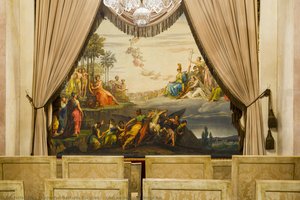
Borghesi’s initial artistic endeavors centered on decorative murals within residential spaces and ecclesiastical buildings. These early commissions served as invaluable training grounds, honing his skills in pigment mixing, brushwork, and the meticulous rendering of architectural details. Notably, he undertook significant work on the Arena di Parma, a monumental amphitheater undergoing renovation—a project that demanded considerable logistical planning and artistic ingenuity. This undertaking solidified Borghesi’s reputation for tackling ambitious undertakings with unwavering commitment to excellence. Furthermore, his involvement in the Teatro Regio di Parma showcased his talent as a scenic designer, crafting breathtaking sets imbued with classical grandeur and symbolic resonance. The allegorical painting “Maria Luigia,” housed within the Museo glauco lombardi, exemplifies Borghesi's ability to synthesize artistic vision with scholarly knowledge—a hallmark of his distinctive style.
Notable Works and Style
Borghesi’s artistic style is characterized by its austere elegance and unwavering adherence to neoclassic ideals. He favored bold color palettes combined with intricate geometric patterns, reflecting the influence of artists like Jacques-Louis David and Antonio Canova. His paintings frequently depict mythological subjects or historical narratives, meticulously executed with painstaking attention to detail—a testament to his mastery of technique. The Museo glauco lombardi’s collection proudly displays several masterpieces by Borghesi, including “Allegory of Maria Luigia,” which exemplifies the artist's ability to convey complex ideas through visual symbolism. His meticulous brushwork and masterful use of chiaroscuro contribute significantly to the dramatic impact of his compositions.
Influences and Legacy
Borghesi’s artistic sensibilities were profoundly shaped by Biagio Martini, who championed the revival of classical art forms as a corrective to the excesses of Rococo aesthetics. This intellectual engagement fueled Borghesi's unwavering belief in the transformative power of reason and observation—values that permeated his artistic practice. He stands as an exemplar of neoclassicism’s commitment to clarity, balance, and idealized beauty. His enduring legacy resides not only in his impressive body of work but also in his contribution to establishing Parma as a center for artistic innovation during the nineteenth century. Giovanni Battista Borghesi continues to inspire artists today with his unwavering dedication to classical principles and his unparalleled skill in translating intellectual concepts into captivating visual representations.
Important Links
* https://OriginalUniqueArt.com/@/giovanni-battista-borghesi
* https://wikipedia.org