Retrato de Edward Armitage

Las 27 pinturas más famosas de Edward Armitage, cada una única en su clase

Actualizado octubre 2026 · clasificado según nuestro índice de popularidad (búsquedas, visitas y pedidos de cada obra) · 29 obras de Edward Armitage en nuestro catálogo

En resumen

El festival de Ester (1865) es la pintura de Edward Armitage que más llama la atención; la obra original pertenece al Real Academia de Artes, Londres. Después, la mirada se dirige a The Woman Taken in Adultery (1860) y Saint Simon (1862). De las 29 obras de Edward Armitage en nuestro catálogo, estas 27 son las más famosas; cada una es un original único presentado con su año, su museo y la razón de su trascendencia.

1817 – 1896, Londres Arte académico Más obras: Auckland Art Gallery Toi o Tāmaki

Las 10 mejores pinturas de Edward Armitage, bajo la mirada de la galería

1
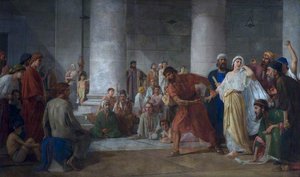
El festival de Ester (1865) de Edward Armitage

El festival de Ester

1865 · Óleo sobre lienzo · Real Academia de Artes, Londres

La escena se desarrolla dentro de la grandiosa y legendaria atmósfera de El festival de Ester, una obra que nos invita a un momento de celebración comunitaria. Pintada por Edward Armitage, este óleo sobre lienzo captura un instante específico de reunión y alegría compartida. Algunos observadores reconocen esta misma escena a través de su título alternativo, El banquete de Ester, un nombre que resalta la importancia central del festín que…

Pinturas famosas de Edward Armitage, de la número 11 a la 27

Los temas que cautivaron la mirada de Edward Armitage

Los cuatro temas que se repiten con más frecuencia en estas obras originales, cada uno con su mejor ejemplo.

Los museos que conservan los originales de Edward Armitage

Los 8 museos que albergan la mayoría de las pinturas de esta página.

Museos Ciudad Obras de Edward Armitage Pinturas de esta lista
Auckland Art Gallery Toi o Tāmaki, AucklandAuckland Art Gallery Toi o Tāmaki Auckland 3 Dawn of the first Easter Sunday, Blind Beggar of Assisi, Sea urchins
Walker Art Gallery, LiverpoolWalker Art Gallery Liverpool 2 Julian the Apostate Presiding at a Conference of Sectarians, Serf Emancipation
Hastings Museo y Galería de Arte, HastingsHastings Museo y Galería de Arte Hastings 2 A Dream of Fair Women (diptych, panel 2), A Dream of Fair Women (diptych, panel 1)
Laing Art Gallery, Newcastle upon TyneLaing Art Gallery Newcastle upon Tyne 2 The Cities of the Plain, Souvenir of Scutari
Royal Collection, LondresRoyal Collection Londres 2 The Pontoon on Virginia Water, 5 July 1853, The Battle of Meanee, 17 February 1843
Real Academia de Artes, LondresReal Academia de Artes Londres 1 El festival de Ester
Royal Society, LondresRoyal Society Londres 1 Deputation to Faraday
Galería de la Casa del Gremio, LondresGalería de la Casa del Gremio Londres 1 Herod's Birthday Feast

Edward Armitage a través de las décadas: una obra original única para cada una

Obras por década

Elige una década para ver la obra original que la define.

Pinturas de Edward Armitage: preguntas para la galería

¿Cuál es la obra más famosa de Edward Armitage?Descubre la respuesta

El festival de Ester (1865), Real Academia de Artes, Londres. A The Woman Taken in Adultery (1860) y Saint Simon (1862) le siguen.

¿A qué edad creó Edward Armitage El festival de Ester?Descubre la respuesta

48 años: El festival de Ester data de 1865, y Edward Armitage nació en 1817.

¿Cuáles son las diez pinturas más famosas de Edward Armitage?Descubre la respuesta

El festival de Ester, The Woman Taken in Adultery, Saint Simon, Dawn of the first Easter Sunday, Deputation to Faraday, Julian the Apostate Presiding at a Conference of Sectarians, The Death of Marmion, The Death of Nelson, The Christian Martyr y Christ Calling the Apostles James and John. La clasificación anterior indica el año y el museo de cada una.

¿Cuántas obras de Edward Armitage se conocen?Descubre la respuesta

Nuestro catálogo cuenta con 29 obras de Edward Armitage, datadas desde 1842 hasta 1882.

¿Dónde se pueden ver los originales más famosos de Edward Armitage?Descubre la respuesta

Principalmente en Auckland Art Gallery Toi o Tāmaki (Auckland), Walker Art Gallery (Liverpool) y Hastings Museo y Galería de Arte (Hastings). La tabla de museos arriba los enumera todos.

¿En qué periodo creó Edward Armitage sus pinturas más conocidas?Descubre la respuesta

En 1860s: 10 de las 27 obras de esta página se realizaron entonces, El festival de Ester de ellas.

¿Cuál es la pintura más antigua de Edward Armitage y cuál es la más reciente?Descubre la respuesta

En esta página, la más antigua es The Death of Marmion (1842) y la más reciente Self Portrait (1882).

¿Qué temas prefería Edward Armitage?Descubre la respuesta

Women (4), Birth and death (3) y Portrait (2), en las 27 obras de esta página.

¿A qué movimiento pertenece la obra de Edward Armitage?Descubre la respuesta

Arte académico, a juzgar por los originales de esta página.

¿Qué obras originales de Edward Armitage puedo ver en el Auckland Art Gallery Toi o Tāmaki?Descubre la respuesta

Dawn of the first Easter Sunday, Blind Beggar of Assisi y Sea urchins: el Auckland Art Gallery Toi o Tāmaki, Auckland posee 3 de las obras de esta página.

Edward Armitage: un retrato del artista

Edward Armitage: Victorian Painter of Dramatic History

Edward Armitage RA (20 May 1817 – 24 May 1896) was an english victorian-era painter whose work focused on historical, classical and biblical subjects. He stands as a prominent figure in the Romantic movement’s artistic landscape, embodying its passion for grandeur, moral seriousness, and evocative storytelling. Born into a wealthy yorkshire industrial family—the eldest son of james armitage (1793–1872) and anne elizabeth armitage née rhodes (1788–1833)—Armitage’s upbringing instilled in him an appreciation for both artistic excellence and social responsibility, values that would permeate his entire oeuvre.
  • Early Life & Artistic Training: Armitage's formative years were spent in london, where he received a robust education alongside his brothers, including thomas rhodes armitage (1824–1890), who established the royal national institute of the blind—a testament to Armitage’s familial commitment to philanthropy. Crucially, his artistic training commenced in paris, under the tutelage of paul delaroche, arguably the most celebrated history painter of his time. Delaroche's influence profoundly shaped Armitage’s stylistic sensibilities, fostering a dedication to monumental compositions and dramatic narratives.
  • The École des Beaux-Arts & Collaborative Projects: Armitage’s enrollment at the école des beaux-arts marked a pivotal moment in his artistic development. He participated in ambitious collaborative endeavors, notably assisting delaroche with the fresco hémicycle in the amphitheatre of the palais des beaux-arts—a project that afforded him invaluable experience working on large-scale decorative undertakings and honed his technical skills.

Westminster Palace Commissions & The Spirit of Britannia

Armitage’s involvement in the decoration of westminster palace following the devastating fire of 1834 exemplifies his ambition and artistic vision. He was tasked with designing monumental murals illustrating subjects from british history or mythology—a challenge he accepted with characteristic determination. His contributions to this project, including the ‘cartoons’ for the amphitheatre and the subsequent fresco depicting ‘the spirit of religion,’ solidified his reputation as a leading artist of his era and showcased his ability to capture complex themes with breathtaking artistry.
  • Notable Paintings: Armitage's artistic output spanned numerous genres, encompassing historical paintings, biblical scenes, and portraits. Among his most celebrated works are ‘Retribution’ (1858), a visceral depiction of the indian mutiny—a painting that provoked considerable debate regarding its portrayal of british imperial ambition; ‘Esther’s Banquet’ (1865); ‘The Remorse of Judas’ (1866); and ‘Herod’s Birthday Feast’ (1868)—each imbued with meticulous detail and conveying profound emotional resonance.
  • Technique & Style: Armitage's artistic style is characterized by a masterful command of technique—particularly fresco painting—which allowed him to achieve remarkable textural depth and luminosity. His compositions are grand in scale, reflecting the Romantic preoccupation with sublime landscapes and heroic narratives. He skillfully employed chiaroscuro—the dramatic interplay of light and shadow—to heighten emotional impact and imbue his paintings with an aura of theatrical grandeur.

Critical Reception & Legacy

Armitage’s artistic endeavors garnered considerable critical acclaim during his lifetime, though not without controversy. Critics acknowledged his technical prowess but questioned the appropriateness of certain thematic choices—particularly ‘Retribution,’ which was deemed overly sensationalistic and morally ambiguous by prominent voices like thackeray and professor byles. Despite these dissenting opinions, Armitage's enduring legacy rests upon his contribution to Victorian art history—his monumental paintings continue to inspire admiration for their ambition, artistry, and evocative portrayal of historical events.

Further Exploration

  • Wikipedia: Provides a comprehensive biographical overview and detailed information on his artistic output.
