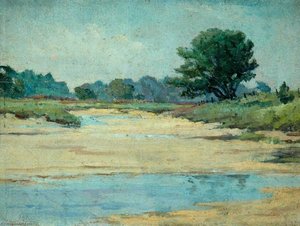
Arnold Priestman (1854–1925): Painter of Yorkshire’s Sublime
Arnold Priestman, born in Leeds, West Yorkshire, England, in 1854, emerged as a prominent landscape artist during the late Victorian era, capturing the dramatic beauty of the Yorkshire Dales with remarkable sensitivity and technical skill. His artistic vision was profoundly shaped by Romanticism and Impressionism, blending elements of both to produce paintings that resonate with emotion and capture fleeting moments of natural grandeur.- Early Life & Education: Priestman’s formative years were spent in a family steeped in artistic tradition. His father, Bertram Priestman, was also a painter, fostering an early appreciation for visual art within Arnold's upbringing. He pursued formal training at the Leeds School of Art and Design, honing his observational abilities and mastering oil painting techniques.
- Style & Technique: Priestman’s distinctive style is characterized by loose brushstrokes and vibrant color palettes—a hallmark of Impressionism—applied to meticulously rendered Yorkshire landscapes. Unlike some Romantic painters who prioritized dramatic atmospheric effects, Priestman sought to convey the essence of a scene through nuanced tonal variations and subtle shifts in hue.
- Notable Works: Among his most celebrated paintings are “View in Norway,” depicting a towering mountain range bathed in sunlight, and “Mountainous Landscape,” showcasing jagged peaks against a turbulent sky. These works exemplify Priestman’s ability to translate the sublime grandeur of nature onto canvas with breathtaking precision.
Influences & Artistic Development
Priestman's artistic sensibilities were undeniably influenced by Romantic painters such as Turner and Constable, whose explorations of light and color established precedents for landscape art. However, he embraced the Impressionist movement spearheaded by Monet and Sisley, adopting their experimental approach to pigment mixing and capturing transient impressions of natural phenomena. This fusion of styles resulted in a uniquely expressive oeuvre that distinguishes him from his contemporaries.- Turner’s Impact: Turner's masterful use of atmospheric perspective and dramatic chiaroscuro—the interplay of light and dark—served as an inspiration for Priestman, encouraging him to prioritize emotional resonance alongside accurate representation.
- Constable’s Observation: Constable’s meticulous attention to detail and his commitment to portraying rural life with realism instilled in Priestman a deep respect for the natural world and its subtleties.
Yorkshire Landscapes & Artistic Legacy
Priestman dedicated much of his artistic career to documenting the landscapes of Yorkshire, capturing their rugged beauty and conveying their spiritual significance. His paintings are treasured for their evocative depictions of heather moorlands, limestone crags, and tranquil valleys—scenes that embody the Romantic ideal of sublime grandeur. Priestman’s legacy extends beyond individual artworks; he helped establish Yorkshire as a center for landscape painting and contributed to shaping perceptions of rural England during the Victorian era.Recognition & Historical Significance
Arnold Priestman achieved considerable acclaim during his lifetime, exhibiting extensively in London and establishing himself as one of Yorkshire’s foremost artists. His paintings continue to be admired for their artistic merit and their ability to transport viewers back to a bygone era—a testament to his enduring contribution to British landscape art and the Romantic tradition. His work resides in numerous public collections, ensuring that his vision of Yorkshire's sublime beauty will inspire generations to come.Preguntas y respuestas
¿Dónde puedo ver todas las obras de Arnold Priestman?
Todas las obras de Arnold Priestman en este sitio web pueden explorarse desde la página de Todas las obras del artista.
¿Existe un resumen de todos los temas que pintó Arnold Priestman?
La página Atlas de temas organiza las obras de Arnold Priestman por tema.
¿Dónde puedo ver el perfil cromático de la obra de Arnold Priestman?
El Genoma de la Paleta de Arnold Priestman es una página que presenta el perfil cromático de la obra del artista.
¿En qué periodo histórico trabajó Arnold Priestman?
Arnold Priestman trabajó durante el periodo 19th Century. Este periodo sitúa la actividad del artista en la historia.
¿Cuántas obras de Arnold Priestman hay disponibles para explorar?
Puede explorar 15 obras de arte obras de Arnold Priestman en la página Todas las obras.
¿Puedo visitar un museo virtual de las obras de Arnold Priestman?
Es posible realizar una visita virtual: la página Museo 3D de Arnold Priestman presenta las obras del artista en una galería tridimensional.
¿Puedo explorar las obras de Arnold Priestman por estado de ánimo?
La página de Galería de estados de ánimo del artista muestra las obras de Arnold Priestman organizadas según su atmósfera.