Relief printing is a family of printing methods where a printing block, plate or matrix, which has had ink applied to its non-recessed surface, is brought into contact with paper. The non-recessed surface will leave ink on the paper, whereas the rece...
To hold a relief print is to feel the weight of a deliberate decision. Unlike the fluid, additive nature of painting, where layers can be corrected and blended, relief printing is an art of subtraction. Every gouge taken from a block of wood or linoleum represents a permanent removal of light. The artist does not simply draw; they sculpt a landscape of presence and absence. When the ink meets the paper, it carries with it the memory of that physical struggle—the resistance of the grain, the pressure of the baren, and the tension between the tool and the surface.
This tactile intimacy is what distinguishes relief from other forms like intaglio, where ink settles into recessed grooves. In relief, the messenger is the raised surface itself. The parts of the matrix that remain untouched by the blade are the ones that hold the pigment, bringing the design to life against the starkness of the paper. It is a medium defined by its boundaries, where the void left behind speaks as loudly as the ink applied.
The Ancestry of the Block: From Chinese Textiles to European Books
The Genesis of Printmaking: From Ancient Origins to Early European Developments Wikipedia: Printmaking Printmaking is the process of creating artworks by printing, normally on paper, but also on fabric, wood, metal, and other surfaces. "Traditional p...
The roots of this practice reach far deeper than the European Renaissance, stretching back to 5th-century China. Long before it was used for fine art, woodblock printing served a practical purpose, replicating intricate patterns on silk and later disseminating Buddhist scriptures. This early use of xylography established a foundation for mass communication, proving that a single carved block could carry sacred text and imagery across vast distances.
As these techniques moved westward, reaching Europe by the 14th century, they found new utility in religious icons and playing cards. The arrival of Johannes Gutenberg’s movable type in the mid-15th century did not render the woodblock obsolete; instead, it integrated it. Because woodblocks could be printed alongside metal type, they became essential for book illustration, allowing for a unified marriage of word and image. This era of blockbooks bridged the gap between hand-copied manuscripts and the modern age of mass media, democratizing information through the power of the repeatable print.
The Grain and the Groove: Technical Distinctions in Carving
Woodcut is a relief printing technique in printmaking. An artist carves an image into the surface of a block of wood—typically with gouges—leaving the printing parts level with the surface while removing the non-printing parts. Areas that the artist ...
While both woodcut and linocut belong to the relief family, they offer vastly different creative rhythms. A woodcut is a dialogue with nature. Using hardwoods like pear, cherry, or the prized Japanese Shina plywood, the artist must contend with the organic direction of the wood grain. Cutting with the grain allows for fluid movement, but cutting across it requires significant strength and control. This resistance often results in a jagged, raw aesthetic, where the texture of the wood itself becomes part of the composition.
In contrast, linocut offers a much smoother, more predictable surface. Linoleum, originally invented in 1860 as a floor covering, lacks the stubbornness of timber. It allows for soft, flowing lines and a uniform surface that is not interrupted by grain. This makes it an ideal medium for experimentation and for achieving clean, graphic contrasts. While a woodcut might feel monumental and heavy, a linocut can feel light and precise, though both rely on the same fundamental principle of carving away the negative space to reveal the light.
Expression Through Contrast: The Legacy of German Expressionism
Introduction Imagine standing in a quiet, dimly lit gallery, where the air feels heavy with the scent of aged paper and linseed oil. Before you lies not just ink on parchment, but the rhythmic, physical struggle of the artist against the grain of woo...
In the early 20th century, the starkness of relief printing found its most profound emotional outlet within the German Expressionist movement. Artists associated with Die Brücke embraced the inherent tension of the medium to convey the anxieties of a changing world. They did not seek the polished perfection of academic art; instead, they utilized the jagged edges and deep blacks of the woodcut to mirror psychological fragmentation. For these artists, the physical difficulty of the medium was an asset, providing a visual language for raw, unmediated emotion.
This legacy of intensity continues to influence how we perceive the power of high contrast. The ability to strip a subject down to its most essential forms—using only black and white or limited color palettes—creates a sense of urgency. Whether through the heavy, dark lines of Käthe Kollocwitz or the energetic, angular compositions of Ernst Ludwig Kirchner, the woodcut became a tool for social and emotional commentary, proving that what is removed from the block can be just as impactful as what remains.
Modern Fluidity: The Evolution of Linoleum as an Artistic Medium
--- title: Relief printing | art printmaking | Britannica author: Britannica Editors url: https://www.britannica.com/art/relief-printing hostname: britannica.com description: Relief printing, in art printmaking, a process consisting of cutting or etc...
As the 20th century progressed, the accessibility of linocut allowed for a new wave of artistic exploration. The medium’s lack of grain permitted artists like Pablo Picasso to experiment with complex, multi-layered color compositions in the 1950s. His work demonstrated that linoleum could move beyond simple black-and-white silhouettes to achieve a dynamic, painterly quality. This shift moved the perception of linocut from a secondary, "easier" technique to a sophisticated vehicle for modern abstraction and color theory.
Today, we see this fluidity in the works of contemporary artists who use the medium to explore identity and narrative. The smooth surface of the linoleum allows for intricate details that can be layered with precision, as seen in the multi-layered color work of Hattie Malcomson. This evolution shows that while the tools may change—from heavy woodblocks to soft rubber-like surfaces—the fundamental goal remains the same: to use the relief surface to capture a moment of truth through the interplay of light and shadow.
Contemporary Impressions: Finding New Voices in Relief Printing
Early Life and Artistic Foundation John William Kuznetov, born in New York City in 1948, embarked on a creative journey that would firmly establish him as a significant figure in American woodcut printmaking. His formative years were steeped in the v...
In our current era, the relevance of relief printing persists because it offers an antidote to digital perfection. In a world of infinite, frictionless pixels, there is a profound human connection found in the intentional imperfection of a hand-pressed print. Contemporary artists continue to push these boundaries, using both woodcut and linocut to address modern themes. From the large-scale, monochromatic silhouettes of Kara Walker to the abstract, geometric explorations of John William Kuznetov, the medium remains a vital way to communicate complex ideas.
The beauty of this art form lies in its ability to adapt. Whether it is the meticulous, labor-intensive process of a multi-block woodcut or the bold, graphic impact of a modern linocut, these techniques allow us to hold onto a sense of history. As we browse collections like those at OriginalUniqueArt.com, we are not just looking at images; we are witnessing the enduring strength of an art form that finds its greatest power in the act of carving away the unnecessary to reveal the essential.
Explore the rich history of printmaking with OriginalUniqueArt. Discover techniques from intaglio to lithography, learn about collecting valuable prints & find museum-quality reproductions. Expert insights for art enthusiasts and collectors.
Descubre los 10 cuadros impresionistas más influyentes de Monet, Renoir y Degas. Explora la historia, técnica y colores vibrantes del impresionismo. Encuentra reproducciones de arte exclusivas en OriginalUniqueArt.com.
OAsistente de estudioEn línea · responde en un minuto
¡Hola! Puedo ayudarte a elegir una obra de arte, realizar el seguimiento de un pedido o resolver tus dudas sobre la garantía. ¿En qué puedo ayudarte hoy?

 Relief printing
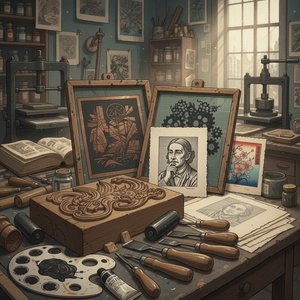 The Enduring Legacy of Printmaking: Techniques, Themes & Artistic Innovation Across Centuries
 Woodcut
 10 Iconic Woodcut Masterpieces That Revolutionized Art History
 John William Kuznetov



