
The Nuremberg Crucible: Craftsmanship and the Goldsmith's Lineage
 Albrecht Dürer
A Life Forged in Nuremberg: The Early Years and Apprenticeship Albrecht Dürer, a name synonymous with the German Renaissance, emerged from the bustling artisan city of Nuremberg in 1471. His father, Albrecht Dürer the Elder, was a successful goldsmit...
To understand the profound precision of Albrecht Dürer, one must first look to the cobblestone streets of Nuremberg, a city that in 1471 served as a vibrant crucible of artisan excellence. Dürer did not emerge from a vacuum of pure abstraction; rather, his artistic soul was forged in the meticulous environment of the goldsmith’s workshop. His father, Albrecht Dürer the Elder, brought with him a Hungarian lineage steeped in the rigorous discipline of metalwork. In this atmosphere, the very air was thick with the scent of heated metal and the exacting demands of fine handiwork. For a young Dürer, the transition from an apprentice in his father’s trade to a student in the workshop of Michael Wolgemut was not a departure from craftsmanship, but an evolution of it.
This early immersion in the goldsmith's tradition instilled in him a jeweler’s obsession with detail—a fundamental characteristic that would later define the Northern Renaissance. The discipline required to manipulate precious metals and the intricate design work found in illuminated manuscripts provided a foundational language of line and texture. Even as he moved toward the grander stages of painting and engraving, Dürer retained that essential, microscopic focus. It was this heritage of precision that allowed him to treat a copper plate or a wooden block with the same reverence and exacting care as a master engraver treats gold, ensuring that every stroke carried the weight of intentionality and structural integrity.
A Bridge Between Worlds: Merging Northern Realism with Italian Humanism
 Master of the Renaissance: The 25 Greatest Artworks by Albrecht Dürer
Introduction To step into the world of Albrecht Dürer is to witness the precise moment when the meticulous soul of Northern Europe met the soaring intellectualism of the Italian Renaissance. Imagine walking through a quiet, sunlit gallery where every...
Dürer’s career represents one of history's most exquisite artistic syntheses: the moment when the meticulous, tactile soul of Northern Europe met the soaring intellectualism of the Italian Renaissance. While his roots remained firmly planted in the German tradition of profound realism and spiritual intensity, his spirit was restless, driven by an insatiable curiosity to master the classical ideals emerging from the south. His transformative journeys to Italy were not merely travels of discovery but pilgrimages to the heart of a new way of seeing. Encountering the works of masters such as Raphael and Bellini, Dürer absorbed the principles of harmonious proportion, mathematical perspective, and the grace of human expression.
This convergence created a visual language that was entirely unique. He did not simply replicate Italian forms; he infused them with a Northern sensibility for texture and atmospheric depth. Where an Italian master might focus on the idealized geometry of the human form, Dürer would capture the microscopic texture of a stag's fur or the heavy, palpable weight of a velvet cloak with equal spiritual intensity. He became a bridge between eras, capable of navigating the vast, mathematical proportions of the Renaissance while maintaining a deep-seated connection to the intricate, observational realism that characterized his homeland. This duality allowed him to elevate the medium of printmaking and painting into a realm where science and soul resided in perfect equilibrium.
The Precision of the Line: Mastery in Engraving and Woodcut
The following is a list of woodcuts by the German painter and engraver Albrecht Dürer. == Art catalogs == One of the earliest list of woodcuts by Dürer was assembled in 1808 by Adam Bartsch in his "Le Peintre Graveur" volume 7 and in the appendix. In...
Perhaps nowhere is Dürer’s genius more palpable than in the delicate, disciplined world of graphic arts. Through his mastery of engraving and woodcut, he revolutionized the democratization of art, utilizing the burgeoning technology of the printing press to disseminate profound imagery across the continent. His technique in engraving—a process involving the meticulous cutting of intricate lines into copper plates—demonstrated a level of control that remains unparalleled. Through the sophisticated use of cross-hatching, Dürer could simulate the play of light and shadow, creating an illusion of three-dimensional volume and tactile surface on a two-dimensional plane.
His woodcuts, often characterized by their bold yet intricate compositions, reached a zenith of religious and narrative symbolism. In works like his monumental Apocalypse series, the woodcut was elevated from a mere illustrative tool to a high art form capable of profound theological expression. The sheer technical rigor required to manipulate these mediums—ensuring that every fine line and subtle shadow served the larger composition—speaks to an artist who viewed the line as a vessel for truth. Whether rendering the imposing, armored presence of a rhinoceros or the agonizing tension in Christ Before Herod, Dürer’s ability to command the graphic medium ensured that his visual voice could resonate far beyond the confines of a single canvas.
Symbolism and Science: The Intellectual Depth of Dürer’s Naturalism
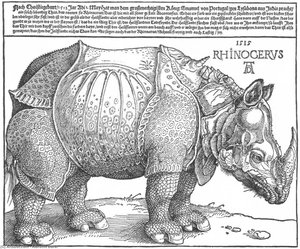 rhinoceros, berlin Smpk
A Study in Rhino: Albrecht Dürer's Engraving Albrecht Dürer’s “Rhinoceros, Berlin Smpk” is more than just an engraving; it’s a window into the European fascination with the exotic and the unknown. Executed around 1515, this meticulously crafted work ...
Dürer’s art was never merely decorative; it was an intellectual endeavor, a profound meditation on the natural world and the divine order. He possessed a rare ability to blend scientific observation with deep-seated spirituality. His fascination with the exotic and the unknown is vividly captured in his Rhinoceros engraving, where he uses masterful hatching to depict a creature virtually unheard of in Europe at the time. This work serves as a window into the Renaissance fascination with discovery, blending the artist's painstaking process with an engagement with the burgeoning scientific curiosity of his age.
Every element within his compositions often carried a secondary layer of meaning. In his portraits, such as The Man with a Hat, the subtle inclusion of objects like books or specific colors could signify intellectual pursuit, virtue, or even divine love. This layering of symbolism ensured that his work invited continuous contemplation. He saw the divine in the details—in the way light hits a leaf or the precise anatomy of a wing. By treating the natural world with such rigorous, observational accuracy, Dürably transformed the act of looking into an act of worship and scientific inquiry, making his art a profound testament to the interconnectedness of all living things.
The Enduring Influence: Dürer’s Legacy in Modern Visual Language
 Albrecht Dürer's Masterpieces: 25 Iconic Artworks for Your Home | OriginalUniqueArt
Introduction To embark on a journey through the 25 most significant works of Albrecht Dürer is to enter a world where meticulous detail dances with profound symbolism, and technical mastery serves the loftiest artistic ambitions. These are not merely...
The legacy of Albrecht Dürer continues to pulse through the veins of contemporary art and design. His ability to capture microscopic texture with spiritual intensity laid the groundwork for the modern appreciation of detail and realism. In an era that often favors the broad and the abstract, Dürer’s work remains a vital reminder of the power of precision. He redefined the boundaries of printmaking, established the artist as an intellectual figure, and created a visual vocabulary that continues to influence how we perceive texture, light, and human emotion.
Today, his influence is felt in everything from the meticulousness of modern illustration to the grand scale of architectural murals. His life’s work stands as a monumental achievement of the German Renaissance, a period where technical mastery served the loftiest of artistic ambitions. For the modern collector and enthusiast, Dürer offers more than historical interest; he offers a masterclass in how to merge the physical reality of our world with the profound depths of the human spirit. His works remain windows into a transformative era, inviting us to rediscover the beauty found in the most infinitesimal details.
At OriginalUniqueArt.com, we celebrate this enduring legacy of craftsmanship. We specialize in bringing the soul of the Old Masters back to life through our premium Handmade Oil Reproductions. Our artists, many of whom hold degrees from prestigious Fine Arts academies, utilize the same dedication to detail that Dürer himself embodied. Whether you are seeking a museum-quality reproduction of a Renaissance masterpiece or a custom "period shift" transformation of a personal photograph into a classical oil painting, our 100% hand-painted works on cotton canvas offer a depth and texture that digital prints simply cannot replicate. We invite you to explore our curated collection and experience the timeless elegance of art history, reimagined for your contemporary space.


