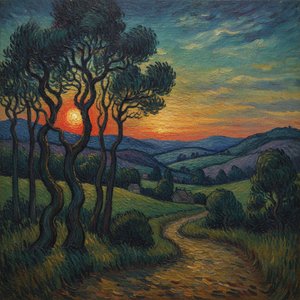
The Soul's Rebellion: Moving from Impressionist Light to Expressionist Emotion
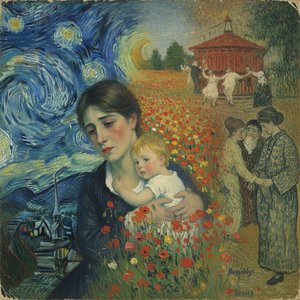 Capturing the Soul: The Most Emotionally Moving Impressionist and Post-Impressionist Masterpieces
The Luminous Revolution: How Impressionism Redefined the Art of Seeing Impressionistic Landscapes: 10 Masterpieces That Changed Art & Decor Introduction To gaze upon these ten canvases is to step directly into a world transformed by light, color, and...
To those of us who have spent a lifetime wandering through the hallowed, sun-drenched halls of the Musée d'Orsay or the Courtauld Gallery, the transition from Impressionism to Expressionism feels less like a change in technique and more like a profound awakening of the spirit. We remember, with a certain nostalgic tenderness, the era of the Impressionists—those courageous rebels who taught us to see the world through a veil of dappled sunlight and ephemeral mist. They captured the fleeting dance of light upon the Seine, the soft, hazy edges of a summer afternoon in Giverny, and the very breath of the atmosphere. Yet, as the nineteenth century gave way to the turbulent dawn of the twentieth, a new hunger emerged within the artist's soul. It was no longer enough to merely observe the external world; there arose a desperate need to articulate the internal storm.
This shift marked the beginning of a movement that sought to move beyond the surface of reality. While the Impressionists were masters of the optical moment, capturing how light vibrates across a landscape, the precursors to Expressionism—the Post-Impressionists—begained to infuse their canvases with a more permanent, structural depth. They traded the soft, fleeting impressions for something far more visceral. Where Monet sought the shimmer of water, artists like Van Gogh began to seek the pulse of life itself. This was the birth of a rebellion where color ceased to be a descriptive tool and became a direct line to the human psyche, paving the way for an era where art would no longer reflect the eye, but speak directly to the soul.
A Symphony of Distortion: How Color and Form Became a Language of the Inner Self
 10 Post-Impressionist Masterpieces That Changed Art Forever
Introduction To step into the world of Post-Impressionism is to leave behind the mere observation of light and enter a realm where color breathes, shapes vibrate, and the artist's inner psyche dictates the landscape. While the Impressionists sought t...
In the world of Expressionism, the canvas becomes a mirror of the artist's inner turmoil and ecstasy. The movement rejected the pursuit of photographic accuracy in favor of a much more potent truth: the subjective experience. Imagine, if you will, a landscape where the trees do not merely stand, but twist in agony or dance in triumph; where the sky is not a mere backdrop of blue, but a swirling vortex of electric yellows and bruised violets. This was achieved through the deliberate use of visual distortion and hyper-expressive pigments. The artists utilized thick, textured brushstrokes—the heavy impasto technique—to create a tactile rhythm that pulls the viewer into their emotional orbit.
Color, in this new language, became highly symbolic and often unnaturally saturated. It was no longer bound by the laws of nature but by the laws of feeling. A face might be rendered in sickly greens to convey malaise, or a sunset might explode in violent crimsons to signal passion or dread. This use of color and form allowed for a communication of overstressed emotion that a realistic depiction could never grasp. When we gaze upon these works, we are not just looking at a scene; we are witnessing the artist's very essence being poured onto the cotton canvas, creating a symphony of distortion that resonates with our own deepest, often unspoken, human experiences.
Echoes in Architecture and Cinema: The Pervasive Reach of the Expressionist Spirit
 German expressionist cinema
German expressionist cinema was a part of several related creative movements in Germany in the early 20th century that reached a peak in Berlin during the 1920s. These developments were part of a larger Expressionist movement in Northwestern European...
The brilliance of the Expressionist movement lay in its refusal to remain confined to the edges of a frame. It was a pervasive cultural phenomenon that breathed life into the very structures of modern civilization. In the realm of architecture, we see the movement's influence in the dramatic, often biomorphic forms that challenge the rigid geometry of traditional design. From the jagged, emotive lines of German Brick Expressionism to the fantastical, dreamlike silhouettes of avant-garde structures, architecture became a medium for communicating weight, tension, and even utopian hope. These buildings were not merely shelters; they were sculptural expressions of the era's social and political upheavals.
Similarly, the shadows of Expressionism lengthened across the silver screen of early cinema. German Expressionist film, reaching its peak in the 1920s, utilized highly stylized set designs—characterized by geometrically absurd angles and stark, high-contrast lighting—to reflect the psychological fragmentation of a post-war world. Films like The Cabinet of Dr. Caligari or Nosferatu rejected cinematic realism entirely, using visual distortions to mirror the inner conflicts of their characters. This interconnectedness of painting, architecture, and film created a unified aesthetic language of emotion, ensuring that the Expressionist spirit would forever alter the way we perceive both our physical surroundings and our cinematic dreams.
The Legacy of Subjectivity: How Post-Impressionist Roots Birthed Modern Emotional Depth
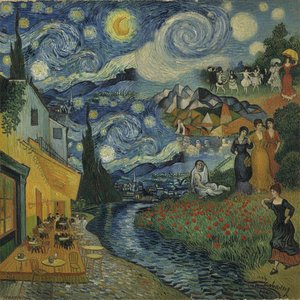 10 Iconic Post-Impressionist Masterpieces That Changed Art History
Introduction Imagine stepping into a room where color doesn't just sit on the canvas—it vibrates, screams, and pulls you into another dimension. Post-Impressionism wasn't just an art movement; it was a high-voltage rebellion against the fleeting, sof...
We must never forget that the roots of this emotional revolution were planted by the visionaries of Post-Impressionism. The movement was a high-voltage rebellion against the perceived limitations of their predecessors, seeking to find structure and symbolic meaning within the chaos of modern life. Artists like Cézanne provided the geometric foundations, while Gauguin explored the spiritual resonance of color, and Van Gogh offered the ultimate template for emotional intensity. They were the architects of subjectivity, teaching us that art could be a vessel for personal truth rather than just a window into the world.
This legacy is what we celebrate today when we encounter works that move us to tears or stir a sense of profound wonder. The transition from the light-drenched landscapes of Impressionism to the raw, emotive power of Expressionism fundamentally altered the course of Western art history. It established the precedent that the artist's internal landscape is just as valid, and perhaps more important, than the external one. This era of profound cultural transition, where the stability of the old world dissolved into the vibrant energy of the modern, gave us a new way to understand ourselves through the lens of color, texture, and unadulterated soul.
Preserving the Pulse: Honoring the Tactile Beauty of Expressive Brushwork in Contemporary Reproductions
 Irises\n\n(Front)
Vibrant Depiction of Nature’s Beauty This stunning artwork captures a lush, exuberant garden scene centered around a dense cluster of irises in full bloom. The composition bursts with vitality, showcasing the natural elegance and intricate details of...
For those of us who cherish these masterpieces, the desire to bring their emotive power into our own homes is a profound calling. However, there is a vast difference between a mere print and a true tribute to the masters. A digital print, no matter how high the resolution, often lacks the very thing that makes Expressionism so vital: the physical presence of the paint itself. To truly capture the spirit of Van Gogh or Monet, one must look to the tactile richness of hand-painted oil reproductions. It is in the visible, rhythmic brushstrokes and the deep, luminous tonal range of real oil on 100% cotton canvas that the "pulse" of the original artwork is preserved.
At OriginalUniqueArt.com, we dedicate ourselves to this preservation of emotion. Our artists, trained in the finest academic traditions, do not simply copy; they interpret with passion. They utilize the same heavy impasto techniques and vibrant pigments that allow a painting to breathe and vibrate on your wall. Whether it is a custom commission where you wish to see a personal memory reimagined in the swirling, emotional style of Van Gogh, or a meticulously crafted reproduction of a classic landscape, our goal is to ensure that the soul of the movement remains intact. We invite you to experience art that does not just sit upon a surface, but one that invites you into a deeper, more meaningful conversation with history.