The Rise of the 'Grand Style': Reynolds's Artistic Vision
Sir Joshua Reynolds, a name synonymous with 18th-century British portraiture, wasn’t merely a painter of likenesses; he was an architect of artistic identity. Emerging from humble beginnings in Plympton, Devon, Reynolds ascended to become the first President of the Royal Academy and a pivotal figure in establishing Britain's own distinct art tradition. His ambition extended beyond technical skill – he sought to elevate British painting to rival the celebrated masters of Europe, particularly those of Italy and the Renaissance. This quest manifested in his championing of what became known as the ‘Grand Style,’ a deliberate move away from the more provincial portraiture that had previously dominated the English art scene.
Reynolds’s understanding of the Grand Style wasn't simply about replicating classical forms, but rather about distilling their underlying principles. He believed true artistry lay in generalization and idealization – perceiving subjects not as they *were*, but as they *ought* to be. This concept, extensively articulated in his fifteen Discourses on Art delivered to Royal Academy students between 1769 and 1790, emphasized the importance of studying ancient sculpture and the High Renaissance masters like Raphael. He argued that painters should strive for a noble simplicity, imbuing their subjects with dignity and grace even if those qualities weren’t immediately apparent in reality. This wasn't about deception, but about revealing an inner truth through artistic interpretation.
The influence of artists like Rembrandt, Rubens, and Van Dyck was also crucial to Reynolds’s development. He admired their mastery of light and shadow, their ability to convey texture and emotion, and their skill in creating a sense of atmosphere. However, he adapted these influences to suit his own vision, incorporating them into the framework of the Grand Style. He wasn't simply copying; he was synthesizing, innovating, and forging a new path for British art.
Reynolds and the Royal Academy: Establishing British Art Standards
 Wikipedia: Joshua Reynolds
Sir Joshua Reynolds (16 July 1723 – 23 February 1792) was an English painter who specialised in portraits. The art critic John Russell called him one of the major European painters of the 18th century, while Lucy Peltz says he was "the leading portra...
The founding of the Royal Academy in 1768 marked a watershed moment for British art, and Reynolds’s election as its first President solidified his position as its leading figure. Before the Academy, artistic training was fragmented and often reliant on foreign influences. Reynolds envisioned an institution that would provide structured education, promote native talent, and foster a sense of national pride in artistic achievement. The Discourses became central to this mission, serving as both theoretical guidance and practical instruction for aspiring artists.
Reynolds’s presidency wasn't without its challenges. He faced resistance from those who favored more traditional approaches to art, and he had to navigate the complex social dynamics of the London art world. However, his unwavering commitment to elevating British painting ultimately prevailed. The Academy provided a platform for artists to exhibit their work, receive critical feedback, and gain recognition. It also established a hierarchy of genres, with history painting at the apex – reflecting Reynolds’s belief that this was the most intellectually demanding and artistically significant form of art.
The very structure of the Academy, modeled after continental institutions, signaled a shift in British artistic consciousness. It wasn't enough to be technically proficient; artists were now expected to engage with art history, understand classical principles, and contribute to a broader cultural discourse. Reynolds’s leadership was instrumental in shaping this new landscape.
Portraiture as Social Commentary: Capturing 18th-Century Society
Grand manner refers to an idealized aesthetic style derived from classicism and the art of the High Renaissance. In the eighteenth century, British artists and connoisseurs used the term to describe paintings that incorporated visual metaphors in ord...
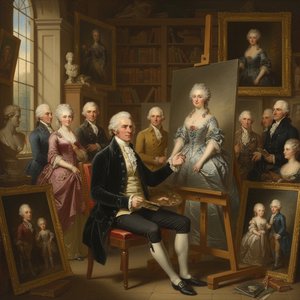
While advocating for the Grand Style, Reynolds didn't abandon portraiture – he embraced it as a vehicle for exploring societal values and capturing the spirit of his age. His portraits weren’t merely records of physical appearance; they were insightful commentaries on wealth, status, power, and personality. He painted members of the aristocracy, prominent intellectuals, actors, and even children, each portrait offering a glimpse into the lives and aspirations of 18th-century Britain.
Mrs. Mary Nesbitt (1781), for example, exudes elegance and refinement, her pose and attire conveying a sense of social standing. Similarly, Mrs. Henry Thrale with Her Daughter showcases familial affection within the context of a prosperous household. These weren’t simply flattering depictions; they were carefully constructed narratives that reflected the sitter's position in society.
Reynolds also demonstrated a keen interest in portraying individuals from diverse backgrounds, as seen in A Fortune-Teller (1777). This work captures a moment of intrigue and curiosity, hinting at the social anxieties and fascination with the unknown that characterized the era. His studio was famously prolific, producing over 2,000 paintings during his lifetime, each one contributing to a vast visual archive of 18th-century life.
Idealization and Technique: The Methods Behind Reynolds’s Masterpieces
The ‘idealization’ central to Reynolds’s Grand Style wasn't achieved through arbitrary alteration but through a sophisticated understanding of artistic technique. He meticulously studied anatomy, light, and composition, employing layers of glazing to create depth and luminosity in his paintings. His brushwork was often loose and expressive, yet always controlled, allowing him to capture the texture of fabrics, the sheen of skin, and the subtle nuances of emotion.
Reynolds’s technique wasn't without its drawbacks. He experimented with bitumen in his blacks, which unfortunately proved unstable over time, leading to cracking and discoloration in some of his works. However, even these imperfections serve as a reminder of the artist’s willingness to push boundaries and explore new approaches.
He also understood the power of symbolism, subtly incorporating objects and motifs into his portraits to convey deeper meanings. A classical statue might signify intellectual refinement, while a landscape could evoke a sense of pastoral innocence or noble heritage. These details weren't merely decorative; they were integral to the overall narrative of the painting.
Beyond Likeness: Symbolism and Narrative in Reynolds’s Work
Reynolds wasn’t content with simply capturing a physical resemblance; he sought to imbue his portraits with psychological depth and symbolic resonance. He often drew inspiration from classical mythology, literature, and history, weaving these references into the fabric of his compositions. This approach elevated portraiture beyond mere representation, transforming it into a form of visual storytelling.
Consider Portrait of George Grenville, Marquess of Buckingham, and His Family, which includes an enslaved servant – a poignant reminder of the complex social realities of the era. The inclusion of this figure isn’t simply incidental; it invites viewers to contemplate the ethical implications of wealth and power. Similarly, his portrait of Francis Barber, Samuel Johnson's former servant, challenges conventional notions of representation and identity.
Reynolds’s ability to infuse his portraits with such layers of meaning is a testament to his intellectual curiosity and artistic sensitivity. He wasn’t just painting faces; he was capturing the essence of an era, exploring its contradictions, and prompting viewers to question their own values and beliefs.
Reynolds’s Enduring Legacy: Influence on Subsequent Generations of Artists
Sir Joshua Reynolds's impact on British art is immeasurable. He not only established a national artistic identity but also inspired generations of artists to strive for excellence, embrace classical principles, and engage with the broader cultural landscape. His influence can be seen in the work of Thomas Lawrence, John Singer Sargent, and countless others who followed in his footsteps.
His Discourses on Art continue to be studied by art students today, offering valuable insights into artistic theory and practice. The Royal Academy, which he founded, remains a leading institution for artistic education and exhibition. And his portraits, with their elegance, sophistication, and psychological depth, continue to captivate audiences around the world.
Reynolds’s legacy extends beyond the realm of art history; it speaks to the power of vision, the importance of cultural institutions, and the enduring human desire for beauty and meaning. At OriginalUniqueArt.com, we celebrate his contributions by offering high-quality reproductions of his masterpieces, allowing you to bring a touch of 18th-century elegance into your own home.