Introduction
To step into the world of Contemporary Realism is to enter a space where the boundaries between the observed truth and the artist's soul begin to blur. It is an art movement that refuses to retreat into abstraction, choosing instead to confront the tangible world with an unflinching, almost hyper-sensory clarity. While the masters of the past sought to capture the essence of light and form, the contemporary realist looks deeper, finding profound narratives within the textures of everyday life, the quiet tension of a portrait, and the overlooked details of our modern landscape.
Emerging from a cultural desire to reconnect with the physical reality of our surroundings, this movement serves as a bridge between classical academic precision and the complex, often fragmented nature of 21st-century existence. It is a movement rooted in technical mastery—the ability to manipulate oil on canvas to mimic the softness of skin or the cold hardness of steel—yet it is driven by an emotional urgency that speaks to our shared human experience. These works do not merely replicate what the eye sees; they interpret what the heart feels, using hyper-detailed execution to evoke a sense of presence that is both haunting and deeply comforting.
Today, these masterpieces remain vital because they offer us a moment of stillness in an increasingly digital age. In a world of fleeting pixels, the weight of a brushstroke and the depth of a glazed shadow provide a grounding force. They remind us of the beauty found in the permanent and the palpable. As we journey through this selection, we will encounter ten pivotal works that have not only defined the technical standards of the movement but have also expanded our understanding of what it means to truly see .
Prepare to walk through a curated gallery of visionaries, where each canvas serves as a window into a meticulously rendered reality, inviting you to rediscover the profound power of the real.
Freedom from want - Norman Rockwell
 Freedom from want - Norman Rockwell
In Freedom from Want by Norman Rockwell, the true magic lies in the tactile precision of his brushwork—the way the light catches the glistening, textured skin of the roasted turkey and the crisp, heavy folds of the linen tablecloth. Rockwell’s mastery of contemporary realism is found in these minute details; his ability to layer oils to create a sense of warmth, abundance, and palpable domesticity is what secures this work's place among the top 10 masterpieces of the movement. He does not merely paint a scene; he builds a sensory experience of American gratitude through light and texture.
At OriginalUniqueArt.com, we strive to preserve this essential three-dimensional quality for collectors and professionals alike. Our hand-painted oil reproductions focus on capturing every visible brushstroke and the rich, tonal depth that digital prints simply cannot replicate. By utilizing 100% cotton canvas and traditional techniques, we ensure that the emotional resonance and physical materiality of Rockwell’s iconic vision are brought into your space with museum-grade authenticity.
Reflection with Two Children (Self-Portrait) - Lucian Freud
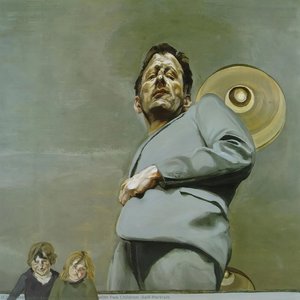 Reflection with Two Children (Self-Portrait) - Lucian Freud
In Reflection with Two Children (Self-Portrait) , Lucian Freud delivers a profound psychological study that stands as a cornerstone of the Contemporary Realism movement. This 1965 masterpiece transcends mere portraiture, offering an unflinching gaze into the complexities of identity and familial connection. The composition is dominated by the artist’s monumental presence; his crossed arms and defensive posture suggest a soul caught in deep introspection. Flanking him, the two smaller figures of young girls appear almost as spectral reflections, their diminished scale creating a poignant tension between protection and detachment.
Freud’s signature technique—characterized by thick, tactile impasto and a somber, muted palette of olive greens and earthy tones—imbues the canvas with a palpable sense of weight. The heavy brushstrokes do more than define form; they capture the very texture of human existence. As you observe the diffused light and the organic, slightly distorted shapes, the painting transforms from a visual record into a gallery of the soul , inviting you to experience the raw, emotional honesty that defines Freud’s enduring legacy.
First Steps - Georgios Jakobides
 First Steps - Georgios Jakobides
While many view First Steps as a simple domestic vignette, few realize that Georgios Jakobides utilized the rigorous academic discipline of the Munich School to capture a fleeting, almost impossible moment of motion. Painted in 1892, this masterpiece achieves a technical leap by blending the heavy, tactile textures of stone and fabric with an ethereal, directional light that seems to breathe life into the toddler’s uncertain movement.
The painting is a masterclass in contemporary realism, where every brushstroke serves a dual purpose: documenting the physical reality of a rustic interior while weaving a profound narrative of intergenerational support. The soft glow from the window illuminates the earthy ochres and creams, creating a sense of quiet prestige and warmth. This meticulous attention to detail—from the subtle presence of a crucifix to the weathered textures of the walls—offers a sophisticated focal point for any professional space. Integrating such a work into a modern home office or study fosters an atmosphere of focused calm and enduring stability, mirroring the very growth and resilience depicted within the frame.
Benefits Supervisor Sleeping (also known as Big Sue) - Lucian Freud
 Benefits Supervisor Sleeping (also known as Big Sue) - Lucian Freud
Acquiring a piece inspired by Benefits Supervisor Sleeping by Lucian Freud is an investment in the very pinnacle of twentieth-century legacy and uncompromising taste. As a cornerstone of the Contemporary Realism movement, this 1995 masterpiece stands as a monumental study in human vulnerability and physical truth. Freud’s unflinching approach—characterized by thick, tactile impasto and a visceral engagement with flesh—challenges traditional beauty standards through a masterful use of muted earth tones and dramatic light.
The painting's market significance is anchored by its profound psychological depth, making it a definitive work within the School of London. The heavy textures of the floral couch and the nuanced, layered skin tones create a sensory experience that demands contemplation. For the discerning decorator or collector, integrating a high-quality oil reproduction of this scale into a modern luxury interior provides an immediate sense of aesthetic authority. Such a piece brings the raw emotional honesty and prestigious status of Freud’s genius to corporate spaces and private galleries alike, commanding attention through its sheer sculptural presence.
Automat - Edward Hopper
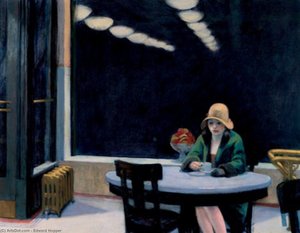 Automat - Edward Hopper
In the quiet, dimly lit corner of a 1927 New York eatery, Edward Hopper’s Automat captures a cinematic moment of profound urban introspection. A lone woman sits enveloped by the shadows of a self-service restaurant, her gaze lost in thought as she stares into the dark reflection of the window. This masterpiece of the Contemporary Realism movement utilizes stark, directional light to carve figures out of the gloom, creating a palpable sense of solitude that resonates through the decades.
The composition is a masterclass in atmospheric tension; deep blues and somber tones are punctuated by the soft glow illuminating her face and a small bowl of fruit. The geometric rigidity of the window frames contrasts with the organic stillness of the subject, evoking a mood of quiet contemplation. Integrating such a piece into a modern interior offers more than mere decoration; it introduces a focal point of profound emotional depth, inviting a sense of calm, reflection, and sophisticated storytelling to any professional or residential space.
The Gross Clinic - Thomas Eakins
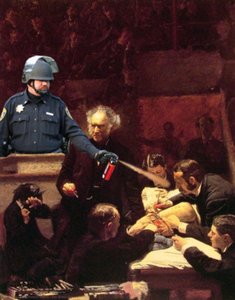 The Gross Clinic - Thomas Eakins
In Thomas Eakins' 1875 masterpiece, The Gross Clinic , the lines of medical drama aren’t merely drawn; they are choreographed . This is not a static composition of a surgical procedure; it is a dance frozen in time , where the tension between scientific progress and human suffering reaches a fever pitch. Eakins utilizes a dramatic, chiaroscuro-inspired lighting to pull the viewer into the operating theater, casting deep shadows that contrast sharply with the clinical intensity of Dr. Gross’s focus.
The painting serves as a cornerstone of the contemporary realism movement, utilizing anatomical precision and a somber, earthy palette to transform a moment of visceral reality into high art. The heavy textures of the surgeons' attire and the stark, emotional presence of the onlookers create a rhythmic flow of light and shadow across the canvas. For the discerning collector, bringing this work into a space allows your walls to breathe rhythm , offering a profound balance of historical gravity and unparalleled artistic depth that makes chaos feel like harmony.
Gas - Edward Hopper
 Gas - Edward Hopper
Edward Hopper’s Gas (1940) stands as a profound pillar within the Contemporary Realism movement, offering much more than a mere depiction of a roadside stop. It captures a hauntingly beautiful sense of American solitude, where the stillness of a rural landscape meets the quiet tension of modern life. Through his masterful use of light and shadow, Hopper transforms an ordinary gas station into a stage for introspection, using a palette of muted earthy greens and striking reds to evoke a deep, nostalgic melancholy.
As a masterpiece of the movement, Gas is essential for its ability to find monumental emotion in the mundane. The composition—defined by clean geometric lines and a vast, open horizon—resonates powerfully with modern architectural aesthetics. For today’s interior designers and collectors, the painting’s balanced tension and cinematic atmosphere provide a sophisticated focal point, bringing a sense of calm, structured depth and timeless storytelling to any contemporary professional or residential space.
Chop Suey - Edward Hopper
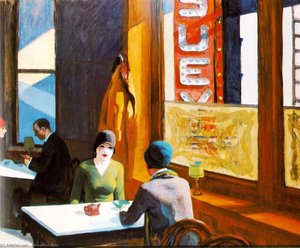 Chop Suey - Edward Hopper
In Chop Suey by Edward Hopper, a singular moment of urban introspection is frozen within the amber glow of a 1920s diner. This masterpiece stands as a pillar of the Contemporary Realism movement, immortalized for its profound ability to balance the vibrant energy of modern commerce with the quiet, heavy ache of human solitude. Through a masterful interplay of light and shadow, Hopper transforms a simple cafe interior into a stage of psychological depth.
The canvas breathes with a rich, saturated palette; warm oranges and yellows from the neon signage collide with cooler, melancholic blues, creating a sensory experience that is both energetic and dreamlike. The sharp, geometric lines of the Art Deco-inspired architecture guide the eye through a landscape of light, where the textures of oil on canvas evoke the bustling yet alienated atmosphere of the era. For the modern collector, this work offers more than mere decoration; its sophisticated use of perspective and dramatic lighting brings a sense of cinematic narrative and timeless elegance to any contemporary interior, inviting a contemplative stillness into the home.
Office at Night - Edward Hopper
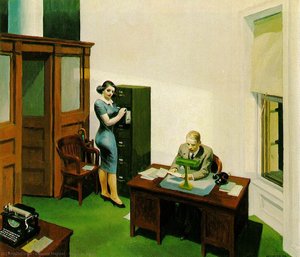 Office at Night - Edward Hopper
There is a gaze in Office at Night by Edward Hopper that follows you—not with judgment, but with understanding . This isn’t merely a portrait of mid-20th-century bureaucracy; it is a mirror reflecting the quiet, shared solitude of the modern professional. As one of the defining works in the movement of Contemporary Realism, Hopper captures the heavy stillness of an office late at night, where the muted greens and deep browns of the wooden furniture meet the sharp, artificial glow of desk lamps.
The composition, featuring a woman at her typewriter and a man lost in documents, uses light and shadow to transform mundane tasks into a cinematic experience. The striking blue of the woman’s dress punctuates the somber palette, acting as a focal point amidst the geometric rigidity of filing cabinets and window frames. Now, imagine that gaze in your space. Not watching you, but reminding you : you are seen. You are part of this enduring story of dedication and introspection.
Summertime - Edward Hopper
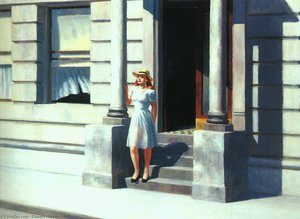 Summertime - Edward Hopper
In Summertime by Edward Hopper, a piercing, sun-bleached light dominates the canvas, casting sharp shadows that evoke a sense of midday stillness and quiet introspection. This mastery of high-contrast lighting is precisely why this work stands as a pillar among the Top 10 Masterpieces That Defined the Contemporary Realism Art Movement . Hopper utilizes a palette of cool, architectural greys contrasted against the soft, light blue of the woman’s dress, creating an atmosphere that feels both physically warm and emotionally detached.
For the discerning decorator or professional curator, integrating this piece into a modern interior offers a sophisticated way to anchor a room's emotional lighting. The painting’s interplay of stark shadows and bright highlights can be used to complement minimalist spaces or dining rooms with strong geometric lines. By introducing Hopper’s signature tension between light and solitude, you can curate a space that feels profoundly contemplative, using the artwork to establish a focal point of calm, structured elegance within a contemporary urban setting.
Conclusion
As the light fades on our journey through these ten defining works, we are reminded that Contemporary Realism is far more than a mere technical mastery of light and shadow; it is a profound way of witnessing the world. These paintings do not exist solely within the silent halls of museums or the pages of history books. Instead, they live on through the quiet moments they evoke in our daily lives—the way a familiar texture can ground a room, or how a captured glance can stir a sudden, deep sense of nostalgia within a modern interior.
Each brushstroke serves as a bridge between the tangible reality we inhabit and the emotional truths we often struggle to articulate. By bringing these masterpieces into our homes, we invite an eternal dialogue into our personal spaces, allowing the pulse of human experience to beat alongside our own. They transform walls into windows, turning our living environments into sanctuaries of reflection and wonder. As we look upon these works, we find that they continue to shape our culture and our connection to one another, proving that the most intimate details of reality are often where the most universal truths reside.
We invite you to continue this exploration and discover how these enduring visions can become a part of your own story by browsing our full collection .