The Birth of Order: Understanding De Stijl's Historical Context
 De Stijl
De Stijl (, Dutch: [də ˈstɛil]; 'The Style') was a Dutch art movement founded in 1917 by a group of artists and architects based in Leiden (Theo van Doesburg, J. J. P. Oud), Voorburg (Vilmos Huszár, Jan Wils) and Laren (Piet Mondrian, Bart van der Le...
To understand the striking, minimalist impact of De Stijl, one must first look back at the turbulent dawn of the twentieth century. It was an era defined by profound fragmentation; old empires were crumbling, and the rapid industrialization of human existence was reshaping the very fabric of society. Amidst this chaos, a group of visionary artists and architects emerged from the heart of Europe, seeking something far more permanent than the fleeting emotions of the moment. Founded in 1917, De Stijl—literally meaning "The Style"—was not merely an aesthetic trend but a radical response to a world in flux. Based in locations such as Leiden and Voorburg, pioneers like Theo van Doesburg and Piet Mondrian sought to create a visual language that could transcend the wreckage of war and provide a sense of enduring stability.
This movement was born from a deep-seated desire for clarity. While much of the art world was still grappling with the representational traditions of the past, the De Stijl circle looked toward a future defined by intellectual rigor and visual harmony. They were driven by an idealistic mission to unite the material and spiritual worlds through the medium of pure geometry. For those of us who find beauty in the structured elegance of modern living, the history of De St Stijl serves as a powerful reminder that even in times of great upheaval, there is a profound human impulse to seek out balance, order, and a universal truth that remains untouched by temporal decay.
The Grammar of Geometry: Primary Colors and Orthogonal Lines
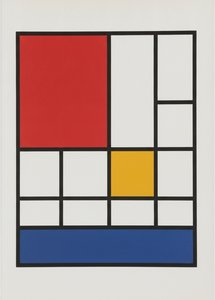
 Composition with red blue and yellow
Piet Mondrian: Architect of Geometric Harmony Piet Mondrian’s *Composition with Red, Blue and Yellow*, completed in 1937–42 during his time in New York City, stands as a cornerstone of abstract art. Born Pieter Cornelis Mondriaan in Amersfoort, Nethe...
Entering the world of De Stijl is akin to learning a new, highly disciplined grammar. The movement stripped away the superfluous—the curves, the shadows, and the organic irregularities of nature—to reveal what they believed was the essential structure of reality. This reductionist approach resulted in a breathtakingly potent vocabulary consisting of only the most fundamental elements. At its core, the movement utilized a strict palette: the three primary colors of red, yellow, and blue, complemented by the achromatic strength of white, black, and grey. These pigments were never used to describe objects or mimic light; instead, they functioned as pure, energetic forces acting upon the canvas.
The composition of these works relies on a precise arrangement of orthogonal lines—the intersection of horizontal and vertical planes. There is no illusion of depth or three-dimensional space here; rather, there is a captivating tension created where a vibrant block of red meets a stark field of white. This meticulous technique, often seen in the works of masters like Ilya Bolotowsky, requires an incredible level of precision. In many of Mondrian’s most iconic pieces, such as Composition with Grid #1, X-ray photography has even revealed a hidden scaffolding of the classical golden section beneath the surface. This ensures that despite the apparent simplicity, every line and color block exists in a state of perfect, mathematical proportion, offering an aesthetic experience that is both intellectually stimulating and visually soothing.
Neoplasticism Unveiled: The Quest for Universal Harmony
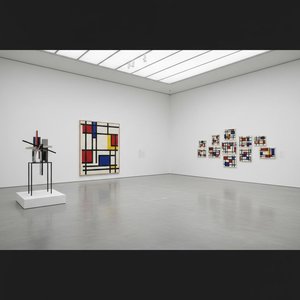 Neoplasticism Unveiled: The Power of Pure Color and Geometric Form in Modern Abstract Art
The Genesis of Neoplasticism: Piet Mondrian and the Pursuit of Universal Order In the turbulent dawn of the twentieth century, as the world grappled with the fragmentation of old empires and the industrialization of human existence, a profound moveme...
At the heart of this movement lies the profound philosophy of Neoplasticism. For Piet Mondrian, the movement's most celebrated figure, art was never intended to be a mirror held up to nature. He famously believed that art should exist above reality, serving as a tool to uncover the underlying mathematical and spiritual equilibrium that governs the cosmos. This pursuit of "pure plastic art" required an uncompromising rejection of the particular in favor of the universal. By abandoning the recognizable forms of landscapes or portraits, Mondran sought to communicate a sense of cosmic balance that resonates with the very structure of the universe itself.
This philosophical depth is what gives De Stijl works their enduring emotional resonance. When you gaze upon a composition like Quadro I, you are not just looking at red and white squares; you are witnessing an attempt to resolve the opposing demands of the material and the spiritual. The grid serves as a resolution—a way to find peace within the tension. This search for universal beauty was deeply influenced by the intellectual currents of the time, including explorations into archetypal patterns and the desire for a rhythmic, predictable order. It is this very quality—the ability to evoke a sense of profound, quiet stability—that makes Neoplasticism so much more than mere abstraction; it is a visual manifesto for a harmonious existence.
Beyond the Canvas: How De Stijl Shaped Modern Architecture and Design
 Ilya Bolotowsky
Ilya Bolotowsky: Pioneer of Geometric Abstraction Ilya Bolotowsky (1907-1981) stands as a pivotal figure in the history of 20th-century abstract art, particularly within the influential De Stijl movement. Born in Saint Petersburg, Russia, amidst the ...
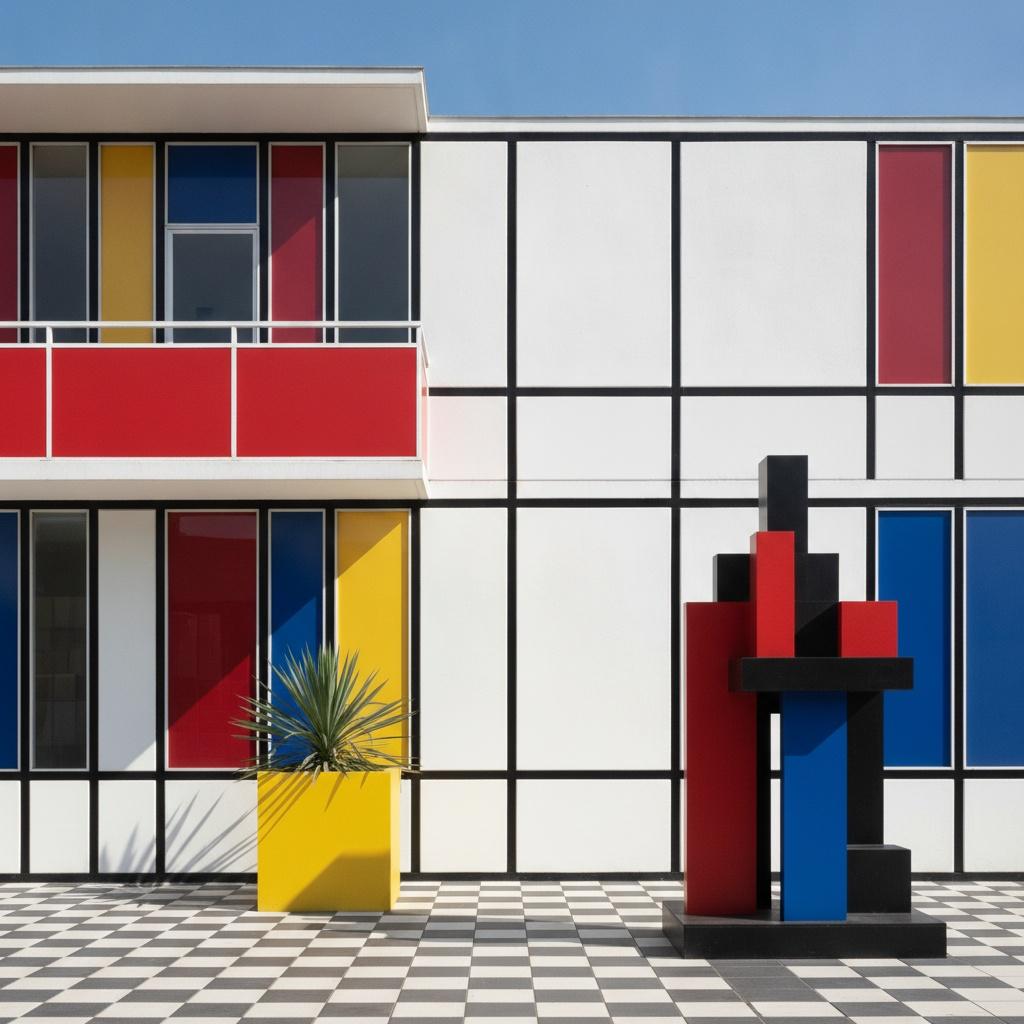
The influence of De Stijl was never confined to the edges of a canvas; it was a totalizing vision intended to reshape the entire human environment. The principles of geometric clarity and primary color application flowed seamlessly from painting into architecture, furniture design, and even typography. Architects like J.J.P. Oud and Gerrit Rietveld embraced the movement's ethos, creating spaces and objects that rejected ornamentation in favor of functional, structural honesty. This legacy can be seen in the way modern interiors often utilize clean lines, open floor plans, and a sense of rhythmic spatial organization.
The impact of this movement on modern design is perhaps most visible in the way we approach the concept of "the grid" in our living spaces today. From the modularity of contemporary furniture to the minimalist aesthetics of high-end architectural projects, the DNA of De Stijl is everywhere. Even the works of later artists like Ilya Bolotowsky, who brought these ideas to the American abstract scene, helped cement the idea that geometric abstraction could be a cornerstone of modern life. When we surround ourselves with objects that prioritize form and function through a balanced, structured lens, we are participating in a design dialogue that began over a century ago in the studios of the Netherlands.
Bringing the Movement Home: Integrating Abstract Mastery into Your Interior
 Quadro I 1
A Geometric Revelation: Exploring Piet Mondrian’s Quadro I Subject Matter & Composition: Style & Technique: Historical Context & Influences: Symbolism & Conceptual Significance: Emotional Resonance & Aesthetic Appeal: Piet Mondrian’s *Quadro I*, a de...
For the modern decorator, integrating the bold spirit of De Stijl into a home is an exercise in creating meaningful, sophisticated spaces. Because the movement relies on such a distinct and powerful color palette, these pieces serve as incredible focal points that can anchor a room. Whether you are looking for a large-scale multi-panel set to transform a wide hallway or a single, striking canvas to add energy to a study, the key is to embrace the balance of the primary colors. A well-placed piece featuring vibrant reds and deep blues can provide a sense of "visual weight" that complements more neutral, contemporary furnishings.
At OriginalUniqueArt.com, we believe that art should be an accessible discovery. We understand that for many, entering the world of abstract art can feel daunting, which is why we focus on helping you find pieces that resonate with your personal mood and room type. If you are inspired by the textured, tactile depth of a hand-painted oil reproduction, our artists can recreate the meticulous precision of Mondrian’s work, capturing the true essence of the brushstrokes and the vibrant energy of the pigments. By choosing works that celebrate geometric harmony, you aren't just decorating a wall; you are bringing a piece of history's most profound search for order into your daily life, creating a sanctuary of balance and timeless beauty.