Expressionism · 1906
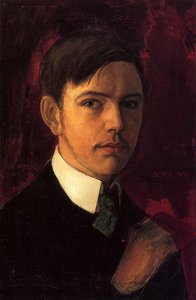
Self-portrait (August Macke, 1906)
August Macke (1887–1914) creó Self-portrait. Data de 1906. Pertenece al movimiento Expressionism. Está realizado en Oil. Sus dimensiones son 54 × 35 cm.
- 1906
- Oil
- 54 × 35 cm

 Ver en contexto

 Óleo pintado a mano
 Enviar
 Compartir
 Guía


 Descargar
 Similares
 Radiografía
 Presentación de diapositivas
 Preguntas y respuestas

 Estadísticas
Self-portrait: lo esencial
- Título
- Self-portrait
- Artista
- August Macke (1887–1914)
- Lugar de nacimiento del artista
- Meschede, Alemania
- Fecha
- 1906
- Técnica
- Oil
- Dimensiones
- 54 × 35 cm
- Movimiento
- Expressionism
- Época
- Modern
- Tema
- famous people, men, portraits
¿Qué representa Self-portrait?
A Moment Frozen in Time: The Introspection of August Macke
In the quiet, focused gaze of Self-portrait (1906), we encounter a rare moment of stillness from an artist whose life would soon be swept up in the turbulent currents of German Expressionism. Before the vibrant, kaleidoscopic colors of his later works defined his legacy, this early piece captures August Macke in a state of profound introspection. The painting presents a man with short, neatly groomed hair, dressed in the formal elegance of a white shirt and tie—an attire that suggests a sense of dignity and perhaps a preparation for the public eye. Yet, beneath this composed exterior, there is an unmistakable depth to his expression. His eyes, directed toward the viewer, hold a serious, contemplative weight that invites us to look beyond the surface of the canvas and into the psyche of a young creator on the cusp of greatness.
The composition of this work serves as a masterclass in early twentieth-century portraiture, balancing the intimacy of the subject with a structured, almost architectural background. While the man remains the undeniable focal point, the subtle presence of decorative elements in the periphery hints at an environment rich with culture and aesthetic awareness. The technique employed here reflects Macke’s formative years at the Düsseldorf Art Academy, where he honed his ability to render texture and light with meticulous care. There is a palpable sense of realism in the way the fabric of his shirt catches the light, contrasted against the more shadowed, enigmatic depths of the background. This interplay between clarity and mystery creates a tension that keeps the viewer perpetually engaged, searching for meaning within the artist's steady stare.
For the discerning collector or interior designer, this self-portrait offers much more than mere decoration; it provides a window into the soul of a lost generation. As an era-defining piece from 1906, it carries the historical gravity of the pre-war period, capturing a sense of peace and intellectual rigor before the world was irrevocably changed by conflict. The painting’s sophisticated palette and balanced proportions make it an ideal centerpiece for a curated gallery wall or a refined study. It possesses a timeless emotional impact, evoking feelings of nostalgia, respect, and quiet strength. To possess a reproduction of this work is to bring a piece of art history into one's personal space—a tribute to the enduring power of the human spirit and the transformative beauty of the expressive gaze.
Self-portrait en alta resolución

August Macke, Self-portrait (1906). Dominio público
Un experto digital coteja los colores con la pintura original y retoca el archivo, respetando fielmente la pincelada del artista.
Comprar la imagen en alta resoluciónPreguntas sobre Self-portrait
¿Dónde puedo encontrar estadísticas sobre "Self-portrait" de August Macke?
La página Estadísticas de "Self-portrait" de August Macke presenta las estadísticas de visitas públicas: visitas mensuales de esta obra, una comparación con las obras más vistas del artista y el origen de sus visitantes.
¿Qué sensación transmite "Self-portrait" de August Macke?
El estado de ánimo que transmite "Self-portrait" de August Macke es Classic, y su tono emocional es Reflective.
¿Qué representa "Self-portrait" de August Macke y qué atmósfera transmite?
"Self-portrait" de August Macke combina famous people, men, portraits con una atmósfera Classic.
¿Es "Self-portrait" de August Macke una pintura, un dibujo o un grabado?
"Self-portrait" es una obra de WallArt.
¿Qué paleta y qué color predominante definen a "Self-portrait"?
"Self-portrait" de August Macke utiliza una paleta de Earthy, con el Walnut (#784d29) como color dominante.
¿Dónde debería colgarse una reproducción de "Self-portrait" de August Macke?
El formato (Portrait) y el espacio recomendado (Office) son los dos datos de colocación registrados para "Self-portrait" de August Macke.
¿A qué movimiento y a qué época pertenece "Self-portrait" de August Macke?
"Self-portrait" pertenece al movimiento Expressionism, y su creador trabajó en la época Edad Moderna.
¿Qué emoción transmite la obra de Expressionism "Self-portrait"?
"Self-portrait" transmite un tono emocional Reflective dentro del movimiento Expressionism.
¿Cuál es la atmósfera general de "Self-portrait" de August Macke?
"Self-portrait" de August Macke se describe con un ambiente Classic. Esta clasificación puede ayudar a combinar la obra con un entorno.
Sobre el artista, August Macke
1887–1914, Alemania
August Macke
Primeros años, familia y formación La historia de August Macke comienza en la ciudad de Meschede, Alemania, donde nació el 3 de enero de 1887. Fue el único hijo de August Friedrich Hermann Macke, un contratista de obras y artista aficionado, y Maria Florentine. Su infancia estuvo marcada por los vaivenes de la fortuna de la empresa de su padre, lo que llevó a la familia a Colonia y, más tarde, a Bonn. Incluso siendo apenas un niño, la atracción por la expresión visual era evidente; pasó sus primeros años realizando bocetos y diseñando escenografías para obras escolares, encontrando una forma de trasladar su entorno al papel mucho antes de pisar una academia formal.
Otras obras de August Macke
 Mujer con una Chaqueta Verde1913
 Chicas bañándose con el pueblo al fondo1913
 La Tienda de Sombreros1913
 Retrato de la esposa del artista con sombrero1909
Ensayos sobre Self-portrait
 The Inner Landscape: Exploring Themes of Introspection in Visual Art Across Movements & ErasExplore the captivating world of introspective art! Discover how artists across eras – from Rembrandt to Kahlo – used self-portraiture to r…
 Las 10 obras maestras del Expresionismo que cambiaron el arte para siempreExplora las 10 obras maestras del expresionismo de Munch y Kandinsky. Descubre su historia y colección en OriginalUniqueArt.com.
 August Macke: Expressionist Visions of Harmony & Modern LifeExplore the vibrant Expressionist paintings of August Macke (1887-1914). Discover his key role in Der Blaue Reiter, Fauvist influences, and…