Retrato de Joseph Noel Paton

Las 46 pinturas más famosas de Joseph Noel Paton, una selección de la galería

Actualizado noviembre 2026 · clasificado según nuestro índice de popularidad (búsquedas, visitas y pedidos de cada obra) · 46 obras de Joseph Noel Paton en nuestro catálogo

En resumen

De todos los originales que dejó Joseph Noel Paton, la más famosa es Hesperus, la estrella de la tarde, sagrada para los amantes (1857). Le siguen muy de cerca Puck y las hadas, de "Sueño de una noche de verano" (1850) y El sueño de Miguel Ángel. Nuestro catálogo cuenta con 46 obras de Joseph Noel Paton; la galería ha conservado las 46 que el mundo más admira, cada una presentada con su fecha, su museo y su historia.

1821 – 1901, Dunfermline Prerrafaelismo Más obras: Galería Nacional de Escocia

Las 10 mejores pinturas de Joseph Noel Paton: la elección de la galería

2
Puck y las hadas, de "Sueño de una noche de verano" (1850) de Joseph Noel Paton

Puck y las hadas, de "Sueño de una noche de verano"

1850 · Óleo sobre tabla · Yale Center for British Art, Nueva Haven

El bosque respira con una vida secreta mientras la luz de la luna se filtra a través de un denso dosel de vegetación enmarañada. En este claro íntimo, el aire se siente pesado con el aroma de la tierra húmeda y el zumbido de una magia invisible. Puck se inclina sobre la escena desde la parte superior derecha, su forma grande y redondeada proyectando una presencia vigilante sobre la delicada…

3
El sueño de Miguel Ángel de Joseph Noel Paton

El sueño de Miguel Ángel

Óleo sobre lienzo

La obra presenta un retrato dramático de una figura envuelta en una profunda túnica roja, situada dentro de un arco formado por columnas clásicas. Esta figura central domina la composición de orientación vertical, creando una sensación de recogimiento. A través del arco, se vislumbra un paisaje que presenta una luna creciente y una línea de horizonte distante que sugiere el crepúsculo o el amanecer. La escena se caracteriza por un…

4
Las tentaciones de San Antonio (1860) de Joseph Noel Paton

Las tentaciones de San Antonio

1860 · Terracota · Israel Museum, Jerusalén

En este relieve de terracota de tonalidades terrosas, Joseph Noel Paton nos presenta una escena íntima y serena titulada Las tentaciones de San Antonio. La composición se articula en torno a dos figuras vestidas con atuendos clásicos, creando una disposición equilibrada y focalizada. Una figura femenina sentada es capturada de perfil, orientada hacia la izquierda; viste una prenda drapeada que se distingue por sus finos pliegues verticales que capturan la…

5
In Memoriam (1863) de Joseph Noel Paton

In Memoriam

1863 · Acuarela · Royal Collection, Londres

La escena se despliega entre las delicadas y translúcidas capas de In Memoriam, un conmovedor estudio a acuarela o gouache del artista escocés Joseph Noel Paton. Creada en 1863, esta obra captura un momento silencioso y espectral donde los límites entre lo físico y lo espiritual comienzan a disolverse. El papel alberga una visión de la memoria, plasmada con una suavidad que sugiere la naturaleza fugaz de la vida misma.

6
El hombre con el rastrillo de inmundicia (estudio) (1872) de Joseph Noel Paton

El hombre con el rastrillo de inmundicia (estudio)

1872 · Óleo

El hombre con el rastrillo de inmundicia (estudio) emerge de la pincelada de Joseph Noel Paton, un hombre cuyas manos fueron moldeadas por los intrincados patrones de la industria textil escocesa. Nacido en 1821 en Dunfermline, Reino Unido, Paton traslada la precisión de un tejedor a su labor como artista, ilustrador y escultor. Esta pieza en particular, que data de 1872, captura un momento de intenso enfoque espiritual o moral.…

8
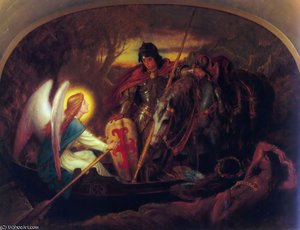
The choice de Joseph Noel Paton

The choice

In "The choice" by Joseph Noel Paton, a heavy tension hangs in the air, freezing a moment of profound conflict. Three figures dressed in medieval clothing occupy the center of the scene, their bodies angled toward one another in a struggle of words or wills. On the left, a man clad in armor stands as a rigid presence, his metallic attire catching the light amidst the unfolding drama. The others…

9
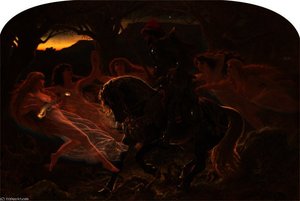
Oskold and the Elle Maids de Joseph Noel Paton

Oskold and the Elle Maids

Oil

A man sits atop a horse, a solitary figure amidst a sudden surge of movement. Around him, the forest breathes with the presence of the Elle Maids. These women, appearing as nymphs or fairies, drift through the shadows and the light, their forms scattered like fallen petals across the woodland floor. Some linger in the foreground, their presence felt in the immediate air, while others recede into the deep green…

10
The Reconciliation of Oberon and Titania de Joseph Noel Paton

The Reconciliation of Oberon and Titania

Oil On Canvas · Galería Nacional de Escocia, Edimburgo

The Reconciliation of Oberon and Titania emerges from the shadows of a Scottish forest, a scene where magic and emotion collide. Painted in 1847, this oil on canvas work by Sir Joseph Noel Paton captures a moment of profound transition. The air feels heavy with the aftermath of a great dispute, as the fairy rulers move toward a delicate peace. It is a sequel to a previous quarrel, a continuation…

La selección de Joseph Noel Paton continúa, de 11 a 46

Pinturas famosas de Joseph Noel Paton, época por época

Los temas que cautivaron la mirada de Joseph Noel Paton

Los cuatro temas que se repiten con más frecuencia en estas obras originales, cada uno con su mejor ejemplo.

Los museos que conservan los originales de Joseph Noel Paton

Los 7 museos que albergan la mayoría de las pinturas de esta página.

Museos Ciudad Obras de Joseph Noel Paton Pinturas de esta lista
Galería Nacional de Escocia, EdimburgoGalería Nacional de Escocia Edimburgo 3 The Reconciliation of Oberon and Titania, Dawn - Luther at Erfurt, La disputa de Oberón y Titania
Royal Collection, LondresRoyal Collection Londres 2 In Memoriam, 'Hogar': El regreso de Crimea
Yale Center for British Art, Nueva HavenYale Center for British Art Nueva Haven 1 Puck y las hadas, de "Sueño de una noche de verano"
Israel Museum, JerusalénIsrael Museum Jerusalén 1 Las tentaciones de San Antonio
Laing Art Gallery, Nueva Gales del SurLaing Art Gallery Nueva Gales del Sur 1 The Man of Sorrows
Galerías de Arte de la Ciudad de Sheffield, SheffieldGalerías de Arte de la Ciudad de Sheffield Sheffield 1 La reina de las hadas
Musée de Grenoble, GrenobleMusée de Grenoble Grenoble 1 Beati mundo corde

Joseph Noel Paton década tras década: la obra original que define cada una

Obras por década

Elige una década para ver la obra original que la define.

Preguntas de coleccionistas sobre las pinturas de Joseph Noel Paton

¿Por qué obra es más famoso/a Joseph Noel Paton?Descubre la respuesta

Hesperus, la estrella de la tarde, sagrada para los amantes (1857). A continuación, Puck y las hadas, de "Sueño de una noche de verano" (1850) y El sueño de Miguel Ángel.

¿Qué edad tenía Joseph Noel Paton cuando se creó Hesperus, la estrella de la tarde, sagrada para los amantes?Descubre la respuesta

36 años: Hesperus, la estrella de la tarde, sagrada para los amantes data de 1857, y Joseph Noel Paton nació en 1821.

¿Cuáles son las diez pinturas más famosas de Joseph Noel Paton?Descubre la respuesta

Hesperus, la estrella de la tarde, sagrada para los amantes, Puck y las hadas, de "Sueño de una noche de verano", El sueño de Miguel Ángel, Las tentaciones de San Antonio, In Memoriam, El hombre con el rastrillo de inmundicia (estudio), Michelangelo Sculpting the Statue of 'Night', The choice, Oskold and the Elle Maids y The Reconciliation of Oberon and Titania. La clasificación anterior indica el año y el museo de cada una.

¿Cuántas pinturas dejó Joseph Noel Paton?Descubre la respuesta

Nuestro catálogo cuenta con 46 obras de Joseph Noel Paton, datadas desde 1849 hasta 1875.

¿En qué museos se exhiben las obras maestras de Joseph Noel Paton?Descubre la respuesta

Principalmente en Galería Nacional de Escocia (Edimburgo), Royal Collection (Londres) y Yale Center for British Art (Nueva Haven). La tabla de museos arriba los enumera todos.

¿En qué años pintó Joseph Noel Paton sus obras más famosas?Descubre la respuesta

En 1850s: 4 de las 46 obras de esta página se realizaron entonces, Hesperus, la estrella de la tarde, sagrada para los amantes de ellas.

¿Cuáles son las primeras y las últimas obras originales de Joseph Noel Paton?Descubre la respuesta

En esta página, la más antigua es La disputa de Oberón y Titania (1849) y la más reciente The Man of Sorrows (1875).

¿Qué temas eligió Joseph Noel Paton con mayor frecuencia?Descubre la respuesta

Mujer (3), People (3) y Man (3), en las 46 obras de esta página.

¿Qué técnica utilizó más Joseph Noel Paton?Descubre la respuesta

Óleo sobre tabla, para 3 de las 46 obras de esta página.

¿A qué movimiento artístico pertenece Joseph Noel Paton?Descubre la respuesta

Prerrafaelismo y Romanticismo, a juzgar por los originales de esta página.

¿Qué obras de Joseph Noel Paton se exhiben en el Galería Nacional de Escocia?Descubre la respuesta

The Reconciliation of Oberon and Titania, Dawn - Luther at Erfurt y La disputa de Oberón y Titania: el Galería Nacional de Escocia, Edimburgo posee 3 de las obras de esta página.

Joseph Noel Paton: vida y obra

A Scottish Visionary: The Life and Art of Sir Joseph Noel Paton

Sir Joseph Noel Paton (1821–1901) was a Scottish painter who achieved remarkable renown during the Victorian era, establishing himself as one of Scotland’s foremost artistic figures. Born in Dunfermline, Fife, on December 13, 1821, into a family steeped in craftsmanship—his father was a damask weaver—Paton demonstrated an early aptitude for visual arts, nurtured by his familial surroundings and fueled by an innate curiosity about the world around him. Though he eschewed formal academic training, preferring to learn through observation and experimentation, Paton’s artistic sensibilities were profoundly shaped by the Pre-Raphaelite movement, with whom he formed a significant friendship during his studies at the Royal Academy in London in 1843. This connection instilled in him a dedication to meticulous detail and a fascination for capturing the beauty of nature—characteristics that would become hallmarks of his distinctive style.

Weaving Myth and Morality: The Development of a Unique Style

Paton’s artistic journey was marked by an extraordinary synthesis of diverse influences. He wasn't merely illustrating tales; he was breathing life into them with meticulous detail and emotional depth. His early works, such as “The Quarrel of Oberon and Titania” (1847), now a cornerstone of the National Gallery of Scotland’s collection, immediately established his reputation for capturing fantastical scenes with remarkable realism. This painting, inspired by Shakespeare's *A Midsummer Night's Dream*, showcases not only technical skill but also Paton’s ability to imbue mythological subjects with psychological complexity. He didn’t simply depict fairies; he portrayed their passions, conflicts, and vulnerabilities. Beyond the realm of folklore, Paton explored religious themes with equal fervor, as evidenced in works like “Luther Discovering Justification by Faith,” revealing a deep engagement with theological concepts. His paintings are not just visually stunning but also intellectually stimulating, inviting viewers to contemplate profound questions about faith, morality, and the human condition. He wasn’t merely recreating stories; he was using them as vehicles for exploring universal human experiences.
  • His meticulous attention to detail—evident in the intricate costumes, landscapes, and facial expressions—adds layers of meaning to his compositions.
  • The use of dramatic lighting and rich color palettes enhances the emotional impact of his paintings.
  • Paton’s works often feature allegorical figures representing abstract concepts like love, death, and justice.

A Royal Appointment and Enduring Legacy

Recognition of Paton’s exceptional talent came in 1865 with his appointment as Queen's Limner for Scotland—a prestigious position that solidified his status as the foremost artist in the country. Two years later, he was knighted, a testament to his significant contributions to the arts and Scottish culture. This period saw him continue to produce works that blended historical accuracy with imaginative storytelling. Paintings like “Puck and Fairies” exemplify his mastery of capturing the ethereal beauty and mischievous spirit of the fairy world. However, Paton’s unique blend of Celtic mythology, religious themes, and Victorian sensibilities sets him apart as a truly original artist. He stood as a testament to the power of art to transport us to other worlds, explore profound truths, and celebrate the rich cultural heritage of Scotland. His paintings are not merely historical artifacts; they are living embodiments of imagination, faith, and artistic vision. Notable Achievements:
  • He was elected Associate of the Royal Scottish Academy in 1847
  • He attained Full Academician status in 1850
  • He received Knighthood from Her Majesty Queen Victoria in 1867
  • He was awarded Honorary Doctorate of Laws (LL.D.) by the University of Edinburgh
## Themes and Symbolism: A Window into Victorian Scotland Paton’s artistic output consistently grappled with complex themes reflecting both personal convictions and the broader societal concerns prevalent during his time. His fascination with Celtic folklore—expressed in paintings like “The Quarrel of Oberon and Titania”—demonstrates a burgeoning interest in Scottish national identity and mythology amidst the Romantic movement. The fairy subjects he depicted weren’t simply decorative; they conveyed moral lessons about temptation, innocence, and the perils of unchecked desire. Similarly, his religious works—such as “Luther Discovering Justification by Faith”—explored theological concepts with profound sensitivity and intellectual rigor. His ability to convey emotion through visual imagery underscored his artistic prowess and cemented his place as a pivotal figure in Victorian art history. ## Legacy: An Artist Remembered Sir Joseph Noel Paton died peacefully on December 26, 1901, leaving behind an indelible mark on Scottish art and culture. His paintings—characterized by meticulous detail, evocative symbolism, and masterful storytelling—continue to inspire admiration and scholarly study today. They reside in prominent museums across Scotland and internationally, ensuring that his artistic legacy endures for generations to come. Paton’s contribution transcends mere aesthetic beauty; he embodies the spirit of Victorian imagination, faith, and artistic innovation—a testament to the transformative power of art to illuminate human experience and celebrate cultural heritage.